


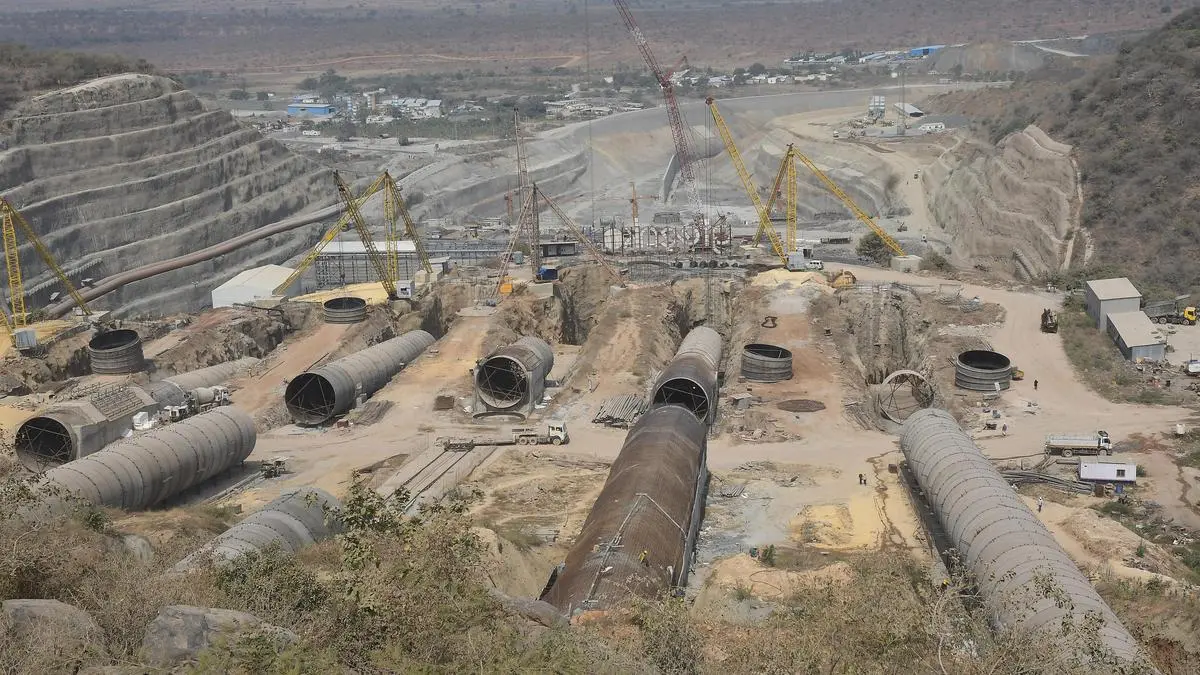
Pinnapuram pumped storage hydropower project in Kurnool district | Photo Credit: GIRI KVS
GE Vernova recently announced that it had secured an order — its second — from Megha Engineering and Infrastructures Ltd (MEIL) to supply nine ‘reversible Francis turbines’ for the Upper Sileru pumped hydro storage project (PSP). ‘Reversible Francis turbines’ are the heart of PSPs — they act as a motor, pumping up water, and as a turbine to generate electricity when the water flows down. GE had earlier won a smaller order from MEIL, for the 125 MW Kundah project.
The new order points to the complete absence of atmanirbharta in this key equipment for PSPs. Apart from the US-based GE Vernova, the other major suppliers are Andritz Hydro of Austria and the German Voith Hydro. Andritz has supplied to Tata Power’s Bhivpuri project, Torrent Power’s Saidongar-Karjat project and Greenko’s Pinnapuram project. Voith has an order for Upper Indravathi project in Odisha.
The only Indian company that claims to have the technology, BHEL, has so far not announced any order wins. India has around 5 GW of operating PSP plants; another 13 GW are under construction and a further 9.5 GW have been approved. The Central Electricity Authority’s ‘Long-term national resource adequacy plan for 2026-27 to 2035-36’ speaks of a need to build 94 GW of pumped hydro storage plants.

India could have an agri-photovoltaic (agriPV) potential of nearly 2,129 GW, according to a new nationwide assessment by The Energy and Resources Institute (TERI), highlighting the scale of opportunity inherent in combining agriculture and solar power generation on the same land.
AgriPV refers to systems where solar panels are installed above or alongside crops, allowing farming and electricity generation to coexist.
The study used a GIS-based methodology to assess suitable cropland across the country. It applied multiple filters, including solar radiation levels, land slope, soil quality, flood risk, ecological constraints and crop compatibility.
TERI identified 47.35 million hectares of restricted cropland, of which 2.835 million hectares were found highly suitable for agriPV deployment alongside specific crops. Horticultural crops — including fruits, vegetables, spices and medicinal plants — emerged as the most compatible for dual-use systems.
Based on a power density of 0.42–0.75 MW per hectare, the study estimated India’s agriPV potential at 1,192–2,129 GW — among the largest such opportunities globally.
The potential is concentrated in a few states. Maharashtra, Rajasthan, Andhra Pradesh, Madhya Pradesh, Karnataka and Uttar Pradesh together account for about half of the estimated capacity.
According to TERI, agriPV offers a “scalable, climate-resilient and farmer-centric” pathway to meet rising energy demand without displacing agriculture. The study said its findings could help move agri-photovoltaics from pilot projects to a coordinated national strategy, integrating food and energy production.
Published on May 11, 2026
此内容由惯性聚合(RSS阅读器)自动聚合整理,仅供阅读参考。 原文来自 — 版权归原作者所有。