


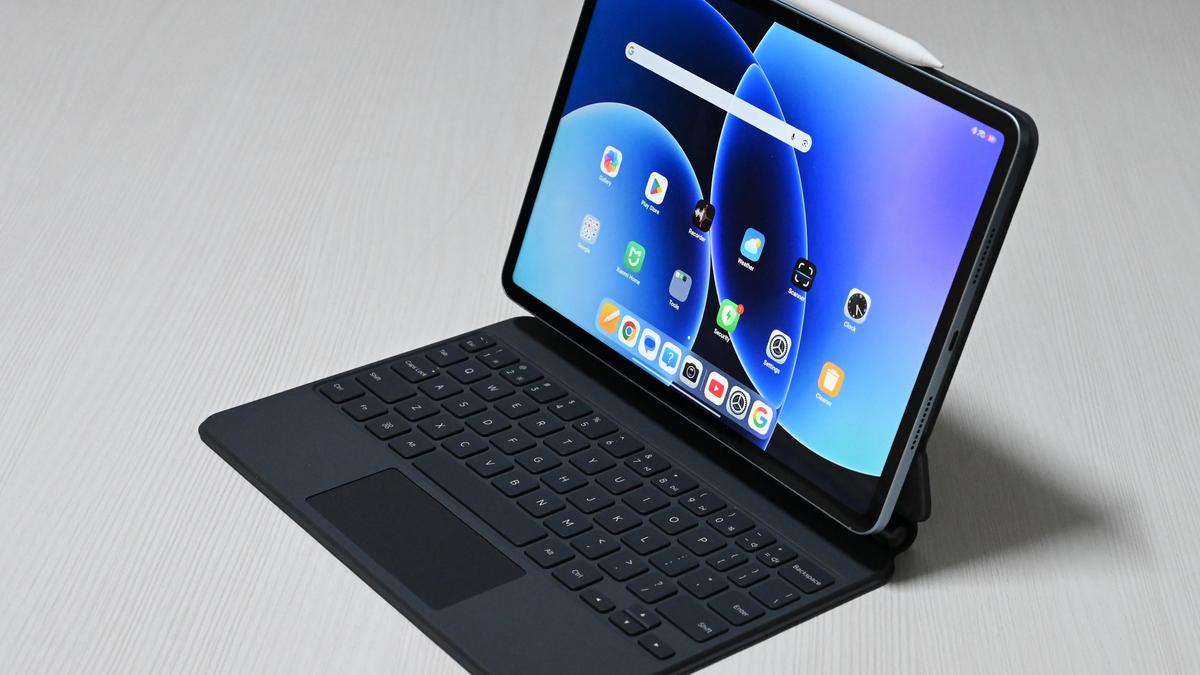
Xiaomi Pad 8 | Photo Credit: BIJOY GHOSH
As tech brands have made their tablet launches a little more fixed over the years, a slow yet steady growth has been seen in the tablet segment, driven by online learning and more. Xiaomi is one such brand that releases a tablet year on year and in true fashion, I have the Pad 8 in for review—the successor to last year’s Pad 7. Here is my take on the device.
Measuring 5.75 mm thick and weighing 485 grams, the aluminium chassis is slim enough to slip into a bag without feeling too heavy. The Pad 8 is available in Gray, Blue and Pine Green; I reviewed the Titanium blue variant, which features a matte metallic finish across the back and sides. This finish resists smudges effectively and strikes a professional balance, offering a sophisticated look without being over the top looks wise.
The Xiaomi Pad 8 features an 11.2-inch 3.2K 144Hz display that strikes a deliberate balance between portability and screen real estate. This form factor feels like the sweet spot for tablets, sitting perfectly between 7-inch and 13-inch extremes. There is also a Nano-Texture display variant available for the tablet.
Despite being an LCD, the panel does an admirable job of rendering true-to-life colours, proving to be a near-ideal canvas for media consumption. Contrast levels remain impressive for an LCD, especially when catching up on the latest season of The Rookie on Netflix. However, at this price point, the inclusion of an OLED or AMOLED panel would have provided even greater value for dedicated media enthusiasts.
Sound from the quad speakers is a standout feature of the Xiaomi Pad 8. Dolby Vision and Atmos tuning provide a significant value-add, ensuring the audio remains clear and retains its composure even at higher volumes.
While testing Tame Impala’s Dracula, a recent earworm of mine, the quad speakers rendered the track beautifully. The layering of the electric guitar, bass, drums and synths remained distinct, with excellent vocal separation for Kevin Parker’s soft, airy tone. The soundstage felt balanced across the top and bottom speakers on the tablet’s frame, making for an immersive listening experience.
Powered by the Snapdragon 8s Gen 4, the Xiaomi Pad 8 comes in 8GB/128GB or 12GB/256GB configurations; I tested the latter. In synthetic benchmarks, the processor lands firmly in the mid-to-high tier and maintains impressive, sustained performance. Gaming was equally stable, with BGMI holding a steady 60FPS without frame drops. Crucially, the chassis remained remarkably cool even during extended sessions—a significant advantage for a tablet of this slim form factor.
The OS is based off Xiaomi HyperOS 3, based on Android 16. It excels on the productivity front, arriving with minimal bloatware and focusing instead on functional tools such as Mi Canvas and WPS Office.
The integrated AI features for notetaking and voice-to-text transcription work reliably. Furthermore, the upgraded Workstation Mode looks to offers an experience approaching the Samsung DeX. While not yet perfect —The floating windows and snapping remained utilitarian, but the ability to connect to an external monitor via USB-C significantly enhances the long-term versatility of the device. When used with the Focus Pro Keyboard and Focus Pen Pro, the Pad 8 delivers a solid mobile office setup.
The Focus Pro Keyboard lets you use the tablet in desk mode and was quite a sturdy folio cover for the Tablet along with keyboard functionality with keys firmly seated on the keyboard with no discernible gaps, offering a reassuring tactile response. Similarly, the Focus Pro pen was very intuitive, featured a haptic motor to deliver precise feedback for every gesture. This is particularly effective within sketching apps such as Mi Canvas and other sketching apps. Both accessories which can be purchased separately or part of a bundle paired and powered worked well alongside the Xiaomi Pad 8.
The Xiaomi Pad 8 features a 13 MP rear camera and an 8 MP front camera, both designed with utility in mind. While tablets are not typically known for their primary cameras, the rear setup supports 4K video and includes dedicated modes for documents, making it a handy tool for scanning and quick captures. The selfie camera is serves as a reliable selfie camera for video and Microsoft Teams calls.
The Xiaomi Pad 8 features a 9,200 mAh battery with 45W turbo charging support and, conveniently, ships with a 67W charger in the box. During the review period, the battery lasted nearly a week under mixed usage, which included streaming video, typing review notes, and attending Microsoft Teams calls.
Charging the tablet from zero to 100 per cent took approximately 1 hour and 50 minutes. The Focus Pro keyboard draws power via pogo pins on the rear of the device, while the Focus Pen Pro charges magnetically when docked on the top right edge.
The Xiaomi Pad 8 balances size, performance, and value starting at ₹43,999. While the use of an LCD display and camera quality aren’t its strongest points, it offers reliable mid-to-high-tier performance, long battery life and strong productivity features, making it a solid alternative to the iPad 11th Gen and OnePlus Pad 3.
Price: ₹43,999 (8+128 GB), ₹48,999 (as reviewed)
Pros: Good mid-range performance, great battery life, good sound.
Cons: LCD display, Average cameras.
Published on March 25, 2026
此内容由惯性聚合(RSS阅读器)自动聚合整理,仅供阅读参考。 原文来自 — 版权归原作者所有。