





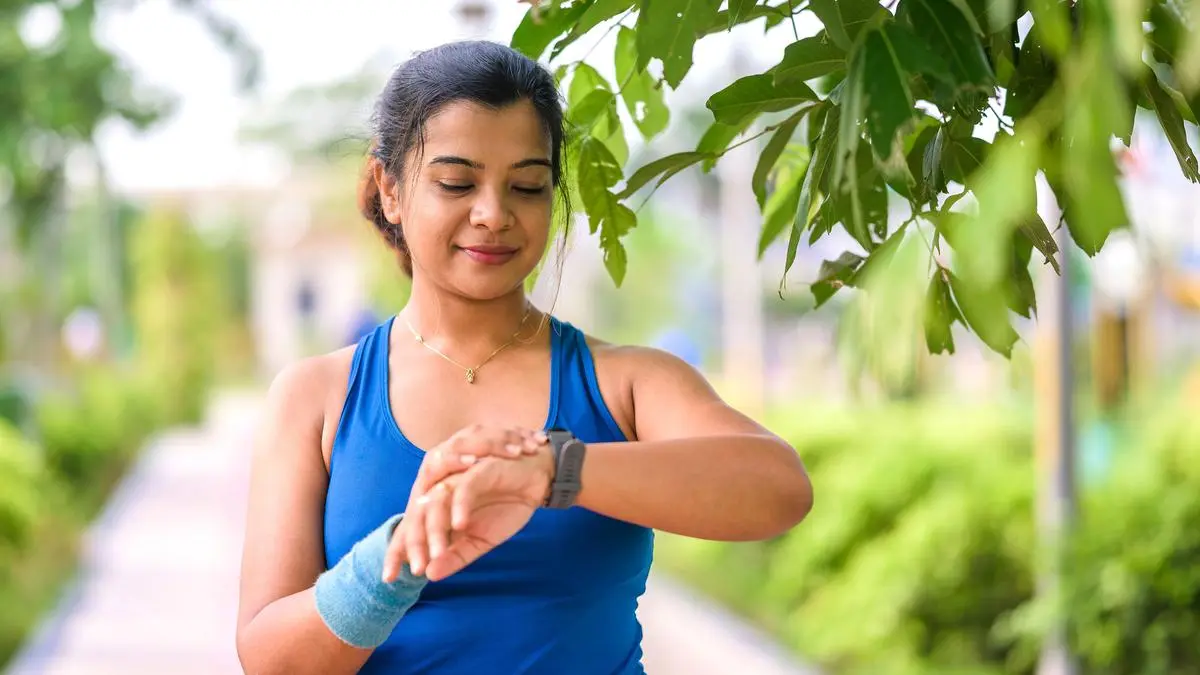
The demand for health-tracking wearables is steadily growing in India | Photo Credit: Ankit Sah
Delhi-based Bhavna Saini loves using her smartwatch at the gym — from tracking her steps and speed to checking the time — it has become second nature to her over the last three years.
“I had used a Fitbit band before this and liked the concept of a smartwatch. Health tracking is an important factor for me. It helps track my speed, milestones, heart rate. Recently, I’ve also started tracking my blood pressure, due to health issues, so it helps with that as well,” she says.
Like Saini, Bengaluru resident Shubham Palriwala also uses a health-tracking wearable. “The device helped me track my sleep. I thought I was fine [in terms of sleep], but it turned out I wasn’t. It benefited me in understanding if my body got enough sleep/rest and how to effectively allocate workload,” he says.
The community of fitness enthusiasts that swears by health-tracking wearables is expanding in India, fuelled by awareness on preventive care and lifestyle-related diseases. In fact, Finnish health-tech company Oura recently launched its Oura Ring 4 products, which track sleep and over 50 other wellness indicators, claiming a vibrant market in India.
ECG (electrocardiogram) monitoring is currently available in less than 5 per cent of smartwatches, while blood pressure tracking is available in 22 per cent, says Counterpoint Research.
“Smartwatches are now increasingly equipped with continuous monitoring of metrics like blood pressure, heart rate, and sleep quality... Preventive monitoring is steadily becoming mainstream, especially among millennials and Gen Z,” says Anshika Jain, Principal Analyst, Counterpoint Research.
Vishal Gondal, Founder and Chief Executive of health-tech company GOQii, says fitness coaches were among the earliest champions of wearable data. Now doctors too have put their trust in devices as a step towards preventive care. In fact, Dr Sunil Khetarpal, Deputy Director General, Association of Healthcare Providers, India (AHPI), describes the use of smartwatches, smart rings and similar devices as a form of self-care that alerts individuals on deviations. The data also helps doctors with early detection, boosted by AI applications within the device — reducing overall morbidity and mortality rate, he says.
“Today, 60 per cent of deaths in India are due to non-communicable diseases like diabetes and high blood pressure, that require long-term treatment. These devices help maintain information about some profiles and contribute to preventative medicine,” he points out.
While some users outline the advantages of wearables, industry watchers raise concerns over the accuracy and protection of user data in India.
GOQii and Oura confirmed near perfect accuracies. Gondal says GOQii’s Smart Vital range uses medical-grade sensors and is approved by the drug regulator as a medical device. The company also holds ISO 13485 certification, which enables integration with out-patient department (OPD) healthcare and insurance. Oura is pursuing regulatory approvals and provides upto 99 per cent accuracy with medical-grade ECG devices and 79 per cent agreement with polysomnography (test to diagnose sleep problems), it says.
However, smart rings and watches continuously collect data and generate profiles of individuals, embedding surveillance in everyday health behaviour, points out Shivangi Rai, Deputy Coordinator and Lead – technology, health and society, Centre for Health Equity, Law and Policy. The data can reveal highly sensitive health inferences. Even when anonymised, the data can be re-identified, especially with longitudinal biometric data, she says.
Smartwatches (₹1,000 to ₹1 lakh) and smart rings (₹1,00-40,000) are the most popular wearable devices
Wristbands and earwear are also in use for tracking health
Average selling price of consumer wearables was ₹4,400 in 2025
Around 1.14 lakh wearable devices, worth $3 billion, were shipped to India in 2025
“The real danger is that intimate bodily and behavioural data becomes a commercial asset. Health data is often reused, shared, or analysed in ways that users are not properly informed about, don’t fully understand or expect, and there aren’t many protections against profiling, breaches, or commercial misuse. Data is shared beyond device manufacturer with app developers, cloud service providers and ad tech companies, often without informed consent of individuals,” says Rai.
Further, breach of privacy could lead to discrimination based on the health data — such as exclusion from insurance coverage, claims denial or levy of high insurance premiums, she adds. While India does have the Digital Personal Data Protection Act (DPDPA), 2023, the law does not define health data or lay down standards for anonymisation, she says, describing it as a major gap in regulation.
Wearables increase the risk of cyber breaches, and data theft exposes sensitive health data, say experts. Since many wearables store or process health data outside the country, it complicates user control or enforcement of data protection laws.
Khetarpal advises individuals to keep their wearable needs simple. Tracking simple metrics like blood pressure, respiratory rate, pulse, sugar and oxygen levels — accompanied by a healthy lifestyle — is a form of preventive medicine, he says, without getting into potential data-linked pitfalls.
Published on April 6, 2026
此内容由惯性聚合(RSS阅读器)自动聚合整理,仅供阅读参考。 原文来自 — 版权归原作者所有。