



惯性聚合 高效追踪和阅读你感兴趣的博客、新闻、科技资讯
阅读原文 在惯性聚合中打开

推荐订阅源

T
Threat Research - Cisco Blogs
freeCodeCamp Programming Tutorials: Python, JavaScript, Git & More
cs.AI updates on arXiv.org
V
Vulnerabilities – Threatpost
GbyAI
GbyAI
P
Proofpoint News Feed
L
LINUX DO - 热门话题
P
Palo Alto Networks Blog
A
About on SuperTechFans
T
Tenable Blog
M
MIT News - Artificial intelligence
IT之家
IT之家
I
Intezer
D
DataBreaches.Net
爱范儿
爱范儿
T
Threatpost
C
CERT Recently Published Vulnerability Notes
云风的 BLOG
云风的 BLOG
博客园 - 三生石上(FineUI控件)
WordPress大学
WordPress大学
K
Kaspersky official blog
大猫的无限游戏
大猫的无限游戏
A
Arctic Wolf
Y
Y Combinator Blog
Cyberwarzone
Cyberwarzone
酷 壳 – CoolShell
酷 壳 – CoolShell
D
Darknet – Hacking Tools, Hacker News & Cyber Security
H
Help Net Security
Microsoft Security Blog
Spread Privacy
Spread Privacy
奇客Solidot–传递最新科技情报
奇客Solidot–传递最新科技情报
AWS News Blog
AWS News Blog
博客园 - 聂微东
C
Check Point Blog
S
Securelist
有赞技术团队
有赞技术团队
雷峰网
雷峰网
aimingoo的专栏
aimingoo的专栏
Last Week in AI
Last Week in AI
Stack Overflow Blog
Stack Overflow Blog
MongoDB | Blog
MongoDB | Blog
D
Docker
G
GRAHAM CLULEY
T
The Exploit Database - CXSecurity.com
C
Cybersecurity and Infrastructure Security Agency CISA
T
Tailwind CSS Blog
L
Lohrmann on Cybersecurity
G
Google Developers Blog
C
Cyber Attacks, Cyber Crime and Cyber Security
L
LangChain Blog

Databricks

Why Talent Transformation Is the Missing Focus of Enterprise AI Public Health Intelligence Shouldn't Require a Data Scientist Mean Time to Detect Is a Data Access Problem First-party audience data is the ad sales relationship now Rethinking Distributed Systems for Serverless Performance and Reliability The AI Scaling Gap Hiding in Digital Native Companies 10 trillion samples a day: Scaling beyond traditional monitoring infra at Databricks AI success starts with clean data, not just better models How nOps Rebuilt Their Cloud Optimization Platform on Databricks Lakebase, and Why Other ISVs Should Too Peril Predicts: Precision Payouts for a Volatile World The foundation of AI scalability: one team, one platform, one operating model The Federal Data Paradox: Rich in Data, Poor in Access Driving Budapest Forward: How BKK Uses Databricks to Transform City Mobility LLM Vs AI: A Practical Guide to Differences, Use Cases, and Tools Model Risk Governance Is Not the Same as Risk Intelligence Generative AI for Business: A Complete Strategy and Implementation Guide Data Science vs Data Engineering: Choosing Analysis or Infrastructure AI Applications: Tools, Use Cases, and Platforms MLOps vs DevOps: A Practical Guide for Data Scientists and IT Teams Top Data Warehouse Tools For Modern Data Analytics Unlocking SAP Business Context in Databricks with Semantic Metadata Delta Sharing The marketing activation gap has a fix: Databricks and Stitch partner to turn data infrastructure into marketing performance Alert Fatigue Is a Business Risk Backstage with Lakebase Shipping Faster isn’t Learning Faster Why Your OEE Dashboard Is Lying to You The Turbine That Tried to Tell You It Was Failing Predicting Readmissions Isn't Enough. Acting in Time Is. Clinical Trials Run Longer Than They Have To. That's a Patient Problem Network Quality Is a Revenue Problem, Not a Technical One Shelf Availability Starts with Better Demand Visibility When Predicting the Next Hit Requires More Than Intuition Approximate Answers, Exact Decisions: New Sketch Functions for Analytics Companies Winning with AI Built the Data Layer First Rethinking SQL ETL for modern data platforms Stripe data now available on Databricks via Databricks Marketplace Databricks and Stripe Projects: Infrastructure Built for Agents Agents are ready but your architecture probably isn't Interoperability Between Unity Catalog and Google BigQuery via Catalog Federation Built In, Not Bolted On: What AI-Native Actually Means in Cybersecurity Operationalizing AI for public sector fraud prevention From months to minutes: Building real-time clinical data pipelines with natural language Agentic Data Engineering with Genie Code and Lakeflow Securely send first-party conversion signals with Snapchat Conversions API on Databricks Marketplace How leading tech companies are killing the builder’s tax with Lakebase Inside one of the first production deployments of Lakebase: LangGuard's agentic workflow governance engine The next generation of Databricks Genie Model Risk Management in 2026: A Banker’s Guide to the Revised Interagency Guidance OpenAI GPT-5.5 now available on Databricks, fully-governed through Unity AI Gateway Operational databases: How they work and when to use them Databricks partners with OpenAI on GPT-5.5 Announcing the Public Preview of Lakeflow Designer Are LLM agents good at join order optimization? How conversational analytics removes the BI bottleneck How to transform document activation workflows with Genie and Agent Bricks Beyond the spreadsheet: how Databricks is delivering the modern CFO in Financial Services AI App Development: Guide To Building AI-Powered Apps IoT in Manufacturing: Strategy, Components, Use Cases, and Challenges Stop Hand-Coding Change Data Capture Pipelines Multimodal Data Integration: Production Architectures for Healthcare AI Personalization Strategies for Media Companies A Modern AI Risk Management Framework Introducing the Databricks Excel Add-in for Business Users Real-Time Decisioning for AI Agents: Why you Need a Customer Context Layer First A Practical Guide to LLM Fine Tuning AI Data Transformation Guide for Data Engineers and Data Scientists Concurrency Control in DBMS: How Locking, MVCC and Optimistic Strategies Keep Data Consistent Bridging data science and marketing: Databricks unveils Delta Sharing integration for Adobe Experience Platform and agentic marketing workflows Take Control: Customer-Managed Keys for Lakebase Postgres Get hands on with agents, vibe coding and more at Data+ AI Summit Mercedes-Benz Builds a Cross-Cloud Data Mesh with Delta Sharing and Intelligent Replication, Cutting Costs by 66% What Is a Transactional Database? Introducing Genie Agent Mode Governing coding agent sprawl with Unity AI Gateway Governing Coding Agent Sprawl with Unity AI Gateway What is pgvector? Banks Don’t Have an AI Problem – They Have a Data Platform Problem Open Platform, Unified Pipelines: Why dbt on Databricks is Accelerating Why Your Agents Can’t Read Enterprise Documents — and How to Fix It Building with Databricks Document Intelligence and Lakeflow Databricks on Google Cloud: Innovate Faster. Smarter. Together. Introducing the Databricks Connector for Google Sheets: Real-Time, Governed Lakehouse Data in the Sheets Users Love Unity AI Gateway: How to connect agents to external MCPs securely Expanding agent governance with Unity AI Gateway Agentic reasoning in practice: Making sense of structured and unstructured data Agent Bricks: The Governed Enterprise Agent Platform 8 AI and data trends shaping financial services in 2026 Building real-time product search on Databricks Lovable + Databricks: Build Data-Driven Apps at the Speed of Thought Memory scaling for AI agents Powering clinical research innovation: How TriNetX uses Databricks to accelerate drug development Database Branching in Postgres: Git-Style Workflows with Databricks Lakebase How Zalando built a unified data foundation for AI and analytics on Databricks The next era of the open lakehouse: Apache Iceberg™ v3 in Public Preview on Databricks How FSIs eliminate silos between clients, operations, and finance How MakeMyTrip achieved millisecond personalization at scale with Databricks A multi-agent approach to audience intelligence AiChemy: Next-generation agent with MCP, skills and custom data for drug discovery Accelerate business insights with Lakeflow Connect, now with a Free Tier Unlocking Next-Gen Customer Experiences with Data Intelligence for Marketing
Introducing Omnigent: A Meta-Harness to Combine, Control and Share Your Agents
Matei Zaharia, Kasey Uhlenhuth · 2026-06-13 · via Databricks

At Databricks, we use and build agents extensively, from coding with them at scale to shipping agent products like Genie. But even though the capabilities of agents have gotten much better, working with them feels clunky. As users, we often have 4-5 agents open at once (coding agents, Gemini search, etc) and spend our time copy-pasting text between them and Docs, Slack, and other collaboration tools. And as agent builders, we’re on a treadmill to improve our agents by combining the latest harnesses, SDKs and models. The problem is that LLM capabilities are wrapped into an agent harness, and these harnesses have different interfaces that make combining them or swapping them difficult.

So we built Omnigent: a meta-harness that sits above the agents you already use (Claude Code, Codex, Pi, or custom agents) and makes them interoperable parts of a richer system. Omnigent targets the problems where a single harness stops: it adds easy ways to compose multiple agents, control them with advanced policies, and collaborate live with teammates.

We believe people will soon work with agents through this new layer, the meta-harness. That’s why today we’re open sourcing Omnigent under Apache 2.0.
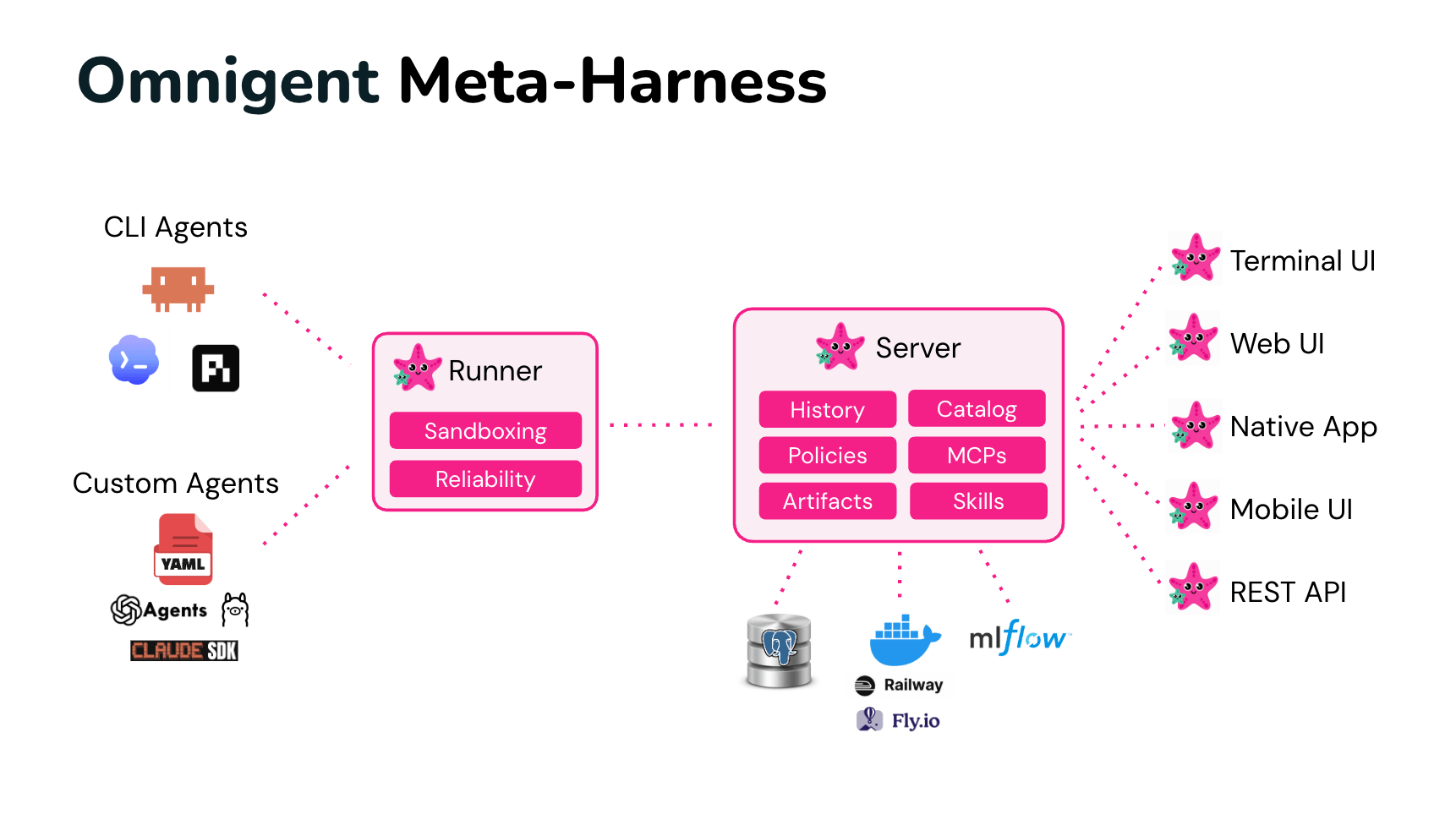
Omnigent architecture: A runner wraps any agent in a sandboxed session with a uniform API. A server provides policies and sharing, and exposes every session over the terminal, the app, and web APIs.

Why build a meta-harness?

At Databricks, we adopted coding agents early across our 5000+ member engineering team and built thousands of agents for customers. That experience convinced us that the frontier of agent engineering is moving up a level. The best results no longer come from a single model in a single harness: Harvey beat a frontier model on quality and cost by giving an open-source worker model a frontier advisor it can call, Anthropic built its research product as a lead agent orchestrating parallel subagents, and our own Genie uses different LLMs for planning, search, and code generation. Engineers are changing how they work, too: instead of prompting one agent at a time, they design loops that drive whole teams of agents.

These patterns span multiple harnesses, models, and people, but each harness only understands its own sessions. To combine agents, govern them, and work on them with other people, you need a layer above the harness. Omnigent is that layer, and it provides:
  • Composition. Combine multiple models, harnesses, and techniques without rewriting code, and switch between Claude Code, Codex, Pi, and your own agents with one-line changes. 
  • Control. Stateful, contextual policies that track agent actions and enforce guardrails like cost budgets and permissions at the meta-harness layer, not via prompts.
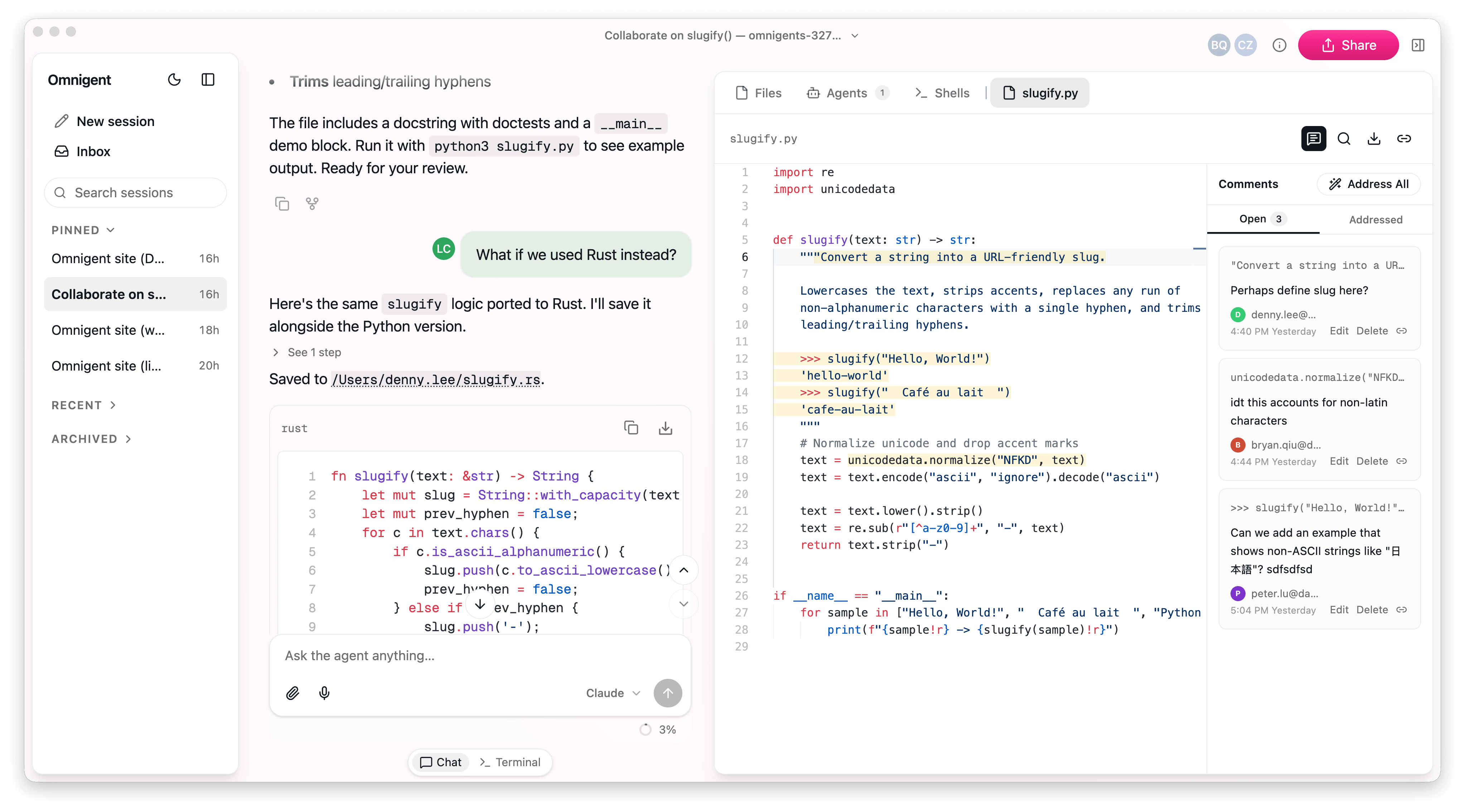
  • Collaboration. Share live agent sessions via URL and review files in them together, so teammates can review, comment, and steer agents together in real time.

How Omnigent works

Omnigent introduces a common interface above command-line agents and agent SDKs to let you easily combine and interchange them, and then focuses on the shared problems where a harness stops. The key insight is that however each agent harness calls into its LLM internally, the interface to users is the same: messages and files in, text streams and tool calls out. Thus we built a common API that wraps both terminal-based coding agents (Claude Code, Codex, Pi, etc) and SDKs (OpenAI Agents, Claude Agents SDK, etc).

On top of this interface, the current version of Omnigent adds the following key features:

  • Real-time collaboration: you can invite other people to view your agent session, comment on files in its workspace, or even send commands, so your sessions and working directories become the main place you collaborate.
  • Multiple interfaces to the same agent: once you connect an agent such as Claude Code to the Omnigent server, you can access it on the web, mobile, Mac OS native app, or APIs.
  • Cloud execution: launch any agent on your own machine or on hosted sandbox providers like Modal and Daytona, for safe collaboration in a hermetic environment.
  • Contextual security policies: Omingent’s security policies go beyond the simple “allow X / deny Y” of coding agents, to track dynamic state about each session and make smarter decisions. For example, you can say that after an agent downloads a new package from npm, it should require human approval to git push, or that it should only be able to write to docs it created, not any doc.
  • Cost policies: One of the things we track dynamically is each session’s LLM cost. For example, you can ask Omnigent to pause an agent and ask to continue after every $100 it spends.
  • Strong OS sandbox: In Omnigent, we include a flexible OS sandbox from our security team with the ability to flexibility lock down OS access and intercept and transform network requests (e.g., don’t let an agent ever see your GitHub security token, but instead, inject it only in the egress proxy on approved requests).
  • Multi-harness authoring: Specify a custom agent as a YAML and port it across harnesses with a one-line change, or combine subagents using different harnesses in the same agent.

These features are just scratching the surface of what can be done at the meta-harness layer, however, and we expect to see a lot more ideas soon from our team and the open source community. Some items on our roadmap include automatic optimization at the meta-harness level with GEPA, code-based introspection within agents similar to MemEx and RLM, an Omnigent Server MCP so agents can work across your sessions, and more harnesses. We’ve also made Omnigent easy to deploy on a wide range of infrastructure, including Fly.io, Railway, Modal and Daytona sandboxes, and many LLM providers, and we welcome patches for more integrations.

A Meta-Harness to Combine, Control and Share Your Age

A new layer for working with agents

Many of the biggest shifts in our industry came from moving to a new layer of abstraction: for example, while engineers used to manage individual processes and servers, they can now manage a whole fleet via cloud systems like Kubernetes and Terraform.

We think agents are at the same point today. Each harness is its own silo, with its own context, its own controls, and its own way of running, and none of it carries over when you switch tools. Moreover, many problems intrinsically span harnesses, including composition, security and collaboration. A meta-harness lifts your work above any single harness, so your sessions, policies, and skills stay with you no matter which agent or model is running. The models and harnesses will keep changing as the field evolves; the layer you work at shouldn't have to.

We're building that layer in the open, and we'd love for you to build it with us.

Try it out

Omnigent is open source in alpha today.