

惯性聚合 高效追踪和阅读你感兴趣的博客、新闻、科技资讯
阅读原文 在惯性聚合中打开

推荐订阅源

F
Fortinet All Blogs
SecWiki News
SecWiki News
L
LINUX DO - 最新话题
T
Troy Hunt's Blog
TaoSecurity Blog
TaoSecurity Blog
H
Heimdal Security Blog
P
Proofpoint News Feed
T
The Blog of Author Tim Ferriss
罗磊的独立博客
S
Secure Thoughts
J
Java Code Geeks
GbyAI
GbyAI
MyScale Blog
MyScale Blog
F
Full Disclosure
小众软件
小众软件
Schneier on Security
V
V2EX
Threat Intelligence Blog | Flashpoint
MongoDB | Blog
MongoDB | Blog
Application and Cybersecurity Blog
Last Week in AI
Last Week in AI
Know Your Adversary
Know Your Adversary
www.infosecurity-magazine.com
M
MIT News - Artificial intelligence
N
Netflix TechBlog - Medium
Webroot Blog
Webroot Blog
G
Google Developers Blog
freeCodeCamp Programming Tutorials: Python, JavaScript, Git & More
Recorded Future
Recorded Future
Microsoft Security Blog
IT之家
IT之家
Hacker News: Ask HN
Hacker News: Ask HN
N
News and Events Feed by Topic
博客园 - 聂微东
Y
Y Combinator Blog
H
Help Net Security
C
CERT Recently Published Vulnerability Notes
Recent Announcements
AI
AI
T
Threat Research - Cisco Blogs
P
Proofpoint News Feed
S
Security Affairs
N
News and Events Feed by Topic
C
Cybersecurity and Infrastructure Security Agency CISA
阮一峰的网络日志
阮一峰的网络日志
V
Vulnerabilities – Threatpost
Spread Privacy
Spread Privacy
有赞技术团队
有赞技术团队
Google DeepMind News
T
Threatpost

TechSpot

Flagship Rematch: Ryzen 7 5800X3D vs. Core i9-12900K Slack chats and internal data from failed startups are finding a second life in AI training A $5 Bluetooth tracker hidden in a postcard exposed a warship's movements Leakers claim PlayStation 6 could offer at least 3x the performance of the PS5 The Mac Mini is no longer a niche product, it's local AI infrastructure IPv6 traffic reaches parity with IPv4 for the first time, Google data shows Xbox expansion cards are now cheaper than SSDs, and PC users are repurposing them Blue Origin prepares to reuse New Glenn booster in bid to challenge SpaceX Nvidia could bring back the 12GB RTX 3060 as supply issues disrupt GPU roadmap What was the first OS you ever used? SNK revives NeoGeo AES with modern upgrades and HDMI support Valve's Proton 11 beta boosts Linux gaming with better performance and classic game support Researchers warn Microsoft Defender vulnerability is already being exploited A four-day Steam freebie turned into $250,000 for an indie game AMD may relaunch Ryzen 7 5800X3D for AM4's 10th anniversary This humanoid robot can almost run as fast as a human sprinter Two New Jersey men jailed for helping North Korean IT workers infiltrate 100+ companies A $7,000 DIY radar project is taking on hardware that usually costs over $100,000 Metro 2039 is going darker than ever, launching this winter on PC and consoles Gemini arrives on macOS with a dedicated desktop app AI infrastructure boom pushes AMD, Intel and Arm to new valuation heights New self-healing material can repair itself over 1,000 times, extend the lifespan of cars and aircraft Japan's bullet train to debut high-tech private cabins, for an added fee Memory card and flash drive pricing surges 120%, with some models spiking 260% Open-source tool decrypts all private data collected by Windows Recall on Copilot PCs The 2026 PC and Console Gaming Report shows most revenue now comes from games outside the Top 20 PureMac is a new open-source macOS cleanup and app removal tool Your Airbnb host might actually be AI Steam might soon display 30-day price history for game deals Intel brings 18A process to budget laptops with new Core Series 3 CPUs How Intel Got Into Trouble: We Test the Last Decade of Intel Flagship CPUs Microsoft counters MacBook Neo with free Game Pass and Office bundle on Windows laptops Popular WordPress plugins backdoored after ownership change, putting thousands of websites at risk Spotify launches physical book sales, expands audiobook features Intel Nova Lake-S is coming after Ryzen APUs with a 16-core iGPU for gamers on a budget Alienware launches $350 QD-OLED monitor with lower brightness to cut costs Recordly brings Screen Studio-style recordings to a free, open-source app Meta doubles down on custom AI chips with Broadcom deal through 2029 Someone finally got an RTX 5090 running on a Mac – no hacks required Will AI agents need to buy their own software licenses? Microsoft sure hopes so Duolingo stops evaluating workers based on how much AI they use Nvidia warranty payouts surged 1,000% last year, not that they can't afford it Nvidia says it's not buying a PC maker, but the idea didn't seem crazy Netgear becomes first router brand exempt from FCC foreign-made ban Google adds Rust to Pixel 10 modem to block attacks at one of Android's weakest points Clicking "reject cookies" might not actually do anything DaVinci Resolve 21 beta adds photo editing and deeper AI integration Malware campaign lures users with fake Windows Update website Apple is testing four smart glasses designs as it prepares to challenge Meta Ray-Bans Amazon purchases Globalstar for $11.6B to expand its low Earth orbit satellite network Capcom's Pragmata earns strong early reviews ahead of release Microsoft is removing 32GB size limit for FAT32 volumes, this time for real Missouri town ousts half of its city council after $6 billion AI data center approval External GPUs were always second best. CopprLink may change that Google will demote websites that hijack your browser's back button Japan finds a way to recover 90% of lithium from old EV batteries Man who vandalized Sam Altman's home claimed AI would end humanity, charged with attempted murder New terahertz technique lets engineers see inside running processors in real time Microsoft just made its Surface laptops a lot more expensive Shipping records suggest Valve will launch the Steam Controller before the Steam Machine This 3D-printed 15-fan side panel drops CPU temps by 20 degrees Rockstar Games hit with ransom demand after third-party data breach Blu-ray lives on as Verbatim and I-O Data pledge support with new drives and discs The software that landed Apollo 11 on the moon is now free online Metal Gear Solid movie is back on track with new directors Anti-data center vote in Wisconsin puts future AI projects on notice Mozilla says Microsoft is using Copilot and Edge to tighten its grip on Windows Gmail encryption goes mobile, but email itself remains the weak link France starts moving government systems from Windows to Linux xAI sues Colorado over AI law, calling it a threat to free speech Florida launches probe into OpenAI as company eyes massive IPO South Korea moves to curb the meteoritic rise of DRAM and PC hardware prices Keychron shares 3D keyboard blueprints on GitHub, opening hardware to modders Nvidia's mythical N1 SoC surfaces on a real motherboard, and it's packing 128GB of LPDDR5X Tesla is working on a smaller, cheaper electric SUV DDR5 prices drop nearly 30%, but memory costs are still far from normal Amazon laid off 30,000 workers while CEO Andy Jassy got a 30% pay bump FBI recovers "deleted" Signal messages through iPhone notifications PC market posts modest growth in early 2026 despite memory shortages and economic strain TikTok star Khaby Lame's $975 million deal is raising serious red flags VeraCrypt, WireGuard among projects disrupted by Microsoft account suspensions Microsoft OneDrive users report mysterious spam files that won't go away Intel tops $300 billion market cap for the first time since the dot-com boom The cables powering the internet are under the ocean – and under threat A version of Windows 10 released a decade ago is now eligible for additional security patches Iran-linked hackers are now targeting industrial controllers in US infrastructure Hackers are turning home routers into tools to spy on Microsoft 365 users A weird macOS bug is blocking new network connections after 49 days of uptime NIH study identifies experimental opioid with strong pain relief and lower addiction risk SanDisk's new 2TB SD card costs $2,000, and it's not even the fastest option Ohio man pleads guilty in first case under federal law banning AI deepfakes John Deere will pay $99 million in right-to-repair lawsuit, but admits nothing Tech layoffs are piling up: 80,000 jobs cut in early 2026, and AI is getting the blame Greece to ban social media for children under 15 starting next year New report revives theory that cryptographer Adam Back could be Bitcoin creator Satoshi Nakamoto Anthropic just lost another round in its fight with the Pentagon Some Windows 3.1 apps were simply "too evil" for Windows 95 to support, says Microsoft veteran AMD confirms Ryzen 9 9950X3D2 priced at $899 German police identify REvil and GandCrab mastermind now living in Russia After Wi-Fi 7's Speed Push, Wi-Fi 8 Is Turning to Reliability
Researchers are turning old Pixel phones into a data center – and they outperform some server hardware
Skye Jacobs · 2026-06-15 · via TechSpot

Serving tech enthusiasts for over 25 years.
TechSpot means tech analysis and advice you can trust.

Forward-looking: Researchers at the University of California San Diego are testing whether retired smartphones can still do useful work instead of ending up as electronic waste. Working with Google, the team is trying to turn retired Pixel smartphones into a low-cost data center. The goal is to keep working hardware in use instead of throwing it out after a few upgrade cycles.

Google Research frames the project around "embodied carbon," the emissions tied to manufacturing devices in the first place. Smartphones, which most people replace every few years, account for a growing share of global e-waste. Extending their useful life, even in a different role, directly reduces that footprint.

What makes the approach viable is not just environmental logic but performance. According to the study, smartphones released roughly three years ago can still outperform certain server configurations on a single-core basis in SPEC benchmarks. Google cited data of a data center system like the Asus RS720A-E11, which supports dual AMD EPYC processors. Those machines are vastly more capable overall, but the per-core comparison suggests that older mobile chips are far from obsolete.

The UCSD team addresses the gap by treating each phone as a small, independent compute node. To get there, the devices are stripped to essentials – screens, batteries, cameras, speakers, and casings are removed, leaving just the motherboard with its SoC.
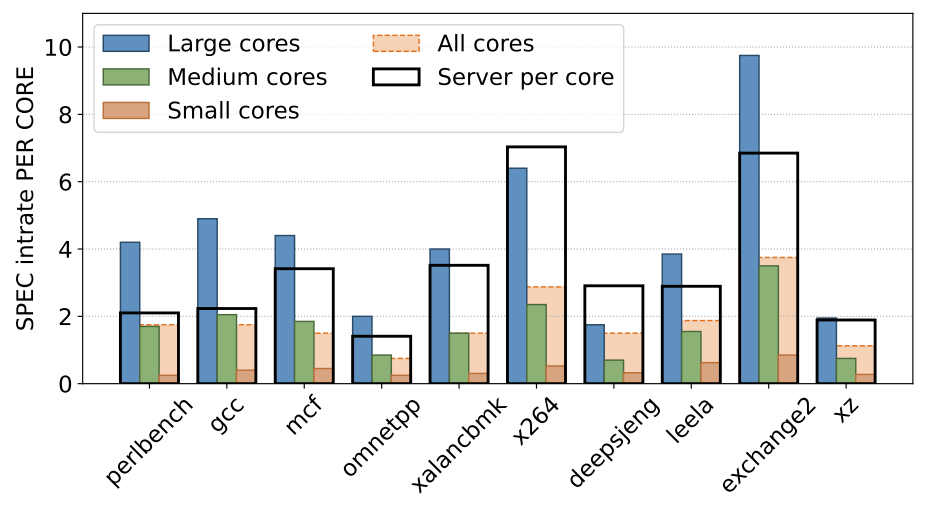
Single-threaded performance of a modern smartphone (2023 Pixel Fold) compared to a server (ASUS RS720A-E11) using the SPEC benchmarking suite. The blue bars represent the per-core performance of the Pixel Fold's performance cores. On most benchmarks they beat the per-core performance of the baseline data center server.

The software stack is rebuilt as well, replacing Android with a general-purpose Linux distribution better suited to data center workloads, and enabling orchestration frameworks like Kubernetes to treat the phones as conventional infrastructure.

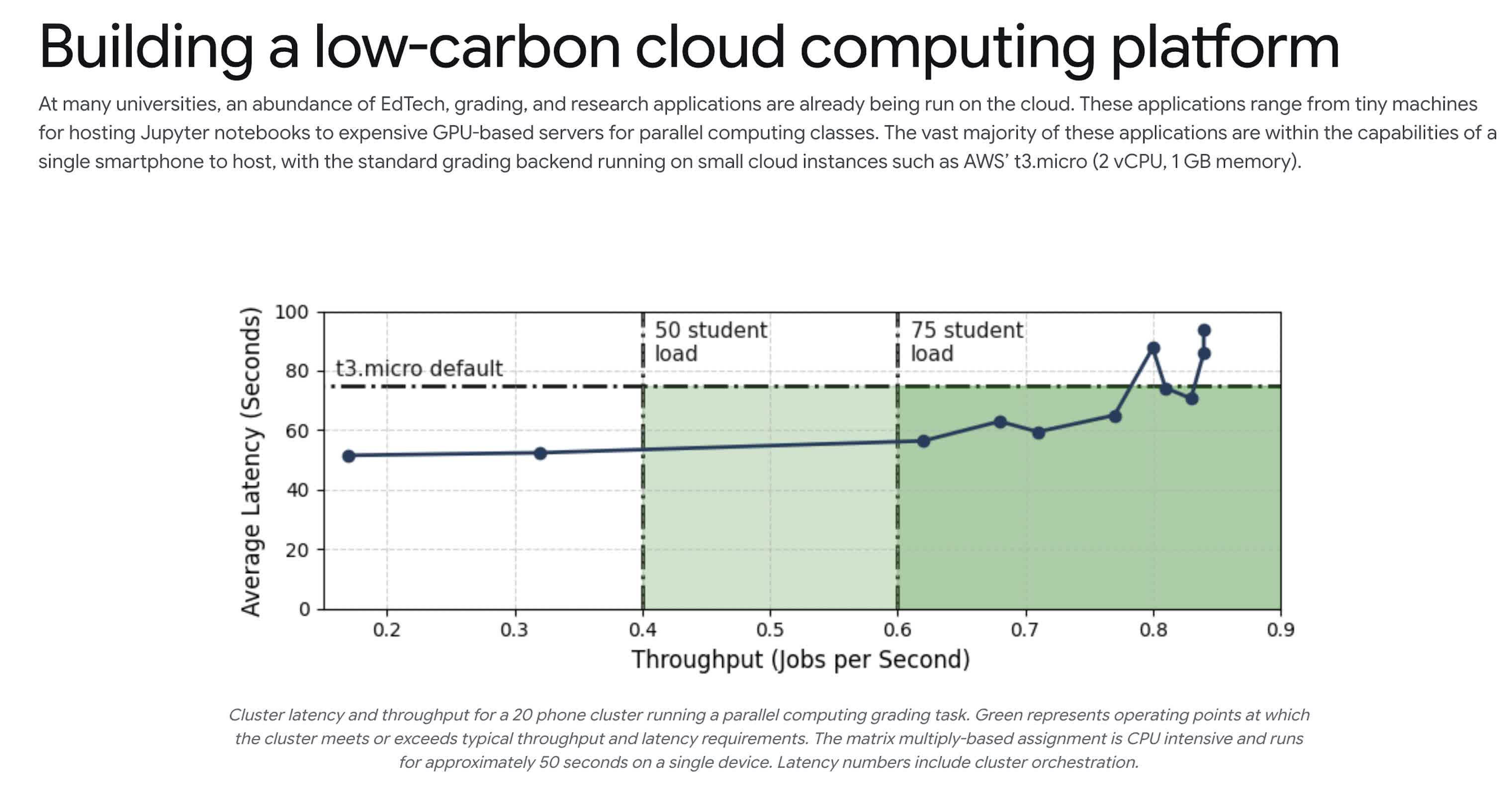
In aggregate, the numbers start to add up. Researchers found that roughly 25 to 50 phones can match the compute output of a single dual-socket server-class CPU. That model is already being tested in practice: a cluster of 20 phones is enough to support an application serving a class of more than 75 students.

That kind of deployment shifts the economics. Instead of relying on cloud infrastructure – which adds both cost and dependency – institutions could run certain workloads locally on repurposed hardware. The researchers describe the system as coming at a "fraction of the usual cost," a point that carries more weight as memory and storage prices continue to climb.

The next step is scale. The team plans to build a cluster of around 2,000 phones capable of supporting "a hundred such classes at once." That rollout, expected later this year, will also test a more practical question: how well consumer hardware holds up under sustained, data center-style use.

There are clear limits. Large hyperscale operators are unlikely to trade standardized, high-reliability servers for clusters of repurposed phones. Managing thousands of small, heterogeneous devices introduces complexity that runs counter to how modern data centers are designed.
Still, the model has a clear lane. Universities, smaller research groups, and organizations with tighter budgets could benefit from a system that trades peak performance for cost efficiency and sustainability. For workloads that can be distributed and don't require cutting-edge hardware, older smartphones may be more than sufficient.

The idea is not entirely new. Researchers have previously explored turning phones into small-scale computing clusters, including deployments for underwater monitoring. And mobile chips have already proven their durability in unexpected settings – NASA, for instance, repurposed a Qualcomm Snapdragon 801 SoC originally used in the Ingenuity helicopter to help the Perseverance rover navigate autonomously on Mars.

What stands out in the UCSD project is not just the reuse of hardware, but the reframing of what counts as infrastructure. Devices built for short consumer lifecycles may still have a role to play, particularly as the industry works to balance performance demands with cost and environmental impact.