


CMMC requirements are in full swing. If you’ve followed through our CMMC series so far, you’ve learned what CMMC Level 1 is and who it pertains to. Then, you used our checklist to drive your evaluation for your self-assessment. for your self-assessment.
Even with a checklist, manually assessing and tracking CMMC compliance is, admittedly, a chore. For MSPs managing multiple CMMC-applicable companies, that chore is multiplied across each client.
Using a Governance, Risk, and Compliance (GRC) solution gives organizations a centralized method for managing and tracking requirements like CMMC Level 1. Here’s how you can use Todyl GRC to streamline you and your clients’ journey to CMMC Level 1 compliance.
As detailed in the previous two blogs, CMMC Level 1 depends on 17 practices broken down across six controls. To prove compliance, you must be able to provide evidence for each practice with documentation supporting each claim. Although checklists like the one shared in our last blog are useful for this endeavor, automated and managed solutions like GRC make things significantly easier.
Todyl GRC natively features detailed guides on CMMC Level 1 and other prominent compliance frameworks. These guides break down each individual requirement, providing:
All of this is located within the same portal you use to manage your clients’ cybersecurity posture and secure their networks. In practice, GRC even auto-maps those practices to relevant controls as covered by the Todyl Platform. Todyl partners have found that just implementing the platform covers nearly 50% of CMMC controls across all 3 levels.
In this way, you have even less manual work to do when self-assessing your CMMC Level 1 compliance.
Supporting the Framework mapping functionality is the Policy feature. This function of GRC gives you a living digital library of all your policy documentation. This allows you to track and manage how your program operates then update and review documentation in real time.
As hinted above, these Policies auto-map to relevant CMMC controls, as well as any other frameworks or regulations your organization tracks on behalf of clients. And, as a digital repository, you can limit access by identity to prevent tampering and misuse while also enabling anyone with access to update from anywhere.
Beyond the obvious compliance ramifications, Policies also helps you organize and centralize your documentation. This makes it easy to enforce consistency across your operations, leading to stronger security posture and simplifying new hire onboarding.
In many cases, you won’t have all the answers you need for CMMC Level 1 self-assessment, such as Media Disposal or Physical Security practices. Your clients, however, will know these, but you need to be able to get those answers directly and in writing.
GRC’s Security Assessment feature helps you create repeatable questionnaires to send to clients and prospects to document key security and operations answers. You can create your own assessments, clone and edit one of our preexisting templates, or send one out directly. Among the many native templates, you can use our CMMC Initial Assessment Pre-Screen (shown below) to scope clients, identify CMMC gaps, and get documentation for key controls and practices.
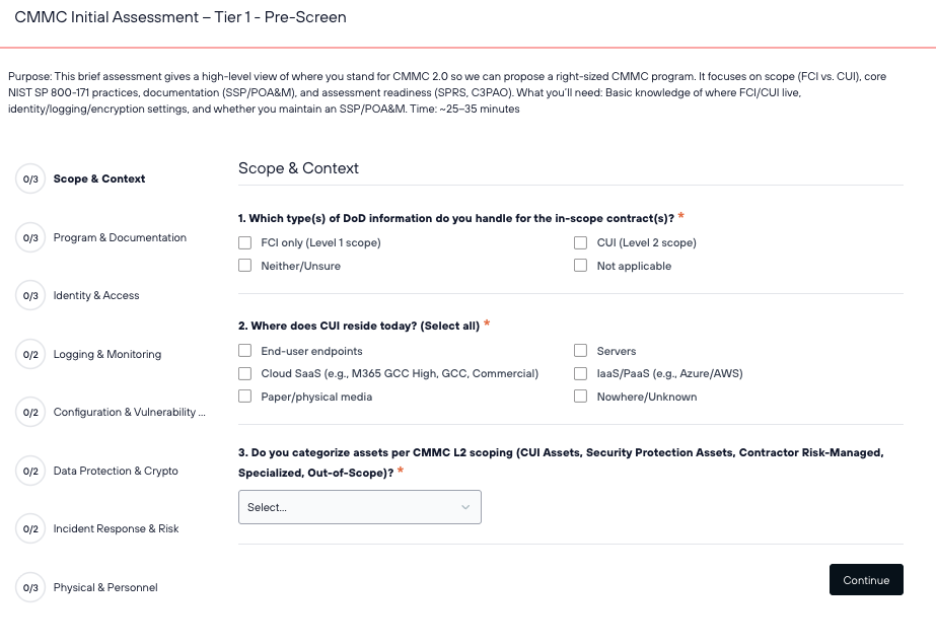
Each assessment is password protected to secure sensitive and proprietary information. With Security Assessments, you get all the answers you need to confidently understand clients’ CMMC picture without tedious manual tracking or back-and-forth emails.
Outside of the GRC module, Todyl Managed Cloud SIEM provides native observability capabilities that are crucial for achieving CMMC Level 1. Specifically, the GRC Dashboard within SIEM automatically sources key insights relevant to the following controls:
… as well as other important audit features and controls in scope for Levels 2 and 3.
The Dashboard makes it simple to view pertinent data that supports your self-assessment so you can easily prove compliance across any tenant. The insights also help you highlight areas of improvement to either guide your team’s efforts and remediation, or concerns that need to be discussed with the client. This ensures that you can quickly iterate so that achieving CMMC Level 1 takes days, not months.
Combining each of these features, you get a single platform to manage and track CMMC Level 1 compliance, as well as most other prominent compliance frameworks and regulations. In terms of recent DoD updates, you can use Todyl GRC to streamline your self-assessment process and quickly prove adherence for yourself and your clients.
Companies that fail compliance can face termination across their federal contracts and potentially fall subject to non-compliance fines and future suspension. Acting now helps you ensure client uptime and, in turn, makes your offering more appealing to prospects with CMMC concerns.
To get started with GRC to simplify your CMMC Level 1 efforts, check out Todyl in action. Contact us to get your free demo so you can start assessing clients and proving compliance.
.png)
Andrew is a seasoned Field CISO with over a decade of experience in the cybersecurity and intelligence domains. As an expert in enterprise solutions architecture and security strategy, Managed Security Service Providers (MSSP), and Security Operations Center (SOC) leadership and transformation, Andrew excels in aligning technology solutions with business objectives to enhance organizational security.
His extensive background includes pivotal roles at Leidos, CrowdStrike, and IBM, where he led the development of complex security solutions, managed and led large SOC organizations, and transformed cybersecurity and risk management programs for both Federal and Fortune 500 private sector organizations.
Andrew’s technical expertise spans threat intelligence, SOC operations, Zero Trust implementations, security architecture, and comprehensive threat detection and remediation strategy development. A recognized thought leader, he has contributed to numerous publications and spoken at industry events, sharing his deep knowledge of threat and risk management strategies. Andrew holds several certifications, including CISSP, CRISC and GSTRT certifications.
此内容由惯性聚合(RSS阅读器)自动聚合整理,仅供阅读参考。 原文来自 — 版权归原作者所有。