







Link to headingConductor on Vercel
Multiple parallel coding agents running at scale in the cloud
Model-agnostic, works with Claude Code, Codex, and other coding agents
Used by engineering teams at Notion, Linear, Ramp, and Life360
Interacting with a single coding agent feels natural, and Conductor makes directing a fleet of agents just as intuitive.
It's a GUI for spinning up multiple coding agents in parallel, each working on an isolated branch of your codebase at once. You review their work, merge what works, and redirect the agents that need to keep iterating.
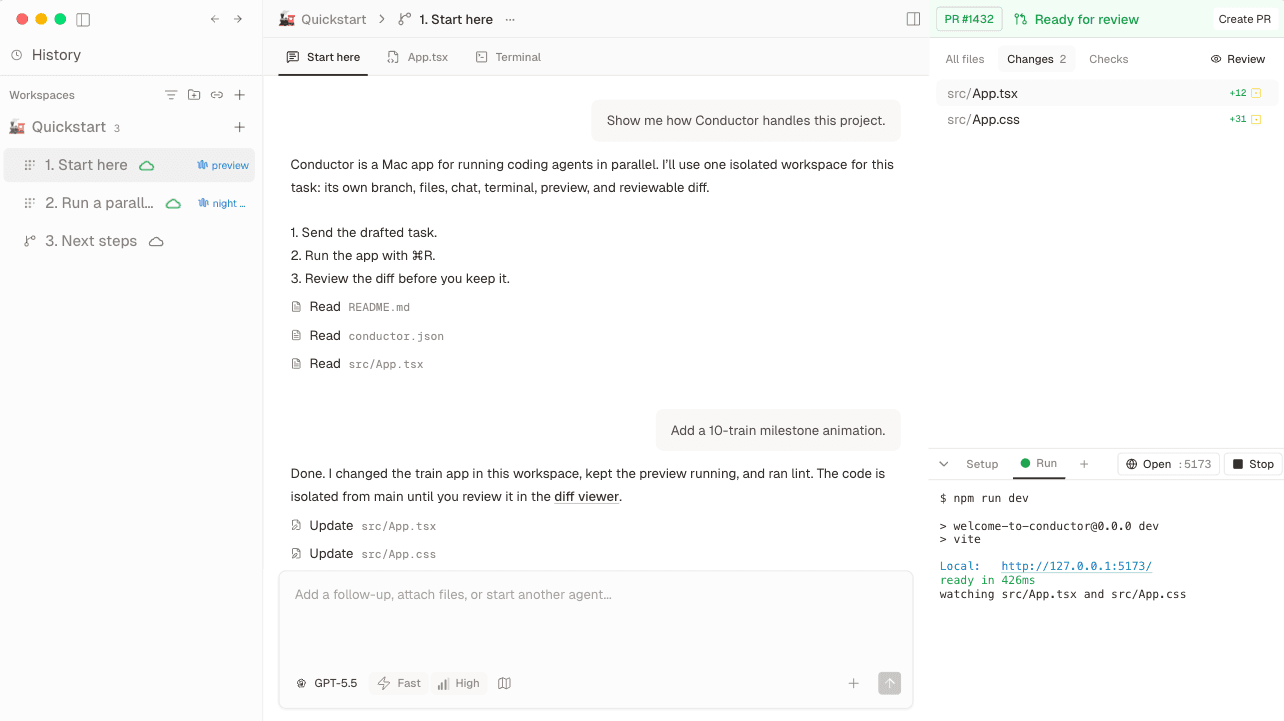
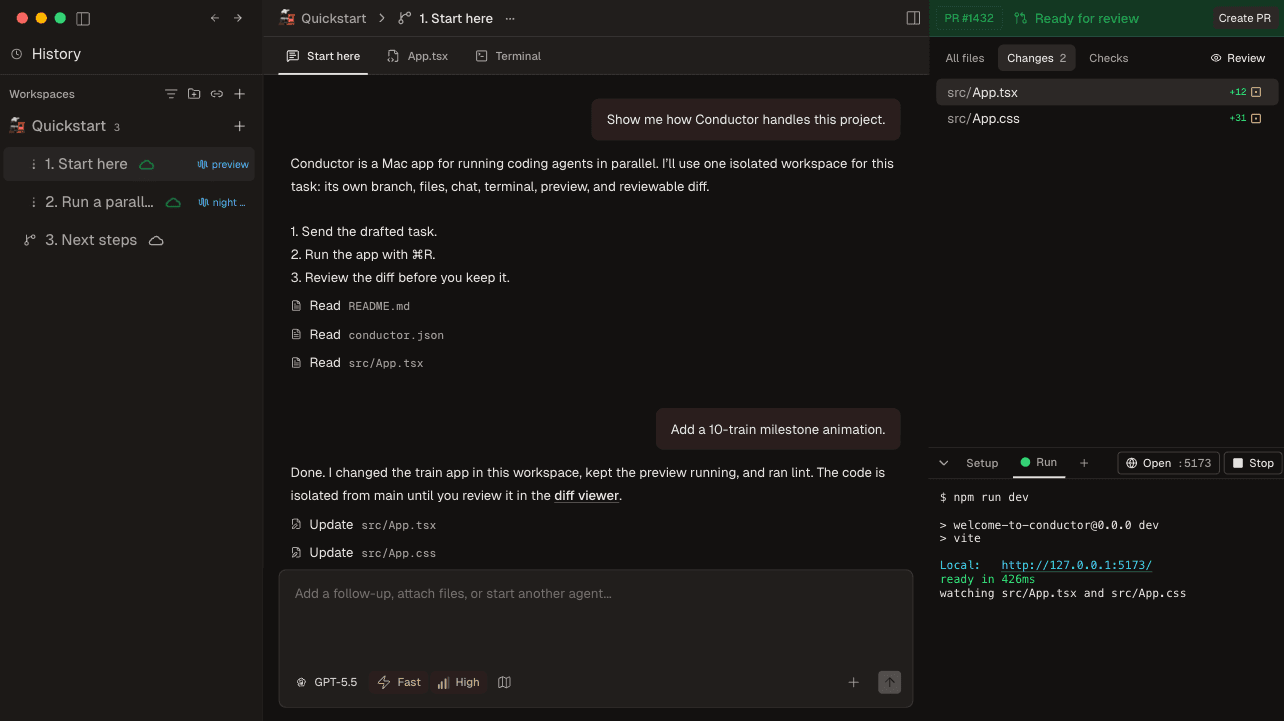
Engineering teams loved it, but hardware was a real limitiation. Every agent ran on your machine, so the fan climbed, the CPU ran hot, and if you closed your laptop, the agents stopped.
Charlie Holtz, co-founder and CEO of Conductor, spent time at Vercel before starting the company. He understands what developers lose when their environment imposes rules on how they can work. Cloud Workspaces, Conductor's remote execution layer built on Vercel Sandboxes, removes the local hardware constraint. Developers can now spawn multiple agents and close the lid without interrupting work.
Link to headingThe journey from local to cloud
Developers who adopted Conductor early felt the power. Notion's engineering team said, "It makes you feel like an octopus, where each one of your arms is working on something separately."
The demand for remote execution came quickly. Developers wanted more agents running longer, and local hardware was the ceiling. For a six-person startup, going from local to cloud is a huge technical leap, and when the developers using Conductor work at companies like Linear and Ramp, provider choice is a matter of building trust with engineers choosing to run their code on infrastructure they don't own.
The team evaluated several sandbox providers, weighing fast spin-up and snapshot support alongside longevity and the depth of the support relationship.
There are so many sandbox providers now, and we needed to know that ours were going to be fast and reliable, and that we would get great support. Vercel checked all of those boxes, and they have incredible DX for our engineering team.
— Charlie Holtz, Co-founder & CEO @ Conductor

Link to headingRunning parallel agents in the cloud
Conductor built Cloud Workspaces on Vercel Sandboxes. When a developer opens a new workspace, agents spin up on a remote server instead of their local machine. The interface doesn't change.
Holtz describes the result: "To our users it feels just like the local version of Conductor. They don't know the difference, which is amazing, and that's because Vercel Sandboxes are super fast."
Our users can't tell the difference between local and cloud because Vercel Sandboxes are super fast.
— Charlie Holtz, Co-founder & CEO @ Conductor
Conductor already supports Claude Code, Codex and other coding agents, but they are model agnostic. That means that no matter how often labs release updates, or what the next popular harness is, they can keep the same cloud layer underneath. As Holtz puts it: "The vibes shift every 3 months. Right now GPT-5.5 has the vibes on its side, but that's going change in another few months. Being agnostic to the providers is the key, and we get that with Vercel."
Link to headingOne interface, whatever the frontier looks like next
Conductor's bet is on the interface: the one place to direct your agents, review their work, and decide what to merge. With Vercel Sandbox, that interface goes wherever developers go.
About Conductor: Conductor is a multi-agent IDE for running coding agents in parallel, each on isolated branches of your codebase. Model-agnostic by design, it works with Claude Code, Codex, and other coding agents.