

惯性聚合 高效追踪和阅读你感兴趣的博客、新闻、科技资讯
阅读原文 在惯性聚合中打开

推荐订阅源

Engineering at Meta
Engineering at Meta
月光博客
月光博客
freeCodeCamp Programming Tutorials: Python, JavaScript, Git & More
V
Visual Studio Blog
大猫的无限游戏
大猫的无限游戏
让小产品的独立变现更简单 - ezindie.com
量子位
cs.CV updates on arXiv.org
腾讯CDC
S
Securelist
Know Your Adversary
Know Your Adversary
cs.AI updates on arXiv.org
博客园 - 【当耐特】
V2EX - 技术
V2EX - 技术
J
Java Code Geeks
OSCHINA 社区最新新闻
OSCHINA 社区最新新闻
Hugging Face - Blog
Hugging Face - Blog
Cisco Talos Blog
Cisco Talos Blog
酷 壳 – CoolShell
酷 壳 – CoolShell
阮一峰的网络日志
阮一峰的网络日志
美团技术团队
W
WeLiveSecurity
S
SegmentFault 最新的问题
奇客Solidot–传递最新科技情报
奇客Solidot–传递最新科技情报
宝玉的分享
宝玉的分享
博客园 - Franky
S
Security Affairs
博客园 - 司徒正美
V
V2EX
K
Kaspersky official blog
T
Threatpost
NISL@THU
NISL@THU
博客园 - 叶小钗
Help Net Security
Help Net Security
PCI Perspectives
PCI Perspectives
IT之家
IT之家
小众软件
小众软件
K
KPMG report finds enterprise disconnect between AI and its ROI | CIO
Last Week in AI
Last Week in AI
Jina AI
Jina AI
爱范儿
爱范儿
罗磊的独立博客
N
News and Events Feed by Topic
博客园 - 三生石上(FineUI控件)
有赞技术团队
有赞技术团队
P
Proofpoint News Feed
L
LINUX DO - 热门话题
Google Online Security Blog
雷峰网
雷峰网
Threat Intelligence Blog | Flashpoint

Vercel News

Vercel Open Source Program: Winter 2026 cohort How Notion Workers run untrusted code at scale with Vercel Sandbox How we run Vercel's CDN in front of Discourse Building Slack agents can be easy Scaling redirects to infinity on Vercel Advancing Python typing Gamma builds design-first agents with Vercel How Avalara turns pipe dreams into patent-pending with v0 Keeping community human while scaling with agents How OpenEvidence built a healthcare AI that physicians actually trust Security boundaries in agentic architectures Skills Night: 69,000+ ways agents are getting smarter Video Generation with AI Gateway We Ralph Wiggumed WebStreams to make them 10x faster How Stably ships AI testing agents in hours, not weeks How we built AEO tracking for coding agents Anyone can build agents, but it takes a platform to run them Introducing Geist Pixel The Vercel AI Accelerator is back with $6m in credits Making agent-friendly pages with content negotiation The Vercel OSS Bug Bounty program is now available Introducing the new v0 Run untrusted code with Vercel Sandbox, now generally available How Stripe built a game-changing app in a single flight with v0 How Sensay went from zero to product in six weeks AGENTS.md outperforms skills in our agent evals Agent skills explained: An FAQ Testing if "bash is all you need" AWS databases are now live on the Vercel Marketplace and v0 Use Perplexity Web Search with Vercel AI Gateway Introducing: React Best Practices Nick Bogaty joins Vercel as Chief Revenue Officer How Mux shipped durable video workflows with their @mux/ai SDK How to build agents with filesystems and bash How we made v0 an effective coding agent Stopping the slow death of internal tools Building AI-Generated Pixel Trading Cards with Vercel AI Gateway We removed 80% of our agent’s tools AI SDK 6 Our $1 million hacker challenge for React2Shell Cline now runs on Vercel AI Gateway How to prompt v0 Build smarter workflows with Notion and v0 Vercel launches partner certification Inside Workflow DevKit: How framework integrations work React2Shell Security Bulletin | Vercel Knowledge Base Billions of requests: Black Friday-Cyber Monday 2025 Investing in the Python ecosystem AWS Databases coming to the Vercel Marketplace How we built the v0 iOS app Workflow Builder: Build your own workflow automation platform Vercel Open Source Program: Fall 2025 cohort Self-driving infrastructure Vercel collaborates with Google for Gemini 3 Pro Preview launch Vercel: The anti-vendor-lock-in cloud How Nous Research used BotID to block automated abuse at scale How AI Gateway runs on Fluid compute What we learned building agents at Vercel Build and deploy data applications on Snowflake with v0 BotID Deep Analysis catches a sophisticated bot network in real-time Vercel achieves TISAX AL2 compliance to serve automotive partners Bun runtime on Vercel Functions David Totten Joins Vercel to Lead Global Field Engineering Vercel Ship AI 2025 recap You can just ship agents AI agents and services on the Vercel Marketplace Built-in durability: Introducing Workflow Development Kit Zero-config backends on Vercel AI Cloud Introducing Vercel Agent: Your new Vercel teammate Update regarding Vercel service disruption on October 20, 2025 Agents at work, a partnership with Salesforce and Slack Running Next.js in ChatGPT: How to Build ChatGPT Apps Talha Tariq joins Vercel as CTO of Security Just another (Black) Friday Server rendering benchmarks: Fluid Compute and Cloudflare Workers Towards the AI Cloud: Our Series F Collaborating with Anthropic on Claude Sonnet 4.5 to power intelligent coding agents Preventing the stampede: Request collapsing in the Vercel CDN BotID uncovers hidden SEO poisoning How we made global routing faster with Bloom filters What you need to know about vibe coding Scale to one: How Fluid solves cold starts Addressing security & quality issues with MCP tools - Vercel AI agents at scale: Rox’s Vercel-powered revenue operating system Helly Hansen migrated to Vercel and drove 80% Black Friday growth Agentic Infrastructure Zero Data Retention on AI Gateway Optimizing Vercel Sandbox snapshots How Waldium made a blog platform work for humans and AI alike How FLORA shipped a creative agent on Vercel's AI stack Agent responsibly Making Turborepo 96% faster with agents, sandboxes, and humans Unified reporting for all AI Gateway usage new.website joins forces with v0 SERHANT.'s playbook for rapid AI iteration Two startups at global scale without DevOps Chat SDK brings agents to your users 360 billion tokens, 3 million customers, 6 engineers Meet the 2026 Vercel AI Accelerator Cohort Build knowledge agents without embeddings
From idea to secure checkout in minutes with Stripe
Dima VoytenkoPrincipal EngineerHedi ZandiProduct Manager · 2026-03-05 · via Vercel News

Building commerce applications looks very different than it did even a few years months ago.

Teams are no longer treating storefronts and billing systems as long-running integration projects that happen after the product is complete. They iterate quickly, deploy globally by default, and increasingly rely on AI tools to generate UI, checkout flows, and subscription logic.

Commerce is becoming more programmable and increasingly agent-driven. As AI systems begin to generate storefronts, assemble checkout flows, and optimize billing logic, the setup, integrations, and infrastructure need to be just as composable and automated.

With tools like v0, and agentic coding agents working with Vercel CLI and Vercel Marketplace, developers can move from idea to deployed product much faster than before. As that workflow becomes more automated and AI-native, the surrounding systems need to keep pace, and the developer's experience (which includes the agent's) needs as much focus as the end-user's.

vercel integration add stripe # provisions Stripe account

vercel integration guide stripe # guides agents through the setup process

Vercel CLI and Marketplace enables a single-click install. This command will instantly create a new Stripe account so you can start coding in seconds.

Link to headingAn improved developer experience

Historically, moving from a Stripe Sandbox to accepting live payments required retrieving API keys, copying them into environment variables, and verifying configuration across multiple environments. It worked, but it introduced unnecessary friction and risk at precisely the moment a team was ready to go live.

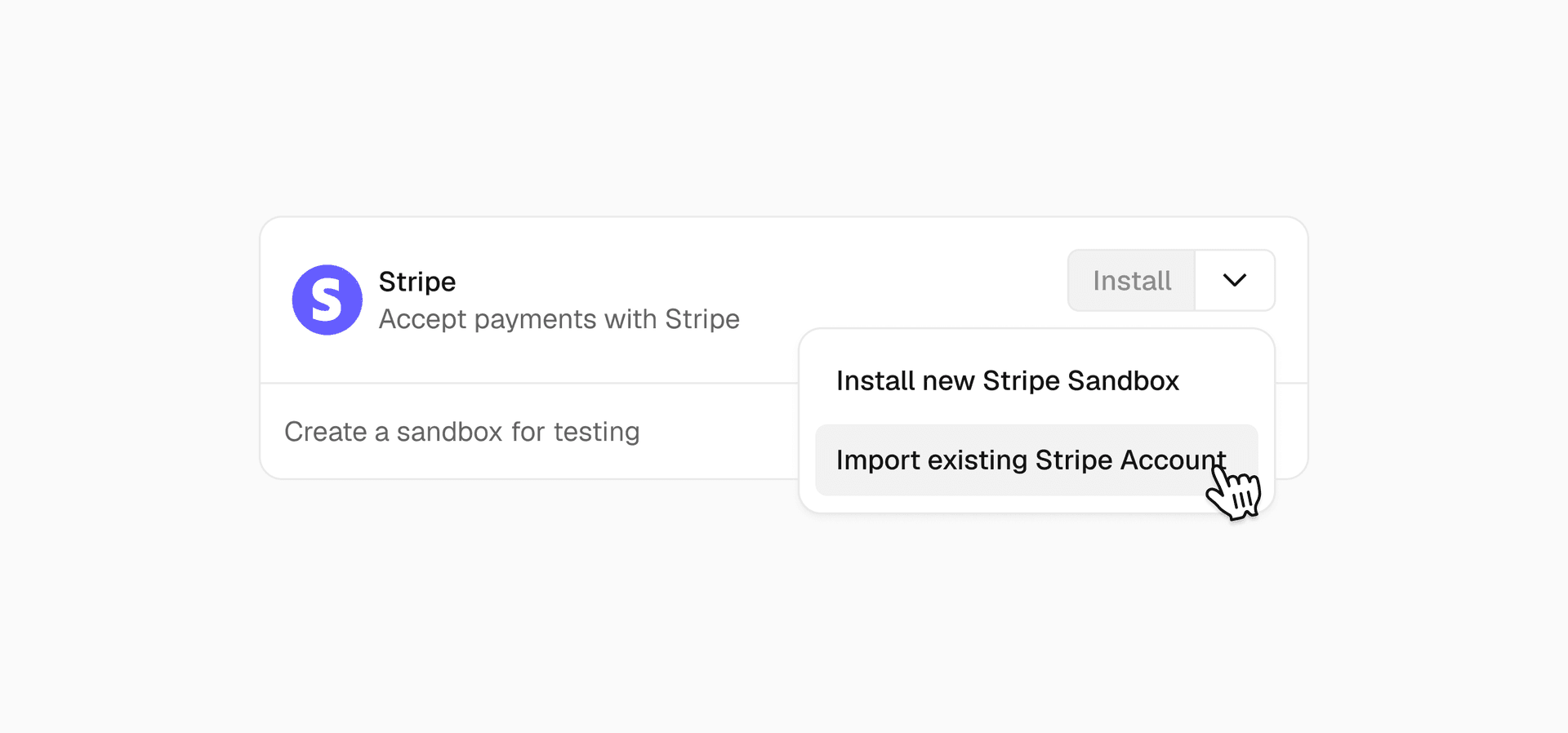
Stripe is now generally available on the Vercel Marketplace and in v0, with full support for connecting production accounts.

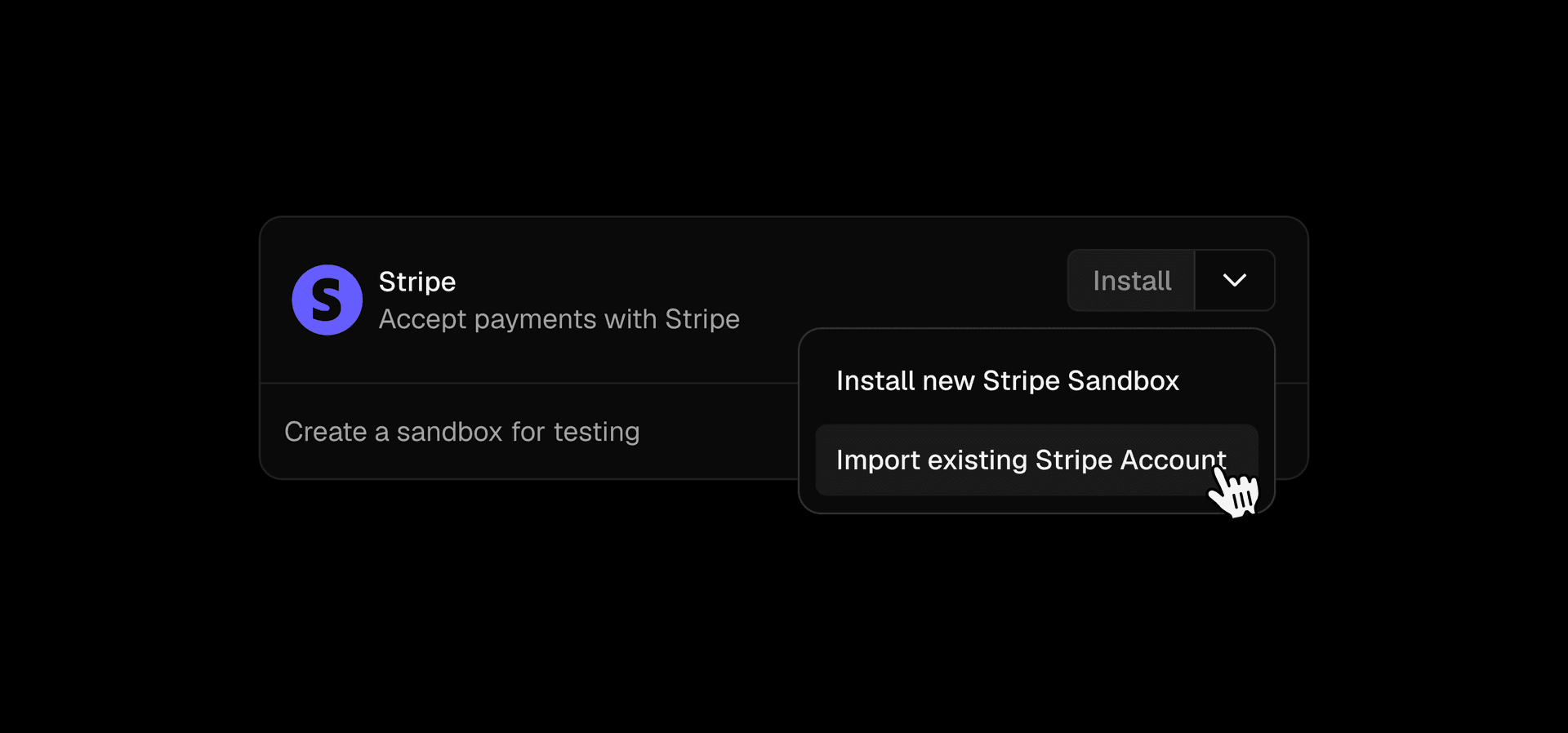
You can connect an existing live Stripe account directly to a Vercel project or import one into your environment and begin accepting real payments without rebuilding your integration. The connection flow provisions the required environment variables automatically, so moving from test mode to live transactions does not require manual key exchange or rewiring your application.

The beta release supported Stripe Sandbox account creation, and now general availability unlocks full production use cases, including live ecommerce storefronts, SaaS subscriptions, usage-based billing, and invoicing.

With this release, going to production with payments is a single integration between your project and Stripe, rather than a separate configuration step that happens outside of it.
Link to headingReducing setup friction while improving security

Making payments easier to connect is only useful if it is also secure by default.

To support production connections, Vercel partnered with Stripe to build a new set of key management APIs.

Credentials are now generated, exchanged, and stored programmatically, reducing the surface area for human error while maintaining correct separation across development, preview, and production environments.

Under the hood, the integration performs a cryptographic key exchange rather than requiring developers to manually retrieve and paste API credentials. The required Stripe keys are provisioned automatically and stored as environment variables within the appropriate Vercel environment, Stripe provides two types of API keys:

  • Secret keys (STRIPE_SECRET_KEY): These must only be used in server-side code, such as API routes or Server Actions. They should never be exposed in client-side code or committed to version control

  • Publishable keys (NEXT_PUBLIC_STRIPE_PUBLISHABLE_KEY): These are safe for client-side use. They identify your Stripe account but cannot perform sensitive operations.

Link to headingGet started

With Stripe connected through the Vercel Marketplace, moving from a working application to live revenue becomes part of the same workflow you use to build and deploy your product.

You can start with a simple example that creates a Checkout Session and deploy your first online store using Vercel and Stripe.

Create a Checkout Session:

import Stripe from "stripe"

const stripe = new Stripe(process.env.STRIPE_SECRET_KEY)

const session = await stripe.checkout.sessions.create({

ui_mode: 'embedded',

redirect_on_completion: 'never',

line_items: [

{

price_data: {

currency: "usd",

product_data: { name: "T-Shirt" },

unit_amount: 40_00,

},

quantity: 1,

},

],

mode: 'payment',

})

Install Stripe from the Vercel Marketplace or v0, connect your account, and your environment variables are ready before you write a line of payment code. See the changelog and documentation for more details.