惯性聚合 高效追踪和阅读你感兴趣的博客、新闻、科技资讯
阅读原文 在惯性聚合中打开

推荐订阅源

S
Securelist
Schneier on Security
Cloudbric
Cloudbric
S
Security @ Cisco Blogs
Webroot Blog
Webroot Blog
Attack and Defense Labs
G
GRAHAM CLULEY
cs.CL updates on arXiv.org
S
Schneier on Security
cs.AI updates on arXiv.org
Latest news
Latest news
C
CXSECURITY Database RSS Feed - CXSecurity.com
D
Darknet – Hacking Tools, Hacker News & Cyber Security
H
Heimdal Security Blog
I
Intezer
GbyAI
GbyAI
T
The Blog of Author Tim Ferriss
罗磊的独立博客
O
OpenAI News
D
Docker
Cisco Talos Blog
Cisco Talos Blog
S
Secure Thoughts
S
Security Affairs
CTFtime.org: upcoming CTF events
钛媒体:引领未来商业与生活新知
钛媒体:引领未来商业与生活新知
The Last Watchdog
The Last Watchdog
L
LINUX DO - 热门话题
AI
AI
B
Blog
C
Cybersecurity and Infrastructure Security Agency CISA
让小产品的独立变现更简单 - ezindie.com
H
Help Net Security
爱范儿
爱范儿
博客园 - 司徒正美
Scott Helme
Scott Helme
博客园_首页
Recent Commits to openclaw:main
Blog — PlanetScale
Blog — PlanetScale
Simon Willison's Weblog
Google DeepMind News
N
News and Events Feed by Topic
A
About on SuperTechFans
T
Threat Research - Cisco Blogs
P
Proofpoint News Feed
Y
Y Combinator Blog
C
CERT Recently Published Vulnerability Notes
T
Tenable Blog
cs.CV updates on arXiv.org
V
V2EX - 技术
The Register - Security

Vercel News

Vercel Open Source Program: Winter 2026 cohort How Notion Workers run untrusted code at scale with Vercel Sandbox How we run Vercel's CDN in front of Discourse From idea to secure checkout in minutes with Stripe Building Slack agents can be easy Scaling redirects to infinity on Vercel Advancing Python typing Gamma builds design-first agents with Vercel How Avalara turns pipe dreams into patent-pending with v0 Keeping community human while scaling with agents How OpenEvidence built a healthcare AI that physicians actually trust Security boundaries in agentic architectures Skills Night: 69,000+ ways agents are getting smarter Video Generation with AI Gateway We Ralph Wiggumed WebStreams to make them 10x faster How Stably ships AI testing agents in hours, not weeks How we built AEO tracking for coding agents Anyone can build agents, but it takes a platform to run them Introducing Geist Pixel The Vercel AI Accelerator is back with $6m in credits Making agent-friendly pages with content negotiation The Vercel OSS Bug Bounty program is now available Introducing the new v0 Run untrusted code with Vercel Sandbox, now generally available How Stripe built a game-changing app in a single flight with v0 How Sensay went from zero to product in six weeks AGENTS.md outperforms skills in our agent evals Agent skills explained: An FAQ Testing if "bash is all you need" AWS databases are now live on the Vercel Marketplace and v0 Use Perplexity Web Search with Vercel AI Gateway Introducing: React Best Practices Nick Bogaty joins Vercel as Chief Revenue Officer How Mux shipped durable video workflows with their @mux/ai SDK How to build agents with filesystems and bash How we made v0 an effective coding agent Stopping the slow death of internal tools Building AI-Generated Pixel Trading Cards with Vercel AI Gateway We removed 80% of our agent’s tools AI SDK 6 Our $1 million hacker challenge for React2Shell Cline now runs on Vercel AI Gateway How to prompt v0 Build smarter workflows with Notion and v0 Vercel launches partner certification Inside Workflow DevKit: How framework integrations work React2Shell Security Bulletin | Vercel Knowledge Base Billions of requests: Black Friday-Cyber Monday 2025 Investing in the Python ecosystem AWS Databases coming to the Vercel Marketplace How we built the v0 iOS app Workflow Builder: Build your own workflow automation platform Security through design: Creating the improved Firewall experience Vercel Open Source Program: Fall 2025 cohort Self-driving infrastructure Vercel collaborates with Google for Gemini 3 Pro Preview launch Vercel: The anti-vendor-lock-in cloud How Nous Research used BotID to block automated abuse at scale How AI Gateway runs on Fluid compute What we learned building agents at Vercel Build and deploy data applications on Snowflake with v0 BotID Deep Analysis catches a sophisticated bot network in real-time Vercel Agent can now run AI investigations Vercel achieves TISAX AL2 compliance to serve automotive partners Bun runtime on Vercel Functions David Totten Joins Vercel to Lead Global Field Engineering Vercel Ship AI 2025 recap You can just ship agents AI agents and services on the Vercel Marketplace Built-in durability: Introducing Workflow Development Kit Zero-config backends on Vercel AI Cloud Introducing Vercel Agent: Your new Vercel teammate Update regarding Vercel service disruption on October 20, 2025 Agents at work, a partnership with Salesforce and Slack Running Next.js in ChatGPT: How to Build ChatGPT Apps Talha Tariq joins Vercel as CTO of Security Just another (Black) Friday Server rendering benchmarks: Fluid Compute and Cloudflare Workers Towards the AI Cloud: Our Series F Collaborating with Anthropic on Claude Sonnet 4.5 to power intelligent coding agents Preventing the stampede: Request collapsing in the Vercel CDN BotID uncovers hidden SEO poisoning How we made global routing faster with Bloom filters What you need to know about vibe coding Scale to one: How Fluid solves cold starts Addressing security & quality issues with MCP tools - Vercel AI agents at scale: Rox’s Vercel-powered revenue operating system Helly Hansen migrated to Vercel and drove 80% Black Friday growth Introducing Vercel Drains: Complete observability data, anywhere Introducing x402-mcp: Open protocol payments for MCP tools MongoDB Atlas is now available on the Vercel Marketplace The second wave of MCP: Building for LLMs, not developers A more flexible Pro plan for modern teams Critical npm supply chain attack response - September 8, 2025 Stress testing Biome's noFloatingPromises lint rule Open SDK strategy Preparing for the worst: Our core database failover test AI-powered prototyping with design systems - Vercel – Vercel AI Gateway: Production-ready reliability for your AI apps - Vercel – Vercel Rethinking prototyping, requirements, and project delivery at Code and Theory - Vercel – Vercel
Agentic Infrastructure
Tom OcchinoChief Product Officer · 2026-04-11 · via Vercel News

Every generation of software eventually demands a new generation of infrastructure.

LLMs and coding agents are driving the next transition, and it's happening fast.

In just three months, weekly deployments on Vercel have doubled, and agents are driving the growth. Today, over 30% of deployments are initiated by coding agents, up 1000% from six months ago. Claude Code accounts for 75%, Lovable and v0 for 6%, and Cursor for 1.5%.

Link to headingSoftware is now agentic

Agents are building, testing, and shipping AI-native software, and they're doing it at a velocity that breaks traditional operations. Vercel projects deployed by coding agents are 20 times more likely to call AI inference providers than those deployed by humans. Agents are writing software that uses AI, and agents are building agents.

As the final actor shifts from human to machine, infrastructure has to adapt again. It has to work for software that acts on behalf of users, writes itself, and increasingly needs to understand its own behavior in production. This new generation of agentic software demands Agentic Infrastructure.

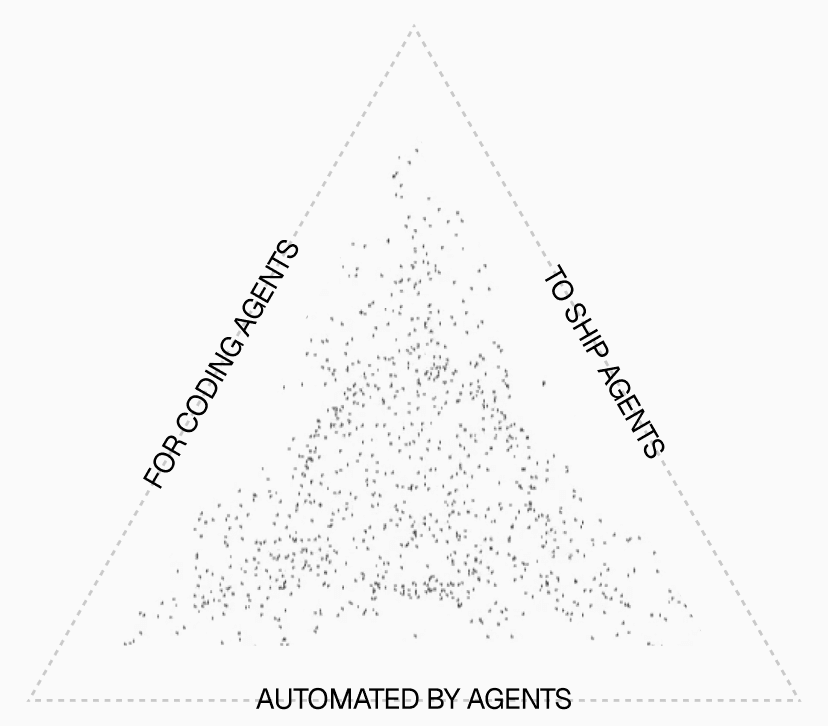
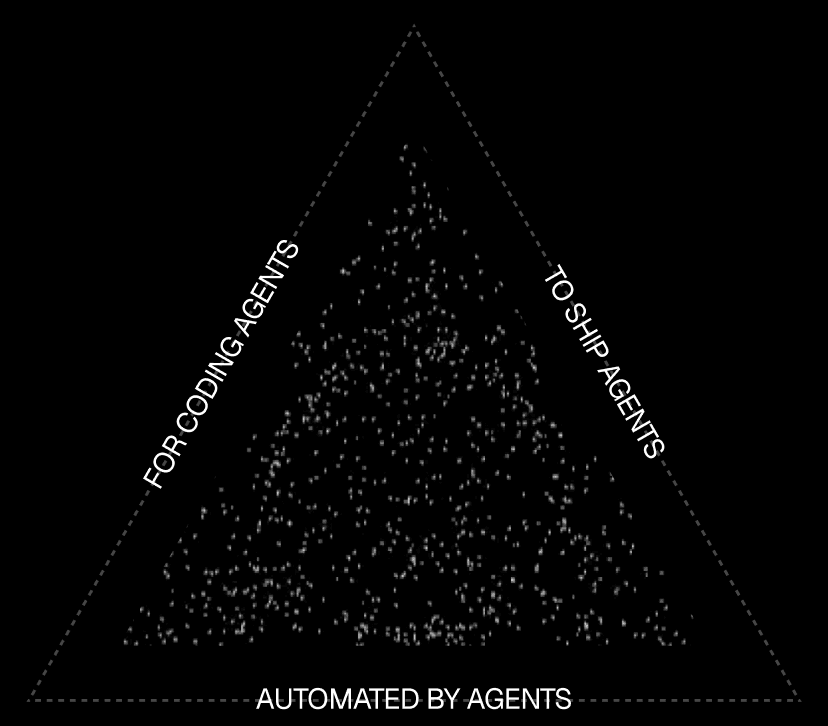
It’s not one evolution, but three:

  1. Infrastructure for coding agents to deploy to

  2. Infrastructure for building and running agents

  3. Infrastructure that itself is agentic

Link to heading1. Infrastructure for coding agents to deploy to

The bottleneck for agentic engineering is operational friction.

When a coding agent writes a feature, it requires a place to run, test, and verify the output, which ultimately means it needs a URL. If the path from code to running system involves manual Terraform state or clicks in a cloud console UI, the autonomous loop breaks. Agents need programmatic, deterministic deployment surfaces.

This is why immutable deployments, preview URLs on every commit, and instant rollbacks aren't just developer experience upgrades anymore. They are absolute prerequisites for machine-driven software development.

Vercel's CLI, API, MCP servers, and git integration give agents native access to a deployment surface where they can generate code, open a PR, get a preview URL, verify the output, and ship to production, all without human intervention.

Link to heading2. Infrastructure for building and running agents

Serverless workloads need functions, caching, and short-lived requests at the edge, but managing that stack yourself means config drift and hours debugging across systems. Vercel solved that by unifying every layer into the frontend cloud.

Agent workloads are a fundamentally different shape. They require long-lived execution, multi-step orchestration, model routing, cost controls, sandboxed code execution, and abuse resistance. It's a more complex stack, and the penalty for running it yourself compounds: every wasted request burns inference dollars, provider outages take your agent offline, and untrusted code opens the door to prompt injection.

Vercel's agentic infrastructure unifies every AI primitive we've built into a single, secure platform, the same way we did for serverless.

  • AI SDK gives developers a unified way to build AI-powered applications across frameworks and providers, and AI SDK 6 adds an agent abstraction so developers can define an agent once and reuse it across interfaces and workflows.

  • Chat SDK makes agents available across dozens of chat apps and platforms from a single codebase.

  • AI Gateway gives teams a single endpoint for hundreds of models, with budgets, monitoring, routing, retries, and fallbacks.

  • Fluid compute is designed for the unusual shape of AI workloads, where latency, concurrency, and idle waiting all matter at once.

  • Workflows and Queues give agents a way to pause, resume, retry, maintain state, and offload background work.

  • Sandbox gives them isolated execution environments for untrusted code.

  • Observability lets teams trace what agents are doing and where they are going wrong.

Together, these building blocks give developers everything they need to build and run agents in one place. But Vercel also puts each of them into a single system with shared context: code, model calls, and runtime behavior. That context is what turns the infrastructure itself into an agent.

Link to heading3. Infrastructure that is itself agentic

Traditional infrastructure is a one-way street: code goes in, logs come out, and a human reads the logs to fix the code. A unified platform provides complete visibility across every layer in real time, giving agents the ability to not just monitor production, but autonomously respond to it.

When a latency spike hits a critical route or a model provider drops requests, Vercel doesn't wait for a human to notice. It investigates the anomaly, queries observability data, reads logs, inspects source code, performs root-cause analysis, and reviews proposed fixes in isolated sandboxes. The platform interprets what the developer intended, observes what the system actually did, and acts on the delta.

Today, that still happens with human approval in the loop. Over time, the platform will take on more of that operational burden, not because it's replacing developers, but because it has enough context to act on their behalf.

Link to headingWhere we're going

The history of cloud computing is the history of removing the human from the machine. Agentic infrastructure is the next evolution, moving us from passive tools that wait for commands to proactive systems that act on our behalf.

The companies that win the next decade will build on infrastructure that expects software to write, ship, and heal itself.