







https://gds.blog.gov.uk/2026/09/15/what-the-early-years-innovation-challenge-showed-us-about-data-sharing-and-collaboration/
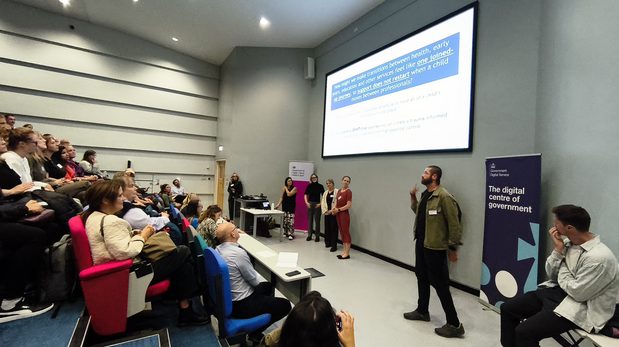
What would a future of seamless, trusted data-sharing mean for how we deliver early years support for children and families?
This was the question at the heart of the Early Years Innovation Challenge day in Sheffield on 9 September. It brought together more than 100 people from local and central government, health, education and partner organisations to explore how better data-sharing could support earlier intervention and improve outcomes for children and families. GDS Local delivered the event with No.10 North, the Local Government Association, South Yorkshire Mayoral Combined Authority and the National Data Library.
The event was part of the new Digital Devolution programme announced by the Prime Minister on 21 August. Through the programme, GDS is working closely with Mayoral Strategic Authorities, the Ministry of Housing, Communities and Local Government and No.10 North to strengthen digital capability, improve access to data and help local leaders deliver better services.
The event was not a traditional consultation. Participants worked together in teams on a clearly defined set of problems, created and tested possible solutions and identified where local action needs support from central government. This encouraged them to creatively solve problems, as they would in a more traditional hackathon.
Considerable information about child development already exists across health, education and local services. However, it is often held in different systems and organisations and in different formats with differing rules about who can see what.
Whist security and responsible use of data is important, this can make it hard for professionals to access the information they need to make the right decision at the right time. Families may have to repeat information to different services, while opportunities to provide earlier support can be missed.
The challenge was grounded in the National Data Library’s Early Years Kickstarter. This work is investigating how health and education data could be brought together safely and securely to help children receive the right support earlier, putting the family at the centre of support, rather than the services.
The event allowed participants to build on that work and consider what a more connected future could look like.
One theme became clear: the problem is rarely a lack of data. The greater challenge is enabling organisations to share and use existing information in trusted, effective and child-centred ways.
Innovation Challenges work best when there is a clear outcome to explore from several different perspectives and participants have a genuine opportunity to influence what happens next.
They provide a structured way to:
At the Early Years Innovation Challenge, participants worked in multidisciplinary teams on three questions:
The morning focused on understanding user needs, sharing evidence and exploring the current information landscape. Teams then generated and prioritised ideas before developing one concept in more detail. They used service journeys, prototypes and other practical tools to show how their ideas could work.
Each team had a facilitator, clear instructions and time limits for each stage. Subject matter experts were available to answer questions and test assumptions as ideas developed.
The aim was not to promote technology for its own sake. It was to develop approaches that could improve decisions, strengthen collaboration and help practitioners access the information they need at the right time.
Ideas became more practical when frontline, policy, delivery, data and technical perspectives came together.
Practitioners tested proposals against behavioural archetypes informed by NDL’s user research. This prompted several teams to narrow or adapt their initial ideas, moving the discussion from what data could be connected to what information would help someone make a better decision.
Local authority participants also highlighted the balance needed between local flexibility and national consistency.
Services and pathways will differ between places because they respond to local circumstances. But councils should not have to solve the same underlying problems repeatedly. Participants identified common challenges around information-sharing, identifiers, governance and coordination between national programmes.
Bringing different organisations together helped distinguish where a reusable national approach might be useful and where local flexibility should remain.
The strongest concepts developed during the event will be explored in a follow-up workshop with GDS Local and the National Data Library, supporting the next phase of the Early Years Kickstarter.
The requirements, barriers and unanswered questions raised by participants will also be shared with relevant teams across GDS and government departments. This will help identify where further discovery, standards, policy or data work may be needed.
Participants have also been invited to contribute to further research as the National Data Library’s work develops.
The challenge created opportunities to share examples of successful local practice. Councils are already testing approaches, conducting user research and learning what does and does not work in areas such as data matching and service integration. National collaboration can add value by making that work easier to find, reuse and scale.
The Early Years Innovation Challenge is an early example of Digital Devolution moving from national ambition to practical action.
Digital Devolution is about more than transferring powers. Local leaders also need the infrastructure, tools and partnerships to understand local needs, make informed decisions and improve public services.
Innovation Challenges are one way to turn local insight into practical action. They can bring ideas and understanding of local needs from local authorities into national programmes earlier to identify where central government and local government can work together to solve common problems once, where appropriate – a key mission of GDS Local.
To hear more about GDS Local’s work and opportunities to get involved, sign up for the GDS Local newsletter.
此内容由惯性聚合(RSS阅读器)自动聚合整理,仅供阅读参考。 原文来自 — 版权归原作者所有。