







Middle East and North Africa: Latest analysis, insights and developments from the World Economic Forum
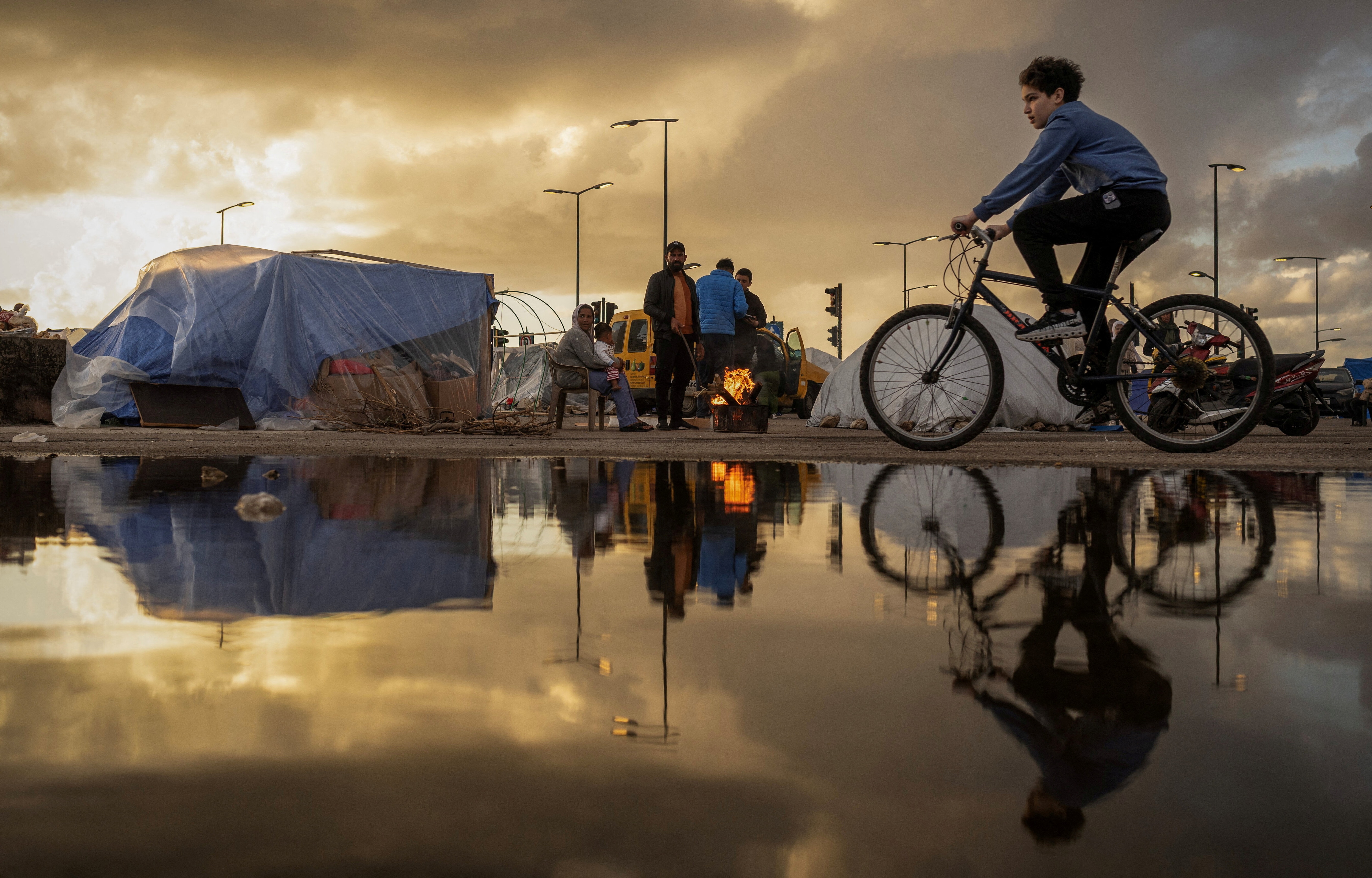
This tracker curates the latest insights, data and analysis from and on the region.
REUTERS/Adnan Abidi/File Photo
Forum live blog team
Keep up with the latest insights, data and analysis from and on the region
What’s shaping the Middle East and North Africa right now? Drawing on the World Economic Forum’s network of leaders and experts, this tracker curates the latest insights, data and analysis from and on the region to help make sense of the news.
Betting on AI and frontier tech as the next pillar of resilience
If energy security is the region's most pressing concern right now, several governments are simultaneously placing a longer-term bet: that AI, quantum computing and digital government infrastructure will be just as decisive for competitiveness by the 2030s.
In Abu Dhabi, the government's TAMM platform now bundles more than 1,150 services for over four million users, with 95% of requests handled through AI-enabled channels — saving the average resident an estimated nine trips to a service centre a year. The next step, an AI-native architecture called GovOS, aims to let a single verified life event — the birth of a child, say — trigger every downstream government process automatically, with the complexity hidden entirely from the citizen.
This isn't an isolated initiative. The Fourth Industrial Revolution Network's 2024–2025 Impact Report shows the region adding frontier-tech capacity across the board. In Saudi Arabia, the Centre for the Fourth Industrial Revolution ran the first national pilot of the Forum's Quantum Economy Blueprint, bringing government, industry and academia together to publish Towards Saudi Arabia's Quantum-Enabled Future — a shared framework for an emerging quantum economy.
The UAE, meanwhile, launched two new Abu Dhabi-based centres in January 2026: the Centre for Frontier Technologies (quantum, robotics and space, hosted by the Technology Innovation Institute) and the Centre for Intelligent Future (AI, hosted by MBZUAI) — alongside existing centres in Qatar (advanced manufacturing and TradeTech) and Oman.
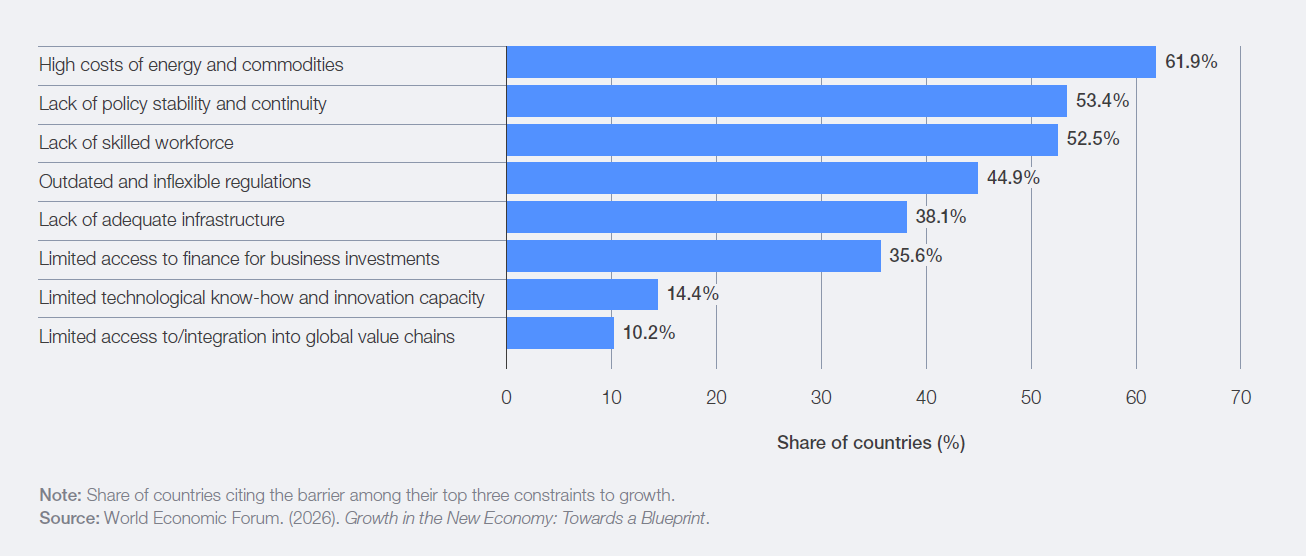
Why does this matter alongside the Hormuz story? Because the two are more connected than they look. The Forum's new white paper, Four Futures for Powering Growth in the New Economy, finds that high energy and commodity costs are already the single most commonly cited barrier to growth worldwide — a top-three constraint in 73 of 118 countries, and especially acute across the Middle East and North Africa.
At the same time, the AI boom that the region is racing to capture is itself one of the biggest new sources of energy demand: global electricity demand from data centres is projected to more than double by 2030. In other words, the region's bet on AI and the region's energy-security challenge are now two sides of the same strategic question.
What may set the leaders apart, according to Abu Dhabi's Ahmed Al Kuttab, is not who moves fastest but who combines speed with legitimacy — building AI systems with human accountability for high-stakes decisions, explainability, and fairness designed in from the start.
As the Four Futures paper puts it, success by 2035 will depend less on simply having access to energy and technology, and more on the ability to "integrate, scale and deploy them effectively within increasingly complex, interconnected and contested economic systems" — a test the Gulf states, in particular, appear determined to set themselves up to pass.
Syria's reawakening and the Gulf's growing seat at the table
Even as the region absorbs the Hormuz shock, two stories this month point to a longer arc: the Middle East's economic and diplomatic centre of gravity continues to shift.
In Damascus, Gulf investors are returning at scale. Saudi Arabia has announced a roughly $2 billion package spanning aviation, telecoms, infrastructure and water, including an $800 million fibre-optic initiative and a new joint airline. The UAE says non-oil trade with Syria more than doubled in 2025 to around $1.4 billion, while CMA CGM has signed on to operate dry ports near Damascus and Aleppo and Turkish Airlines has resumed flights after a 13-year gap.
What makes this more than a reconstruction story is timing. It is unfolding as Gulf economies themselves diversify at speed — Saudi Arabia attracted $31.7 billion in FDI in 2024 and the UAE around $45 billion — and as new trade and connectivity corridors link the Gulf, Turkey, the Levant and Europe.
Syria's historic role as a commercial crossroads is becoming relevant again: a frontier market that, as the Forum's Joanna Lahham writes, may evolve "from being viewed primarily as a crisis zone towards being recognized as one of the region's most consequential long-term economic opportunities."
Attention this week turns to Évian-les-Bains, where France's G7 presidency is explicitly trying to widen the circle of countries shaping the global economic agenda.
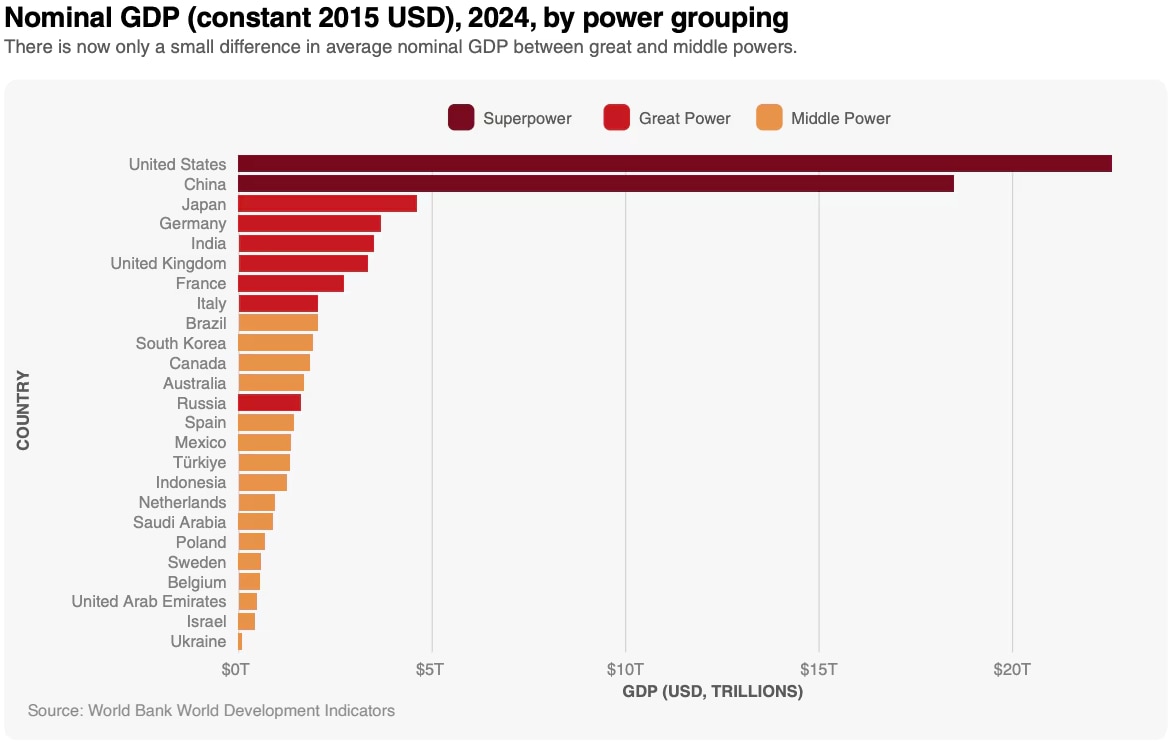
Canadian Prime Minister Mark Carney told Davos in January that "middle powers must act together, because if we're not at the table, we're on the menu" — and Gulf states have form here: Saudi Arabia and the UAE were both invited to the 2025 G7 summit under Canada's presidency, alongside Brazil, India, Indonesia and others.
Put together, these two stories describe the same phenomenon from different angles. The Gulf is no longer just a source of capital for its immediate neighbourhood or a guest at the global table — it is becoming one of the connective threads of a more fragmented system, investing in the reconstruction of a neighbour while also being courted as a bridge between the G7 and the wider world.
That said, it's worth noting the tension here: the same Chief Economists' Outlook referenced above finds multinational companies currently rate the Middle East and North Africa as less attractive for investment because of geopolitical risk. Gulf capital flowing into Syria suggests regional investors may be positioning ahead of that curve rather than waiting for it to clear.
From shock to system redesign: Hormuz and the new arithmetic of resilience
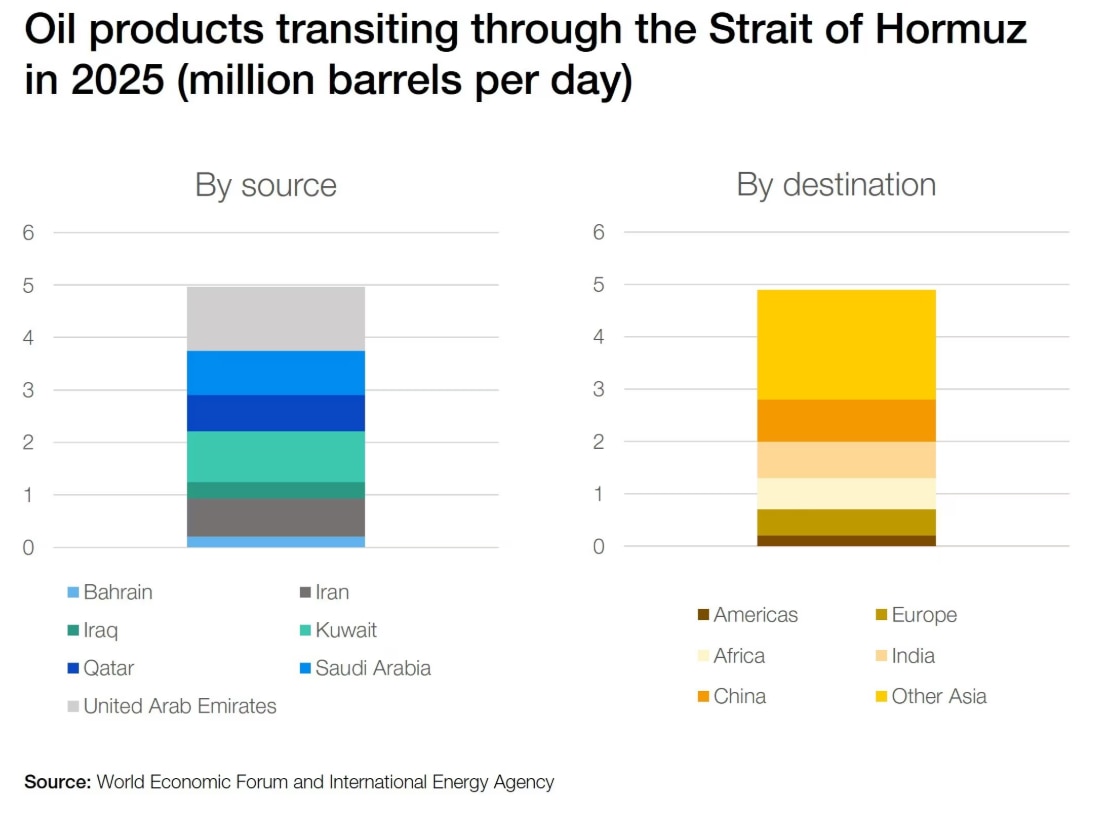
Some months on from the closure of the Strait of Hormuz, the May 2026 Chief Economists' Outlook shows just how far the shock has travelled. 89% of the chief economists surveyed now expect global growth to weaken over the next year, 94% expect inflation to rise, and the Middle East and North Africa region faces the sharpest downgrade of all, with 88% expecting weak or very weak growth.
As Maersk's Ilaria Maselli put it on Radio Davos, the strait is "the aorta of global fossil fuel trade" — and with roughly 6 million barrels a day of supply still missing, chief economists rate the potential impact of a prolonged closure as approaching that of the COVID-19 pandemic.
The disruption is showing up in unexpected places. As explored in recent Forum analysis, jet fuel prices spiked to $220 a barrel in March — well above the post-pandemic peaks of 2022 — pushing up long-haul ticket prices by around €90 and forcing airlines to cancel tens of thousands of routes.
But the same crisis is sharpening the case for sustainable aviation fuels (SAF): with conventional kerosene prices elevated, the cost gap to SAF has narrowed, giving governments and airlines a rare window to invest in more diversified, locally produced fuel supplies that don't depend on a single chokepoint.
That logic — using the crisis to build permanent redundancy rather than just to ride it out — is also playing out in trade infrastructure. Oman's ports at Duqm, Sohar and Salalah absorbed hundreds of diverted vessels without disruption, while Dubai's new "green corridor" to Oman saw customs declarations leap from $272 million to $2.2 billion in a matter of months. Years of investment in ports, airports, rail and road links — including Saudi Arabia's Empty Quarter highway and the Hafeet Rail project linking the UAE and Oman — meant this capacity already existed when it was needed.
The throughline across all three stories is the same: geography still matters enormously — as the Strait of Hormuz video explainer makes clear, there is no like-for-like substitute for a chokepoint that normally carries a fifth of the world's oil and gas — but resilience can be engineered.
Whether it's a barrel of sustainable jet fuel produced from local feedstocks or a container rerouted through Salalah instead of Jebel Ali, the investments that convert a one-off emergency response into lasting redundancy are the ones that will matter most when the next shock arrives.
A new battlefield: cyber, AI and critical infrastructure
Conflict in the region is increasingly playing out in digital and technological realms. At the same time, AI is emerging as both a vulnerability and a tool for resilience, raising the stakes for digital security. The cybersecurity landscape is evolving rapidly, with state and non-state actors targeting critical systems.
“
For the first time in modern conflict, commercial hyperscale data centres became explicit kinetic targets. Iranian state media described the strikes as blows to “the enemy’s technological infrastructure,” and the episode was widely interpreted as a watershed moment in the security meaning of cloud infrastructure.
”
— Oliver Jabbour Deputy Head, Middle East and North Africa, World Economic Forum
Have you read?
Emerging technologies like quantum computing are also entering the strategic conversation, as seen in national-level pilots.
Saudi Arabia, became the first country to operationalize the World Economic Forum's Quantum Economy Blueprint at a national scale. A new paper, Piloting the Quantum Economy Blueprint: Lessons from Saudi Arabia, distils key operational and strategic lessons informed to guide countries and organizations seeking to adapt the blueprint to their own national contexts.
Evolving role of governments
Chokepoints in focus: why Hormuz matters
The Iran oil shock - the largest oil-supply disruption the world has ever seen?
In this episode of Radio Davos, Jason Bordoff of the Center on Global Energy Policy and the Columbia Energy Exchange podcast joined us to explore the potential long-term impacts on global energy systems of the oil shock caused by the Iran war and the closure of the Strait of Hormuz.
The region’s central role in energy supply means a global ripple effect through inflation, food prices and economic growth. Governments around the world are implementing measures to reduce fuel demand and protect consumers. The crisis highlights the growing impact of geoeconomic tensions more broadly on global energy systems and economic stability.
Have you read?
Keep up with the latest insights, data and analysis from and on the region
What’s shaping the Middle East and North Africa right now? Drawing on the World Economic Forum’s network of leaders and experts, this tracker curates the latest insights, data and analysis from and on the region to help make sense of the news.
Related topics:
License and Republishing
World Economic Forum articles may be republished in accordance with the Creative Commons Attribution-NonCommercial-NoDerivatives 4.0 International Public License, and in accordance with our Terms of Use.
The views expressed in this article are those of the author alone and not the World Economic Forum.
Share:

Forum Stories newsletter
Bringing you weekly curated insights and analysis on the global issues that matter.
More on Geographies in Depth
More on Geographies in Depth