





AI, data centres and a more volatile geopolitical environment are increasing demand for electricity that is reliable, secure and clean. In that context, nuclear energy is receiving renewed attention in policy and industry discussions.
Ongoing turmoil in energy markets related to the war in Iran and the closing of the Strait of Hormuz has not only elevated energy prices across the board, but also renewed debate about energy security and supply resilience.
Proponents of nuclear energy argue that it can offer important energy-security advantages. It can provide dispatchable power with round-the-clock availability and in some markets may reduce reliance on imported fuels. Moreover, nuclear plants may be less exposed to day-to-day fuel delivery risk because they typically refuel every 18 to 24 months and additional fuel that can last several additional years can generally be stored on-site.
In Europe, Poland is moving ahead with its first nuclear plant and even Germany seems to be reconsidering its opposition to this source of energy. In Asia, China keeps building at speed and scale, while India is reinvigorating its nuclear programme. In the US, the White House aims for 5 gigawatts of power upgrades at existing reactors and the start of construction on 10 new large reactors by 2030.
The growth in AI and data centres has strengthened interest in power sources that provide reliable, 24/7 low-carbon electricity, including nuclear.
Major technology companies are committing tens of billions of dollars to new AI infrastructure. For example, OpenAI and Oracle are developing 4.5 gigawatts of additional data centre capacity in the US. Google has announced a $40 billion investment in three new Texas data centre campuses, and Amazon plans an additional $15 billion in Northern Indiana on top of an earlier $11 billion project there.
The result is soaring electricity demand. According to an IEA analysis, global data centre electricity consumption reached about 415 terawatt-hours (TWh) in 2024 and is projected to rise to around 945 TWh by 2030. Nuclear is one of the key technologies that can help meeting this demand.
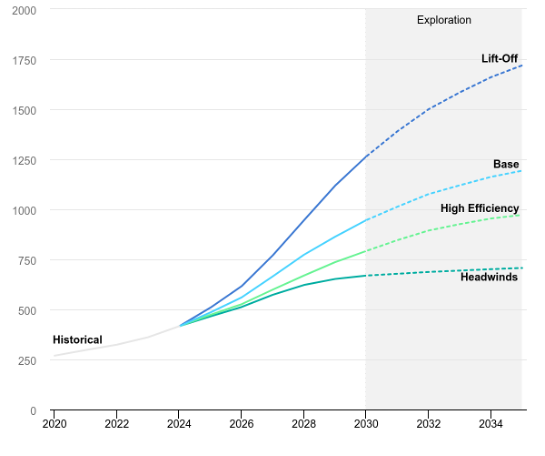
The IEA says 63 reactors are currently under construction worldwide, and over the last five years decisions have been taken to extend the operating lifetimes of more than 60 others.
While a number of innovative reactor designs are moving forward, large pressurized water reactors (PWR) continue to dominate today’s nuclear fleet and near-term build plans. Most reactors under construction, on order and planned are also large PWRs. For example, the US government plans to spend $80 billion to build 10 AP1000 large-scale nuclear reactors.
For years, one of the main constraints of new nuclear projects has been cost, especially major overruns and delays. Some analysts argue this may now be starting to change as projects move away from one-off designs towards repetition, standardization, modularization and stronger supply chains.
Building multiple reactors of the same type with the same delivery teams could reduce costs and construction times through learning effects, although the extent of those gains remains uncertain and context-specific. Some believe that getting about seven reactors of the same type will drive down construction costs and timeframes so each additional new reactor will cost about the same as the seventh and take about the same amount of time to deploy.
The US Department of Energy estimates that advanced construction technologies could reduce the construction costs of building new reactors by more than 10% and significantly lower the scheduling risks associated with them.
A major roadblock to new nuclear construction has been the huge capital outlays required of utilities, and in some markets their regulators’ reluctance to finance plants through ratepayers. But for AI hyperscalers with market capitalizations in the trillions of dollars and relatively easy access to credit, financing nuclear is far less of an issue. In fact, a lack of sufficient, reliable electricity could materially constrain their expansion plans.
There has been much discussion of innovative advanced reactor companies offering “behind-the-meter” solutions, with small reactors co-located with data centres and other industrial facilities.
SMRs (Small Modular Reactors) using modular construction methods are intended to be smaller, simpler and quicker to build than conventional large-scale plants. They may also be better suited to set up in remote areas that lack grid infrastructure, and many designs include passive safety features. Some can utilize spent fuel from existing power plants.
Some companies have already signed contracts to deploy reactors alongside data centres and chemical plants,. At the same time, many of these designs have not reached maturity level for deployment.
SMRs (Small Modular Reactors) using modular construction methods promise to be smaller, simpler and quicker to build than conventional large-scale plants. They’re also easier to set up in remote areas that lack grid infrastructure, and often have enhanced safety features. Some can utilize spent fuel from existing power plants and provide a sustainable solution to the issue of waste.
Some companies have already signed contracts to deploy reactors alongside data centres and chemical plants, and there will likely be many more such agreements. At the same time, these designs are still not yet at techno-economical maturity level for deployment.
One thing to watch in this space is the US Department of Energy’s pilot programme, which aims to move at least three advanced reactor concepts towards criticality by July 4, 2026, the country’s 250th anniversary.
Loading...
Growing needs and shifting energy markets are contributing to renewed interest in the nuclear energy. Restarted, extended and new reactors over the next decade will continue to deliver power into the grid. If more nuclear plants are built using repeatable designs and delivery models, costs may fall and deployment should accelerate. With time, small reactors may eventually be deployed at some data centre and industrial sites, although timelines remain uncertain.
At the same time, no single technology will solve the energy crisis on its own; it will take a mix of solutions, including nuclear, renewables, energy storage, clean fuels and others.
Countries will follow different paths at different speeds. Ensuring a durable and inclusive transformation requires alignment between ambition, finance and delivery – guided by market signals, grounded in local realities and supported by international cooperation.
此内容由惯性聚合(RSS阅读器)自动聚合整理,仅供阅读参考。 原文来自 — 版权归原作者所有。