

惯性聚合 高效追踪和阅读你感兴趣的博客、新闻、科技资讯
阅读原文 在惯性聚合中打开

推荐订阅源

S
Security @ Cisco Blogs
罗磊的独立博客
宝玉的分享
宝玉的分享
Last Week in AI
Last Week in AI
T
The Blog of Author Tim Ferriss
美团技术团队
T
Tailwind CSS Blog
博客园 - 三生石上(FineUI控件)
博客园 - Franky
G
Google Developers Blog
Jina AI
Jina AI
Stack Overflow Blog
Stack Overflow Blog
H
Hackread – Cybersecurity News, Data Breaches, AI and More
V
Visual Studio Blog
腾讯CDC
S
SegmentFault 最新的问题
Recent Announcements
博客园 - 叶小钗
Microsoft Security Blog
雷峰网
雷峰网
L
LangChain Blog
Vercel News
Vercel News
Forbes - Security
Forbes - Security
PCI Perspectives
PCI Perspectives
N
News | PayPal Newsroom
S
Security Affairs
K
KPMG report finds enterprise disconnect between AI and its ROI | CIO
博客园 - 司徒正美
J
Java Code Geeks
Recent Commits to openclaw:main
Hacker News: Ask HN
Hacker News: Ask HN
Schneier on Security
A
About on SuperTechFans
Attack and Defense Labs
Google Online Security Blog
aimingoo的专栏
aimingoo的专栏
MongoDB | Blog
MongoDB | Blog
钛媒体:引领未来商业与生活新知
钛媒体:引领未来商业与生活新知
酷 壳 – CoolShell
酷 壳 – CoolShell
Cloudbric
Cloudbric
B
Blog
C
CXSECURITY Database RSS Feed - CXSecurity.com
P
Proofpoint News Feed
D
DataBreaches.Net
OSCHINA 社区最新新闻
OSCHINA 社区最新新闻
Threat Intelligence Blog | Flashpoint
B
Blog RSS Feed
奇客Solidot–传递最新科技情报
奇客Solidot–传递最新科技情报
让小产品的独立变现更简单 - ezindie.com
N
News and Events Feed by Topic

Microsoft Azure Blog

Frontier models and production agents: Advancing Microsoft Foundry for the agentic era | Microsoft Azure Blog Built to bounce back: How Azure resiliency evolved | Microsoft Azure Blog External key management for Azure Managed HSM Meet Brain: The AI system behind Azure reliability | Microsoft Azure Blog Proving application resilience on Azure with Chaos Studio | Microsoft Azure Blog How to design, build, and optimize cloud infrastructure for long-term efficiency Claude in Microsoft Foundry is now generally available | Microsoft Azure Blog The 2026 Agent Confidence Index: Where 300 builders see real momentum | The Microsoft Cloud Blog Accelerate modern Linux workloads with Azure Files | Microsoft Azure Blog Optimizing PostgreSQL on Azure directly in Visual Studio Code From insight to action: The next phase of agentic cloud operations | Microsoft Azure Blog Modernize your data with Azure Storage: Plan and migrate with confidence | Microsoft Azure Blog 3 things leaders need to know from Microsoft Build 2026 | Microsoft Azure Blog Claude Fable 5 available today in Microsoft Foundry: Powering the next era of autonomous agents AI alone won’t change your business. The system running it will. Announcing Microsoft Discovery general availability and Microsoft Discovery app preview A Developer’s Guide to Managing Models, Cost and Quality in Microsoft Foundry Foundry IQ: Build smarter agents faster with unified knowledge and serverless retrieval Microsoft Build 2026: Building agentic apps with Microsoft Fabric and Microsoft Databases New Azure Cobalt 200 VMs deliver 50% performance improvement, fully optimized for modern agentic AI workloads Claude Opus 4.8 is now available in Microsoft Foundry Powering multi-cluster workloads with seamless cross‑cluster networking for Azure Kubernetes Fleet Manager Azure NetApp Files for EDA workloads: From revolution to breakthrough at scale Azure IaaS: Deploy high-performance workloads with a system-level approach Azure Files Entra-Only identities: Advancing cloud-native identity and security From commit to cloud: Powering what’s next for PostgreSQL Advancing enterprise AI: New SAP on Azure announcements from SAP Sapphire 2026 Red Hat Summit 2026: Platform modernization and AI on Microsoft Azure Red Hat OpenShift Build AI apps with Azure Cosmos DB: Key trends from Cosmos Conf 2026 Scaling cloud and AI: Microsoft Azure’s commitment to Europe’s digital future Azure IaaS: Defense in depth built on secure-by-design principles Enforcing trust and transparency: Open-sourcing the Azure Integrated HSM Microsoft named a Leader in the IDC MarketScape: Worldwide API Management 2026 Vendor Assessment OpenAI’s GPT-5.5 in Microsoft Foundry: Frontier intelligence on an enterprise ready platform Microsoft Discovery: Advancing agentic R&D at scale Introducing Azure Accelerate for Databases: Modernize your data for AI with experts and investments Cloud Cost Optimization: Principles that still matter Optimize object storage costs automatically with smart tier—now generally available Microsoft named a Leader in The Forrester Wave™ for Sovereign Cloud Platforms How Drasi used GitHub Copilot to find documentation bugs Cloud Cost Optimization: How to maximize ROI from AI, manage costs, and unlock real business value Azure IaaS: Keep critical applications running with built-in resiliency at scale Building sovereign AI at the edge: Microsoft and Armada collaborate to deliver Azure Local on Galleon modular datacenters Navigating digital sovereignty at the frontier of transformation Microsoft named a Leader in 2026 Gartner® Magic Quadrant™ for Integration Platform as a Service AI for nuclear energy: Powering an intelligent, resilient future | The Microsoft Cloud Blog What’s new with Microsoft in open-source and Kubernetes at KubeCon + CloudNativeCon Europe 2026 Advancing agentic AI with Microsoft databases across a unified data estate FabCon and SQLCon 2026: Unifying databases and Fabric on a single data platform Microsoft at NVIDIA GTC: New solutions for Microsoft Foundry, Azure AI infrastructure and Physical AI From legacy to leadership: How PostgreSQL on Azure powers enterprise agility and innovation
Azure Databricks delivers proven business value | Microsoft Azure Blog
Jason Pereira, Anavi Nahar · 2026-07-15 · via Microsoft Azure Blog

Microsoft Azure Databricks delivers the first-party advantage of Databricks on Microsoft—and for customers, that advantage shows up as real, measurable value. It is the same Databricks platform your teams already know, co-engineered with Microsoft and delivered as a native Azure service, so it fits naturally into the Microsoft tools, identity, and governance your organization already runs.

The advantage is built-in, not bolted on. Microsoft and Databricks co-engineer the service, share one integration roadmap across the Microsoft data and AI stack, and align go-to-market so you get one motion, one bill, and one support path. For technical teams, that means deeper native integration and stronger performance. For the business, it means lower cost, less risk, and faster time to value.

The strategic partnership drives an accelerated integration roadmap and continuous optimization for improved performance; however, decision-makers constantly ask about what business value all of this translates to. To address this key question, Microsoft commissioned a Forrester Total Economic Impact™ study of Azure Databricks. It found that a composite organization based on interviewed customers realized a three-year 331% return on investment, $58.1 million in net present value, and recovered its investment in less than six months.

331%
Return on investment 
$58.1M
Net present value
< 6 months
Payback period

Commissioned study conducted by Forrester Consulting on behalf of Microsoft, June 2026. Results are over three years and represent a composite organization based on interviewed customers and may not be typical; actual results will vary.

What the study found

Forrester interviewed Azure Databricks customers and built a composite organization to model the impact: a $6 billion company in a regulated industry, running about 10 petabytes of data.

Before Azure Databricks, its data estate was fragmented and expensive. It was unreliable at scale and hard to govern. Afterward, the results were clear: $75.6 million in benefits against $17.5 million in cost over three years translating to $58.1 million in net present value.

The value came from four places:

  • $39.0 million—data and analytics teams’ productivity. Teams handled more work without adding people, with measured gains of 15% to 25%. As a Vice President of data services at a healthcare organization put it: “…we’re doing more work with the same size of the team.”
  • $19.9 million—lower infrastructure costs. Elastic, pay-as-you-go compute replaced overprovisioned hardware.
  • $11.4 million—better data platform resiliency. Managed operations meant fewer outages and no custom disaster recovery to build.
  • $5.4 million—retired legacy software and redeployed DBAs. Consolidating databases and Extract, Load, Transform (ETL) tools eliminated third-party licenses, and managed operations freed database administrators for higher-value work.

Forrester listed more benefits it didn’t put a price on: native Azure services integration, faster insights, wider access to data, and governance through Unity Catalog. That’s where the return starts.
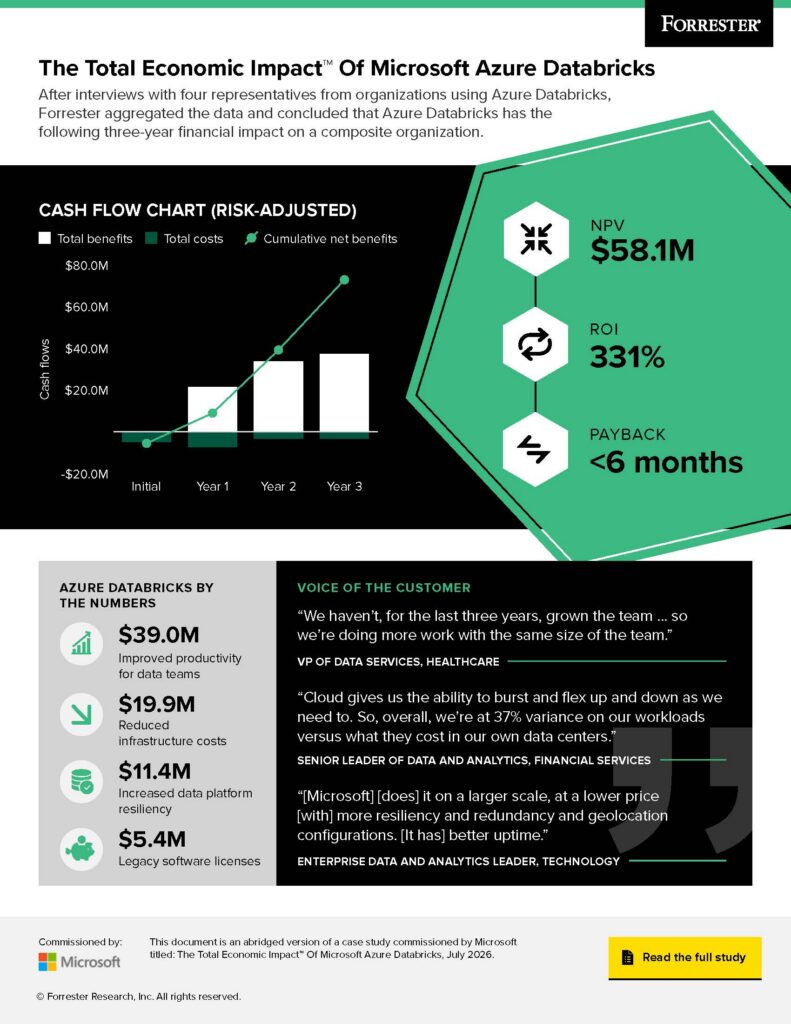
The Total Economic Impact of Microsoft Azure Databricks infographic

Where the value comes from

Those returns come down to one thing. Azure Databricks is a true first-party Azure service, co-engineered by Microsoft and Databricks, it plugs into the tools your teams already use. That removes the extra data copies, tooling, and integration work that raise costs elsewhere.

A great example is the Azure Databricks Genie integration with Microsoft Copilot Cowork. You can add context of your business and build on that intelligence into the tools your teams already use with this integration. Genie lets anyone question the lakehouse in plain language—now inside Microsoft Teams, Microsoft 365 Copilot, and more recently in Copilot Cowork, where it grounds tasks in trusted data through Genie Ontology. Every answer is scoped by Unity Catalog to exactly what each user is permitted to see, so intelligence reaches the flow of work without loosening governance.

The same depth runs across the rest of the platform:

These are the integrations that Forrester valued but didn’t price separately however, they are critical factors driving productivity and cost benefits that were quantified.

Backed by independent benchmarks

Value also depends on speed, and that’s been tested. Principled Technologies, an independent firm, ran an industry-standard, TPC-DS-like decision-support benchmark on a 10-terabyte dataset. Azure Databricks completed a single query stream in up to 21.1% less time than Databricks on AWS (with autoscale disabled) and ran four concurrent query streams more than nine minutes faster.

What it means for you

Choosing a data and AI platform is a long-term decision, and with Azure Databricks the pieces reinforce each other. The integration drives the savings Forrester measured. The performance keeps those gains steady as usage grows. And it all rests on one foundation: a first-party partnership that puts Microsoft and Databricks engineering, roadmap, and support behind your data estate. The value isn’t a claim, it’s been measured: a three-year 331% return, with payback in under six months. It’s why so many teams choose to run their lakehouse on Azure Databricks.

Explore further