






Azure API Management provides a single, Azure-native platform to govern everything from traditional APIs to AI models, tools, and agents.
As AI moves into production, how systems interact is fundamentally changing. Organizations must now manage not just APIs, but how AI systems operate across the enterprise.
We’re proud to share that Microsoft has been named Leader in the IDC MarketScape: Worldwide API Management 2026 Vendor Assessment (#US52034025, March 2026). We believe this recognition reflects our focus on helping organizations securely scale APIs and AI together with the control, visibility, and reliability required for production.
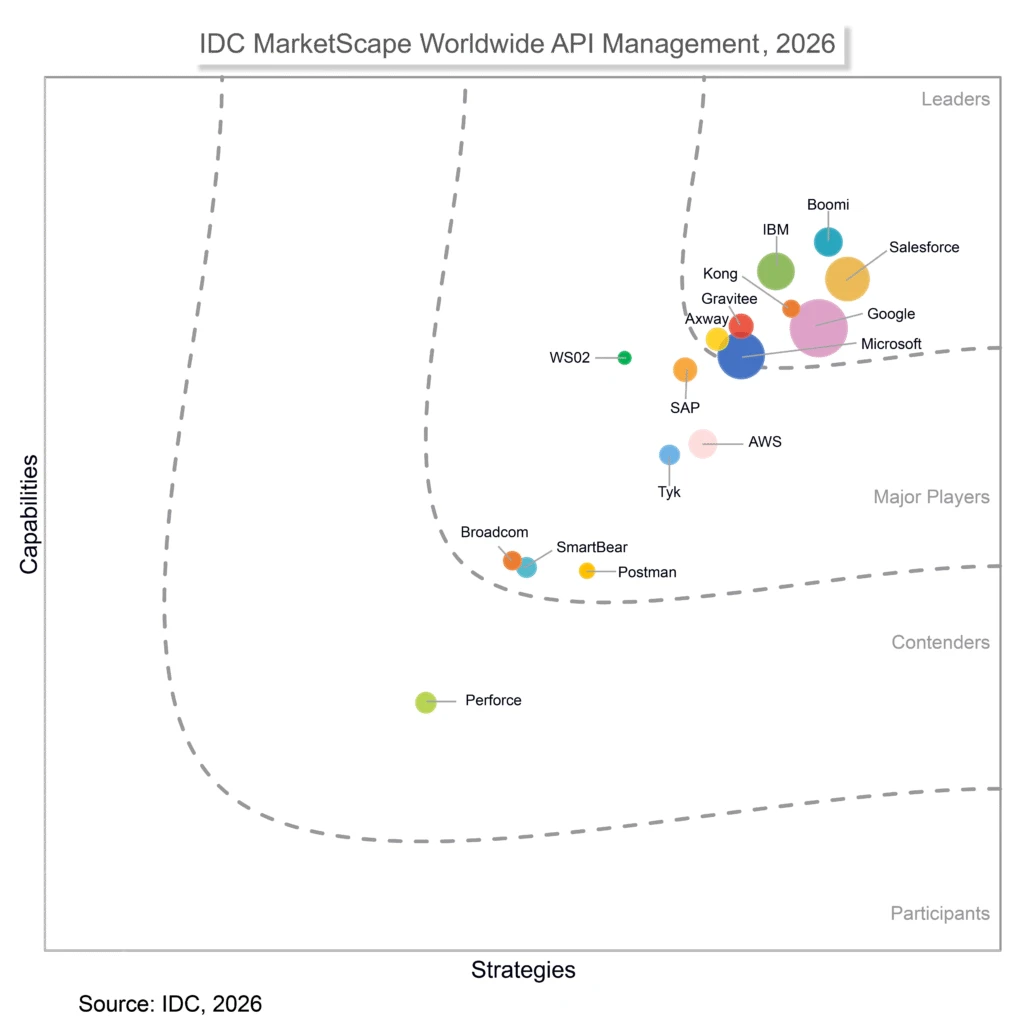
Built on a proven foundation extending into AI
For more than a decade, Azure API Management has served as a trusted control plane for API governance, security, and observability at a global scale, supporting over 38,000 customers, nearly 3 million APIs, and more than 3 trillion API requests each month. That foundation is now extending to a new class of workloads.
As organizations bring AI into production, they must govern a growing mix of API traffic and AI-driven interactions, each with new governance needs, cost dynamics, and reliability requirements. What was once about connecting systems and exposing APIs is now an operational challenge at scale. Organizations must continuously manage how models, tools, and agents behave in production controlling cost, enforcing policies, and ensuring reliability across multi-provider AI traffic.
AI gateway capabilities in API Management build on this foundation, extending API Management’s proven API governance to AI workloads. Today, more than 2,000 enterprise customers are already using these capabilities to safely operationalize AI.
One platform to scale APIs and AI
To meet this shift, organizations need a simpler model, one platform that brings consistency across both APIs and AI.
Azure API Management provides a single, Azure-native platform to govern everything from traditional APIs to AI models, tools, and agents, built on a foundation proven at enterprise scale. This allows organizations to move faster with AI without losing control, visibility, or consistency as they scale. By standardizing how systems connect and interact, teams can reduce fragmentation, simplify operations, and create a trusted foundation for innovation across the business.
This approach is already delivering results on a global scale. Heineken uses Azure API Management as the backbone of its global API platform, enabling teams to build and scale digital experiences faster while maintaining a consistent, centrally governed foundation. In just five months, Heineken built and deployed a worldwide API platform now handling 50 million API calls per month, achieving 100% uptime since go-live, and reducing cost per API call by up to 75% through standardized governance and security at scale.
Governance by design for AI at scale
As AI adoption grows, the challenge shifts from building models to operating them reliably in production. Organizations need a consistent way to control how AI systems operate in production.
Azure API Management provides that governance layer, allowing organizations to define how AI systems access models, tools, and agents, while enforcing security policies, monitoring usage, and maintaining control over cost and behavior across environments. This ensures every interaction is secure, observable, and aligned with business and compliance requirements.
This approach is already proving essential in real-world deployments. Banco Bradesco uses Azure API Management to securely manage AI services and APIs across channels, applying centralized governance and end-to-end visibility. By standardizing how APIs and AI services are exposed and consumed, the bank ensures consistent security policies, improves monitoring across interactions, and supports high-scale digital banking experiences with strong data protection.
With Microsoft Azure API Management, we securely manage AI services and APIs across all channels. It’s the backbone of our architecture scaling with demand while maintaining strict governance and data protection.
—Phelipi Dal’Olio, Bridge Manager, Banco Bradesco
Turning AI innovation into business impact
With governance in place, organizations can move beyond experimentation and focus on delivering real business value with AI.
Telefónica Brasil is using Azure OpenAI to enhance customer interactions across digital channels. This improves service experiences, accelerates response times, and enables more personalized engagement at scale.
At the same time, Access Group embedded AI directly into its product portfolio. Using Azure API Management as the foundation of its AI gateway, Access launched over 50 AI-powered products in a single year and scaled to 2.2 million users. The company also achieved ISO 42001 certification for responsible AI, demonstrating how governance can accelerate innovation.
Air India deployed a generative AI assistant at scale. It now handles up to 40,000 customer queries per day, has resolved over 13 million conversations, and operates with a 97% success rate. This allows the airline to scale customer support without increasing agent volume while saving millions annually.
Azure API Management supports this shift by providing a consistent way to expose, secure, and manage the APIs that power these AI-driven experiences, helping organizations move from isolated innovation to production-ready, enterprise-scale impact.
Expanding the platform for what’s next
As organizations adopt new interaction patterns across APIs and AI systems, the platform continues to evolve. Azure API Management is expanding to support emerging scenarios, including governed agent interactions, exposing APIs as reusable tools for AI systems, and enabling centralized discovery and policy enforcement across environments. This ensures organizations can adopt new capabilities without introducing fragmentation or losing control.
As organizations continue to invest in AI, the ability to govern how systems and AI interact at scale will become a defining capability. API management is evolving from connecting systems to enabling controlled, trusted interaction across the enterprise.
We’re honored to be named a Leader in the 2026 IDC MarketScape for Worldwide API Management Vendor Assessment, and we remain committed to helping organizations scale APIs and AI with confidence.