

惯性聚合 高效追踪和阅读你感兴趣的博客、新闻、科技资讯
阅读原文 在惯性聚合中打开

推荐订阅源

量子位
F
Fortinet All Blogs
J
Java Code Geeks
Y
Y Combinator Blog
Stack Overflow Blog
Stack Overflow Blog
V
Visual Studio Blog
M
MIT News - Artificial intelligence
腾讯CDC
Last Week in AI
Last Week in AI
The Cloudflare Blog
酷 壳 – CoolShell
酷 壳 – CoolShell
Jina AI
Jina AI
Microsoft Security Blog
奇客Solidot–传递最新科技情报
奇客Solidot–传递最新科技情报
P
Proofpoint News Feed
博客园 - 叶小钗
Recent Announcements
T
Tailwind CSS Blog
Engineering at Meta
Engineering at Meta
Cyber Security Advisories - MS-ISAC
人人都是产品经理
人人都是产品经理
L
LangChain Blog
博客园 - 司徒正美
OSCHINA 社区最新新闻
OSCHINA 社区最新新闻

The GitHub Blog

How to bring your software delivery workflow into GitHub with agent apps Your guide to GitHub Universe 2026 is here: The schedule just launched! What 50 open source projects taught us about security in the AI era GitHub availability report: July 2026 Write your first prompt with the GitHub Copilot app Your contributors are AI-first now. Is your project? From coder to orchestrator: How agents shift the role of a developer Using the GitHub Copilot SDK for Java A guide to slash commands in the GitHub Copilot app How we took malware advisories beyond npm How the GitHub legal team used Copilot CLI to streamline their workflows Turn one giant AI-generated pull request to a reviewable stack Don't stop early: Case-folding source code at memory speed Stacked sessions and pull requests in the GitHub Copilot app Tame Dependabot: Group your updates, slow the cadence, keep security fast Disrupting supply chain attacks on npm and GitHub Actions The harness is all you need (mostly) The harness is all you need (mostly) GitHub Copilot app for Beginners: Getting started The case for a cooldown: Why Dependabot now waits before issuing version updates Copilot vs. raw API access: What are you actually paying for? Next chapter: Restructuring GitHub's bug bounty program How to build interactive experiences with canvases $100 million for open source: A milestone built by the community The cost of saying yes has changed GitHub for Beginners: Your roadmap to mastering the GitHub essentials Better tools made Copilot code review worse. Here's how we actually improved it. How GitHub gave every repository a durable owner Automating cross-repo documentation with GitHub Agentic Workflows GitHub availability report: June 2026
GitHub joins coalition advocating for fixes to California...
Natalie Guevara · 2026-06-24 · via The GitHub Blog

GitHub has joined an open source coalition of Black Forest Labs, Hugging Face, and Mozilla Corporation calling for targeted amendments to California’s AI Transparency Act (SB 942, as proposed to be amended in SB 1000). Read the full letter here.

At issue is a narrow but important problem for developers: as currently drafted, the bill’s license revocation provisions conflict with how open source licenses work in practice. Open source licenses are designed to be perpetual and irrevocable, which is what allows developers to reliably build on, reuse, and share code across projects and organizations.

The proposed language would require developers to revoke licenses if downstream users fail to meet certain obligations. That approach is incompatible with widely used open source licenses, and it could introduce uncertainty across the software supply chain—particularly for collaborative and community-driven projects.

The coalition’s letter explains that this requirement is not necessary to achieve the bill’s goals. Developers who modify and deploy AI systems are already directly covered by the law, and enforcement mechanisms remain in place. At the same time, there is a workable alternative: aligning with the EU’s approach in the AI Act Transparency Code of Practice, which recognizes the distinct nature of the open source ecosystem and acknowledges that notifying downstream users of best practices in documentation is sufficient.

GitHub supports these amendments because they preserve the bill’s transparency objectives while maintaining compatibility with open source development. Getting this balance right is critical to ensuring that California continues to support both AI accountability and open, collaborative innovation.

Call to action

We encourage you to review the letter and share your perspective with policymakers. Clear, technically grounded feedback that includes open source developers and civil society can help ensure that AI transparency requirements work in practice without compromising the open source ecosystem that underpins AI innovation.
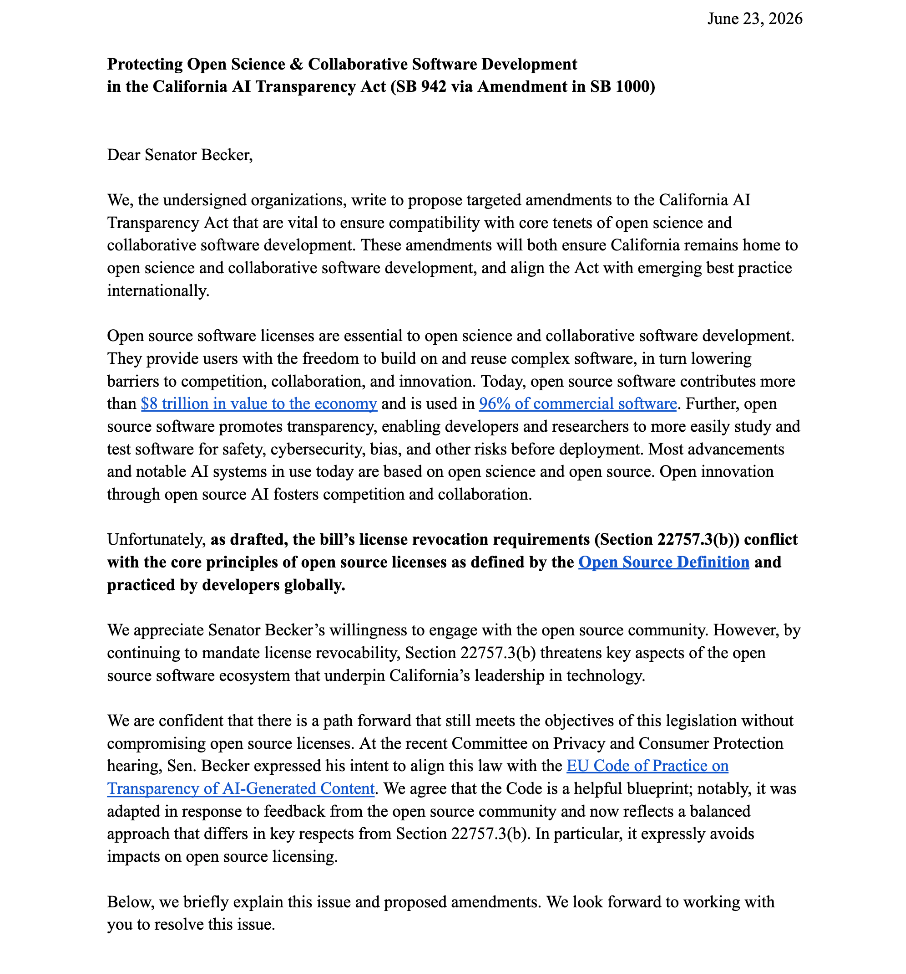
PDF of the letter sent to Senator Becker.
Click to read the full letter.

Written by

Margaret Tucker

Related posts

Explore more from GitHub

Docs

Docs

Everything you need to master GitHub, all in one place.

Go to Docs

GitHub

GitHub

Build what’s next on GitHub, the place for anyone from anywhere to build anything.

Start building

Customer stories

Customer stories

Meet the companies and engineering teams that build with GitHub.

Learn more

GitHub Universe 2026

GitHub Universe 2026

Join us October 28-29 in San Francisco or online for GitHub Universe, our flagship developer event uniting people, agents, and the world’s code.

Register now