惯性聚合 高效追踪和阅读你感兴趣的博客、新闻、科技资讯
阅读原文 在惯性聚合中打开

推荐订阅源

小众软件
小众软件
量子位
博客园 - 叶小钗
Apple Machine Learning Research
U
Unit 42
IT之家
IT之家
F
Fortinet All Blogs
GbyAI
GbyAI
MongoDB | Blog
MongoDB | Blog
H
Hackread – Cybersecurity News, Data Breaches, AI and More
大猫的无限游戏
大猫的无限游戏
freeCodeCamp Programming Tutorials: Python, JavaScript, Git & More
The Register - Security
NISL@THU
NISL@THU
Webroot Blog
Webroot Blog
A
Arctic Wolf
钛媒体:引领未来商业与生活新知
钛媒体:引领未来商业与生活新知
V
Visual Studio Blog
Recent Announcements
Threat Intelligence Blog | Flashpoint
Blog — PlanetScale
Blog — PlanetScale
L
LangChain Blog
P
Palo Alto Networks Blog
Y
Y Combinator Blog
WordPress大学
WordPress大学
让小产品的独立变现更简单 - ezindie.com
AWS News Blog
AWS News Blog
有赞技术团队
有赞技术团队
Engineering at Meta
Engineering at Meta
C
Cybersecurity and Infrastructure Security Agency CISA
aimingoo的专栏
aimingoo的专栏
Know Your Adversary
Know Your Adversary
Cyberwarzone
Cyberwarzone
Martin Fowler
Martin Fowler
The Hacker News
The Hacker News
P
Privacy International News Feed
T
Threat Research - Cisco Blogs
G
GRAHAM CLULEY
宝玉的分享
宝玉的分享
博客园 - 聂微东
cs.CL updates on arXiv.org
Cyber Security Advisories - MS-ISAC
奇客Solidot–传递最新科技情报
奇客Solidot–传递最新科技情报
The GitHub Blog
The GitHub Blog
S
Securelist
T
The Exploit Database - CXSecurity.com
T
Threatpost
Microsoft Azure Blog
The Cloudflare Blog
F
Full Disclosure

Black Hills Information Security, Inc.

Bad Habits: An ANTISOC Operation Same Problem, Different Angles: When Red Team and Blue Team Actually Talk to Each Other How to Identify and Exploit New Vulnerabilities Swapper – A Pure Regex Match/Replace Burp Extension A Practical Guide to BloodHound Data Collection Network Engineering Basics Signed, Trusted, and Abused: Proxy Execution via WebView2 Getting Started In Pentesting – Advice From The BHIS Pentest Lead Cloud Security: Tips and Resources for Securing the Cloud Lessons From A Chatbot Incident How to Lead Effective Tabletops Understanding GRC: How to Navigate Risks and Compliance Standards The “P” in PAM is for Persistence: Linux Persistence Technique Malware Analysis: How to Analyze and Understand Malware OSINT: How to Find, Use, and Control Open-Source Intelligence What to Do with Your First Home Lab When the SOC Goes to Deadwood: A Night to Remember Social Engineering and Microsoft SSPR: The Road to Pwnage is Paved with Good Intentions Common Cyber Threats Finding the Right Penetration Testing Company Deceptive-Auditing: An Active Directory Honeypots Tool The Curious Case of the Comburglar How to Set Smart Goals (That Actually Work For You) Inside the BHIS SOC: A Conversation with Hayden Covington Abusing Delegation with Impacket (Part 3): Resource-Based Constrained Delegation Why You Got Hacked – 2025 Super Edition Abusing Delegation with Impacket (Part 2): Constrained Delegation Abusing Delegation with Impacket (Part 1): Unconstrained Delegation GoSpoof – Turning Attacks into Intel Model Context Protocol (MCP) Bypassing WAFs Using Oversized Requests Getting Started with AI Hacking Part 2: Prompt Injection Wrangling Windows Event Logs with Hayabusa & SOF-ELK (Part 2) DomCat: A Domain Categorization Tool Wrangling Windows Event Logs with Hayabusa & SOF-ELK (Part 1) Microsoft Store and WinGet: Security Risks for Corporate Environments Default Web Content MailFail Commonly Abused Administrative Utilities: A Hidden Risk to Enterprise Security Stop Spoofing Yourself! Disabling M365 Direct Send Bypassing CSP with JSONP: Introducing JSONPeek and CSP B Gone Offensive Tooling Cheatsheets: An Infosec Survival Guide Resource DNS Triage Cheatsheet GraphRunner Cheatsheet Burp Suite Cheatsheet Impacket Cheatsheet Wireshark Cheatsheet Hashcat Cheatsheet EyeWitness Cheatsheet Nmap Cheatsheet Netcat (nc) Cheatsheet Hunt for Weak Spots in Your Wireless Network with Airodump-ng from the Aircrack-ng Suite Detecting ADCS Privilege Escalation Vulnerability Scanning with Nmap Getting Started with NetExec: Streamlining Network Discovery and Access How to Use Dirsearch Augmenting Penetration Testing Methodology with Artificial Intelligence – Part 3: Arcanum Cyber Security Bot How to Design and Execute Effective Social Engineering Attacks by Phone Abusing S4U2Self for Active Directory Pivoting Why Use a Macro Pad? Espanso: Text Replacement, the Easy Way Caging Copilot: Lessons Learned in LLM Security Augmenting Penetration Testing Methodology with Artificial Intelligence – Part 2: Copilot Augmenting Penetration Testing Methodology with Artificial Intelligence – Part 1: Burpference Intercepting Traffic for Mobile Applications that Bypass the System Proxy How to Root Android Phones Communicating Security to the C-Suite: A Strategic Approach Offline Memory Forensics With Volatility Getting Started with AI Hacking: Part 1 Go-Spoof: A Tool for Cyber Deception How to Test Adversary-in-the-Middle Without Hacking Tools Canary in the Code: Alert()-ing on XSS Exploits How to Hack Wi-Fi with No Wi-Fi Why Your Org Needs a Penetration Test Program Burp Suite Extension: Copy For Light at the End of the Dark Web Wi-Fi Forge: Practice Wi-Fi Security Without Hardware Avoiding Dirty RAGs: Retrieval-Augmented Generation with Ollama and LangChain Gone Phishing: Installing GoPhish and Creating a Campaign 5 Things We Are Going to Continue to Ignore in 2025 John Strand’s 5 Phase Plan For Starting in Computer Security Questions From a Beginner Threat Hunter GRC for Security Managers: From Checklists to Influence Attack Tactics 9: Shadow Creds for PrivEsc w/ Kent & Jordan One Active Directory Account Can Be Your Best Early Warning Introduction to Zeek Log Analysis Indecent Exposure: Your Secrets are Showing Creating Burp Extensions: A Beginner’s Guide Pitting AI Against AI: Using PyRIT to Assess Large Language Models (LLMs) The Top Ten List of Why You Got Hacked This Year (2023/2024) ICS Hard Knocks: Mitigations to Scenarios Found in ICS/OT Backdoors & Breaches Intro to Data Analytics Using SQL Finding Access Control Vulnerabilities with Autorize The Detection Engineering Process Cyber Risk Lessons We Can Learn From Hurricane Preparedness Intro to Desktop Application Testing Methodology What Is Penetration Testing? Adversary in the Middle (AitM): Post-Exploitation Pentesting, Threat Hunting, and SOC: An Overview QEMU, MSYS2, and Emacs: Open-Source Solutions to Run Virtual Machines on Windows
AI Large Language Models and Supervised Fine Tuning
BHIS · 2025-01-23 · via Black Hills Information Security, Inc.

Security Consultant, Malware Researcher, New Technology Researcher Evangelist.

This blog post is aimed at the intermediate level learner in the fields of data science and artificial intelligence. If you would like to read up on some fundamentals, here is a list of useful resources.

Large Language Models

Generative large language models (LLMs) based on the transformer architecture have become a very popular technology in natural language processing (NLP). As most readers are aware, there are many popular public LLMs out there which are used daily via a web-based or JSON restful API interface.

Some examples are:

  • ChatGPT (OpenAI)
  • Gemini (Google)
  • Claude (Anthropic)
  • Llama (Meta)

For these very large models, the vendors have built enormous compute resources with many hundreds of Tensor or Graphics Processing Units (TPU/GPU) to train them. Clearly, resources like these are out of reach for the typical information security researcher and/or data scientist.

You can think of these large models as being the digital brain equivalent of a very bright high schooler—or even University graduate today—and they are truly a wonderful resource. Like many University graduates, these models have a broad array of generalized knowledge, but they are typically not “expert” in any specific domain of knowledge.

As an analogy, when we hire a young employee in any specific industry, the new employee’s initial tasks are to get trained on the industry domain focused knowledge, and of course our own local process and procedures.

In the data scientist community, there is a commonly used resource called “Hugging Face” to which some of the very large public models have chosen to be published openly. Thus, the obvious question becomes, can I take one of these large models and send it to school? Can I further train a large model in a very domain specific knowledge or task area so that this model becomes a “professional” or very much more capable in my chosen knowledge domain. The answer is “YES YOU CAN,” and furthermore, you can do this with limited GPU resources.

Large Language Model Goes to School!

Supervised Fine Tuning

The process we use to send a large language model to be schooled in a domain specific knowledge realm is called Supervised Fine Tuning (SFT).

Supervised Fine Tuning of an LLM involves:

  • Adjusting the weights and parameters of an existing pre-trained model to improve its performance in a specific knowledge domain
  • Training of the model on new data that is specific to the task or domain knowledge of interest which updates the model’s weights to adapt to the new data

Aside from knowledge domain adaptation, why would we want to perform Supervised Fine Tuning on a model?

  • Better alignment with desired behavior, and the lowering of irrelevant or undesirable results from the generalized model.
  • To customize the resulting model for a specific business workflow.
  • To improve the efficiency of the model in a limited TPU/GPU resource environment.
  • To avoid a known issue called “catastrophic forgetting,” otherwise said to help retain general capabilities and adapt/align more closely with the new task at hand.

If all this sounds a lot like you are re-training a human to be more proficient in a specific chosen profession, your interpretation is 100% correct. This is the AI-LLM equivalent of the same process. Supervised fine tuning is quite literally tweaking the digital brain to align with a desired new profession!

When performing SFT, we have choices to make. We can either take the approach of:

  • Full Fine Tuning whereby we adjust all of the weights of the model. This is a comprehensive approach but is also resource intensive and not well suited to a limited TPU/GPU environment.
  • Transfer Learning / Repurposing whereby we take an existing model, freeze most but not all its neural network layers, and then fine tune a subset of those layers to achieve the desired resource. Conveniently for us, this is a much less resource intensive task and can often be achieved in a single GPU limited resource environment.

As you might suspect, there have been some algorithmic efficiencies invented to help us with the approach of transfer learning. In particular, Parameter Efficient Fine Tuning (PEFT) is an approach that only adjusts a small subset of model parameters while the majority of the pre-trained parameters remain frozen. This is a very important approach, and the vendors that have openly published LLMs are trying to facilitate the use of their models by publishing different parameter sized models anticipating the SFT process will be used.

There is a notable Python package which is focused on the challenges of a single GPU environment called “Unsloth” published by https://unsloth.ai. Unsloth does a great job of getting you up and running for SFT and I would recommend investigating it.

Meta’s LLAMA 3.1 model for example is published in three parameter sizes. For the purposes of SFT, the different parameter sized models listed below are re-published in a quantized form as a part of the Unsloth framework effort.

  • 8 billion parameters
    • SFT can occur on a single consumer grade GPU with 24GB video ram (VRAM).
  • 70 billion parameters
    • SFT would need more VRAM, typically around 40GB but can still be performed on a single GPU.
  • 405 billion parameters
    • SFT will require a larger multiple GPU architecture.

To maximize efficiency, some additional techniques have been developed to improve the process in a limited resource environment.

  • LoRA stands for low rank adaptation which is a 16-bit word length method designed to reduce memory requirements. Rather than adjust all model parameters, LoRA injects trainable low-rank matrices into specific layers of the model to be adjusted.
  • QLoRA is quantized LoRA, and improves further on the LoRA method by using a 4-bit word length to further lower video RAM requirements. QLoRA represents a trade-off between re-training time and memory resource usage and has become very popular in single GPU environments.

Data Preparation

To be dead honest for a moment, as I first approached re-training the LLAMA3.1 LLM published by Meta, I had this sort of reverence for the technology. Although I was well aware of data science fundamentals, the hype cycle of the capabilities surrounding LLMs was in full swing, and I honestly thought these things could do nearly anything.

With that in mind, my first attempt at SFT was to grab large chunks of textual data on the knowledge domain of choice, and just literally throw it at the wall, so to speak. Did anything stick? Absolutely NOT… in fact, my result was a very confused digital brain that stuttered, repeated itself, converged on single sentence answers, and was, frankly, mentally disabled.

Of course, failure is a fabulous learning opportunity, so I went back to the drawing board and learned that the best path towards fine tuning a generative LLM is in fact to adopt the goal of producing an “instruct model” which requires you to prepare the training data in a “question / answer” pair format.
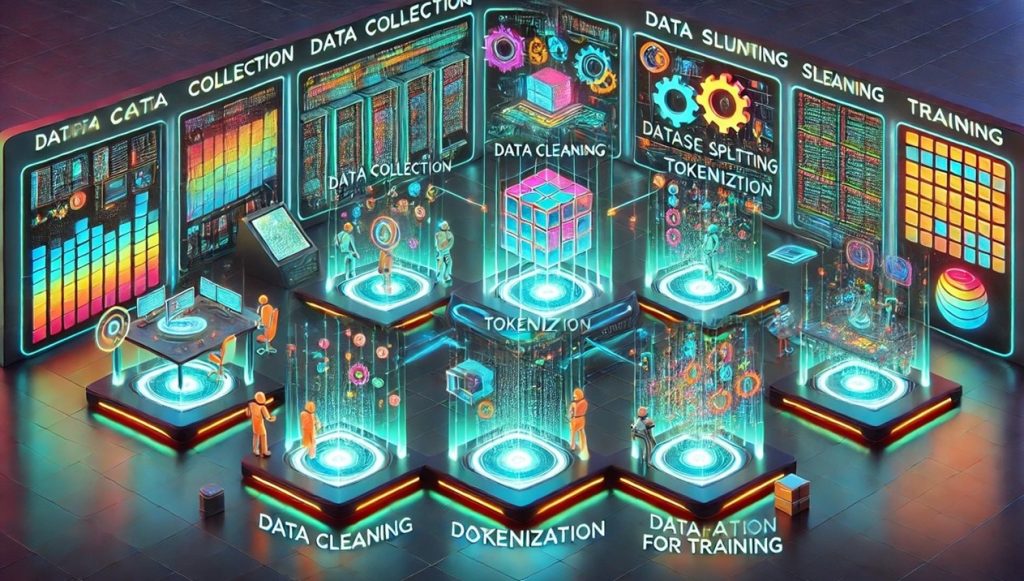
Do Not Proceed Without Careful Data Preparation!

Naturally, my next reflexive response was to groan aloud. I have several hundred megabytes of data that I needed to weed through and prepare in “question/answer” pairs? Whiskey Tango Foxtrot!

In fact, the requirements for a high-quality result are even more stringent if we want to do this right. We need to ensure that:

  • Source data all has task specific or knowledge domain relevance.
  • The data is high in quality and preferably in quantity also.
  • All HTML links, and non-relevant information, and perhaps even some metadata will need to be cleaned up, perhaps corrected, or removed.

In other words, welcome to the drudge work of “data science” which is not in the least attractive and no one really talks about.

In conjunction with these, I was involved in a tremendous amount of reading and research in the field of Artificial Intelligence, and one night around 3am, I had an epiphany which really ended up being more a facepalm moment when it came to me. Why not use another LLM to prepare my data?

Use another LLM to help prepare data for SFT? What?

It so happens that OpenAI’s “chat-gpt-mini-4o” model is extremely proficient at processing textual data. All I needed to do was construct intelligent prompt engineering for the data I was going to feed into OpenAI’s LLM to get my data prepared in a better form.

After working on several different attempts, I also discovered some external helpful resources. A portion of this prompt engineering was inspired by the “LLM Engineers Handbook” (Authors: Paul Lusztin, and Maxime Labonne) which can be found here at https://www.google.com/books/edition/LLM_Engineer_s_Handbook/jHEqEQAAQBAJ
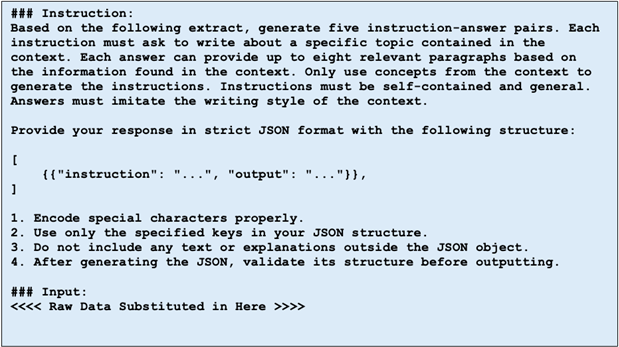
In conjunction with this prompt engineering, I wrote a Python script to interact with OpenAI’s API to present the data. While doing this, I set the “temperature” parameter for the API queries to 0.7 to yield greater creativity in responses, and I also requested the API returned sixteen different responses for each single data item presented as a query.

More specifically, the OpenAI API’s temperature parameter affects the computation of token probabilities when generating output from the large language model. The temperature value ranges from 0 to 2, with lower values indicating greater determinism and higher values indicating more randomness.

Further, because I am a proficient Python programmer, I wrote the code as a multi-threaded script and tuned it such that I would just barely stay below the OpenAI upper token throttling threshold.

Once your data has been properly prepared, you can choose to upload it to a Hugging Face account, if you would like. This makes it easier to integrate with SFT Python scripts or Jupyter notebooks. Importantly, don’t forget to set your prepared data to “private” on Hugging Face if you do not want to publish openly.

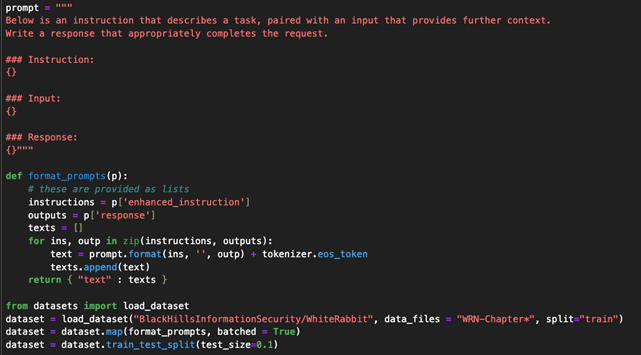
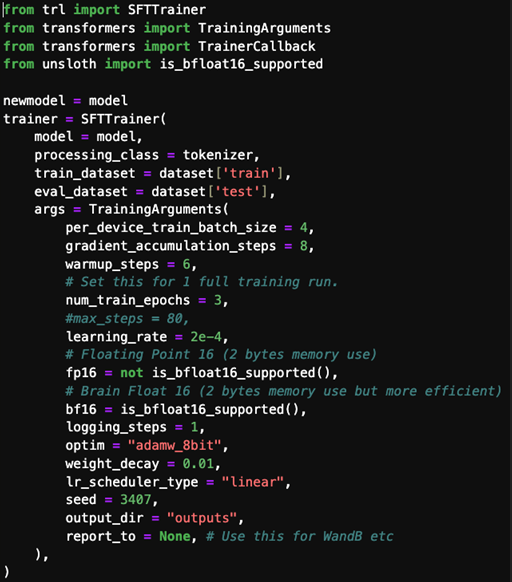
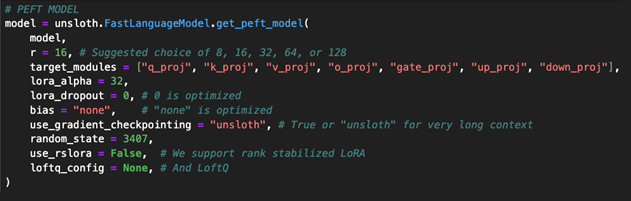
Below is a screenshot of some Jupyter notebook portions of an SFT script so that you can see how you might go about performing SFT using Llama3.1 and the 8 billion parameter model.

In this example, we are using an Information Security domain knowledge dataset called “White Rabbit” to perform SFT on the Llama3.1 model. I did not have to perform any data preparation steps on the White Rabbit dataset as that work had already been done for me.

These script snippets are functional in an Nvidia RTX4090 GPU, 24GB VRAM environment. Note that these are just some fundamental screenshots, not the complete notebook, designed only to give you a sense of what is required.

Load API Keys and the Llama3.1 Model from Hugging Face
Set Up the PFT Object
Set Up the Data Formatting Function and Load The White Rabbit Dataset
Set Up the Supervised Fine Tuning Trainer Object
Perform the Training

In conclusion, the above information covers the process of supervised fine tuning and re-training an LLM for domain specific knowledge purposes. Once retrained, you have the option of publishing your new model on Hugging Face and, of course, using your new model for your own inference query purposes.

Happy AI-LLM hunting! If you want to know more, you can attend the Antisyphon class titled “AI for Cyber Security Professionals” by Joff Thyer and Derek Banks. If you are interested in security assessment of AI models, please contact Black Hills Information Security contact form at this URL: https://www.blackhillsinfosec.com/contact-us/