惯性聚合 高效追踪和阅读你感兴趣的博客、新闻、科技资讯
阅读原文 在惯性聚合中打开

推荐订阅源

S
Security @ Cisco Blogs
Threat Intelligence Blog | Flashpoint
T
Tenable Blog
C
CERT Recently Published Vulnerability Notes
T
Threatpost
C
Cisco Blogs
Know Your Adversary
Know Your Adversary
T
Tor Project blog
博客园 - 司徒正美
有赞技术团队
有赞技术团队
T
Tailwind CSS Blog
D
Darknet – Hacking Tools, Hacker News & Cyber Security
宝玉的分享
宝玉的分享
博客园 - 三生石上(FineUI控件)
L
LangChain Blog
C
Cybersecurity and Infrastructure Security Agency CISA
Stack Overflow Blog
Stack Overflow Blog
Microsoft Security Blog
AWS News Blog
AWS News Blog
人人都是产品经理
人人都是产品经理
P
Proofpoint News Feed
酷 壳 – CoolShell
酷 壳 – CoolShell
A
Arctic Wolf
L
LINUX DO - 热门话题
C
Cyber Attacks, Cyber Crime and Cyber Security
爱范儿
爱范儿
美团技术团队
Recent Commits to openclaw:main
Hugging Face - Blog
Hugging Face - Blog
OSCHINA 社区最新新闻
OSCHINA 社区最新新闻
C
CXSECURITY Database RSS Feed - CXSecurity.com
P
Privacy International News Feed
PCI Perspectives
PCI Perspectives
H
Heimdal Security Blog
Exploit-DB.com RSS Feed
F
Full Disclosure
SecWiki News
SecWiki News
T
The Blog of Author Tim Ferriss
Help Net Security
Help Net Security
Google DeepMind News
P
Palo Alto Networks Blog
博客园 - 叶小钗
C
Check Point Blog
Scott Helme
Scott Helme
V
Visual Studio Blog
博客园 - 聂微东
H
Hackread – Cybersecurity News, Data Breaches, AI and More
Google Online Security Blog
大猫的无限游戏
大猫的无限游戏
The Register - Security

Black Hills Information Security, Inc.

Bad Habits: An ANTISOC Operation Same Problem, Different Angles: When Red Team and Blue Team Actually Talk to Each Other How to Identify and Exploit New Vulnerabilities A Practical Guide to BloodHound Data Collection Network Engineering Basics Signed, Trusted, and Abused: Proxy Execution via WebView2 Getting Started In Pentesting – Advice From The BHIS Pentest Lead Cloud Security: Tips and Resources for Securing the Cloud Lessons From A Chatbot Incident How to Lead Effective Tabletops Understanding GRC: How to Navigate Risks and Compliance Standards The “P” in PAM is for Persistence: Linux Persistence Technique Malware Analysis: How to Analyze and Understand Malware OSINT: How to Find, Use, and Control Open-Source Intelligence What to Do with Your First Home Lab When the SOC Goes to Deadwood: A Night to Remember Social Engineering and Microsoft SSPR: The Road to Pwnage is Paved with Good Intentions Common Cyber Threats Finding the Right Penetration Testing Company Deceptive-Auditing: An Active Directory Honeypots Tool The Curious Case of the Comburglar How to Set Smart Goals (That Actually Work For You) Inside the BHIS SOC: A Conversation with Hayden Covington Abusing Delegation with Impacket (Part 3): Resource-Based Constrained Delegation Why You Got Hacked – 2025 Super Edition Abusing Delegation with Impacket (Part 2): Constrained Delegation Abusing Delegation with Impacket (Part 1): Unconstrained Delegation GoSpoof – Turning Attacks into Intel Model Context Protocol (MCP) Bypassing WAFs Using Oversized Requests Getting Started with AI Hacking Part 2: Prompt Injection Wrangling Windows Event Logs with Hayabusa & SOF-ELK (Part 2) DomCat: A Domain Categorization Tool Wrangling Windows Event Logs with Hayabusa & SOF-ELK (Part 1) Microsoft Store and WinGet: Security Risks for Corporate Environments Default Web Content MailFail Commonly Abused Administrative Utilities: A Hidden Risk to Enterprise Security Stop Spoofing Yourself! Disabling M365 Direct Send Bypassing CSP with JSONP: Introducing JSONPeek and CSP B Gone Offensive Tooling Cheatsheets: An Infosec Survival Guide Resource DNS Triage Cheatsheet GraphRunner Cheatsheet Burp Suite Cheatsheet Impacket Cheatsheet Wireshark Cheatsheet Hashcat Cheatsheet EyeWitness Cheatsheet Nmap Cheatsheet Netcat (nc) Cheatsheet Hunt for Weak Spots in Your Wireless Network with Airodump-ng from the Aircrack-ng Suite Detecting ADCS Privilege Escalation Vulnerability Scanning with Nmap Getting Started with NetExec: Streamlining Network Discovery and Access How to Use Dirsearch Augmenting Penetration Testing Methodology with Artificial Intelligence – Part 3: Arcanum Cyber Security Bot How to Design and Execute Effective Social Engineering Attacks by Phone Abusing S4U2Self for Active Directory Pivoting Why Use a Macro Pad? Espanso: Text Replacement, the Easy Way Caging Copilot: Lessons Learned in LLM Security Augmenting Penetration Testing Methodology with Artificial Intelligence – Part 2: Copilot Augmenting Penetration Testing Methodology with Artificial Intelligence – Part 1: Burpference Intercepting Traffic for Mobile Applications that Bypass the System Proxy How to Root Android Phones Communicating Security to the C-Suite: A Strategic Approach Offline Memory Forensics With Volatility Getting Started with AI Hacking: Part 1 Go-Spoof: A Tool for Cyber Deception How to Test Adversary-in-the-Middle Without Hacking Tools Canary in the Code: Alert()-ing on XSS Exploits How to Hack Wi-Fi with No Wi-Fi Why Your Org Needs a Penetration Test Program Burp Suite Extension: Copy For Light at the End of the Dark Web Wi-Fi Forge: Practice Wi-Fi Security Without Hardware Avoiding Dirty RAGs: Retrieval-Augmented Generation with Ollama and LangChain Gone Phishing: Installing GoPhish and Creating a Campaign 5 Things We Are Going to Continue to Ignore in 2025 John Strand’s 5 Phase Plan For Starting in Computer Security Questions From a Beginner Threat Hunter GRC for Security Managers: From Checklists to Influence AI Large Language Models and Supervised Fine Tuning Attack Tactics 9: Shadow Creds for PrivEsc w/ Kent & Jordan One Active Directory Account Can Be Your Best Early Warning Introduction to Zeek Log Analysis Indecent Exposure: Your Secrets are Showing Creating Burp Extensions: A Beginner’s Guide Pitting AI Against AI: Using PyRIT to Assess Large Language Models (LLMs) The Top Ten List of Why You Got Hacked This Year (2023/2024) ICS Hard Knocks: Mitigations to Scenarios Found in ICS/OT Backdoors & Breaches Intro to Data Analytics Using SQL Finding Access Control Vulnerabilities with Autorize The Detection Engineering Process Cyber Risk Lessons We Can Learn From Hurricane Preparedness Intro to Desktop Application Testing Methodology What Is Penetration Testing? Adversary in the Middle (AitM): Post-Exploitation Pentesting, Threat Hunting, and SOC: An Overview QEMU, MSYS2, and Emacs: Open-Source Solutions to Run Virtual Machines on Windows
Swapper – A Pure Regex Match/Replace Burp Extension
BHIS · 2026-05-06 · via Black Hills Information Security, Inc.

Penetration Tester. Developer. Pure GNU/Linux Phone Enthusiast.

There are a thousand (rough guess) different ways in Burp Suite to swap out session token values when using something like Intruder or the Scanner. But what about the edge cases? Recently, I tested an application that used SOAP-based XML requests. The session token was only used once; each request set a new session token and invalidated the old session token, which makes using Burp Suite tools like Intruder rather difficult. (Good luck using Match and Replace for that!) And… there are extensions (which shall remain nameless) out there that specifically state they handle XML, but they don’t.

To get a valid session token to use with Burp Suite tools, I ended up writing a small Python extension (110 lines of code, but who’s counting?) that obtained a new session token for each request, allowing items like Intruder to work as intended. Cool, I was able to use it during the test, but I would like this to be repeatable. So, this blog is releasing Swapper, a regex pattern-based match/replace Burp Suite extension.

Easy to Install

Install from the Bapp Store here: https://portswigger.net/bappstore/0077e9930f0147679b6c5ddbedac52be

Or download from here: https://github.com/roidrage52/SWAPPER
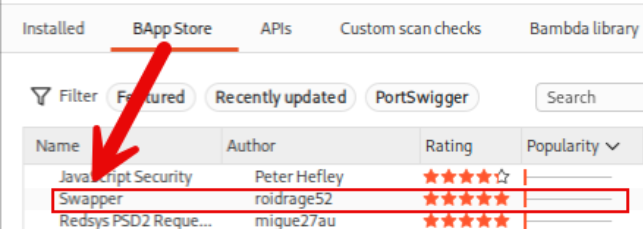
Burp Suite needs the Python environment configured. Ensure you have Jython configured for your environment (more information on that here: https://portswigger.net/burp/documentation/desktop/extend-burp/extensions/troubleshooting#you-need-to-configure-jython-or-jruby). Add the reference to the Jython JAR file in the Extensions settings.

From the Extensions settings, in the Installed tab, select add and choose Python as the extension type. Then load swapper.py. That’s all there is.

Easy(ish) to Use

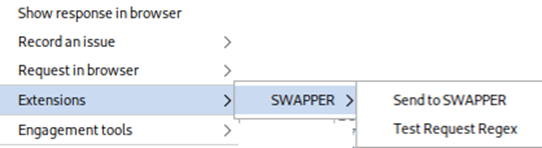
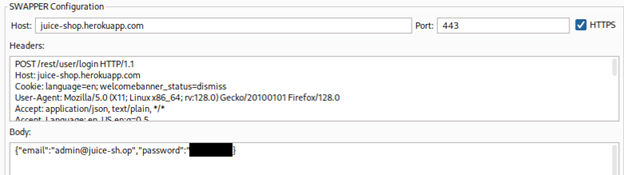
In Burp Suite, select the request that returns the response that contains the value we want to use. Right-click on the request and select “Send to SWAPPER”. This will populate the headers and body in Swapper.
That will populate the SWAPPER configuration tile.
Next is setting up the regex…

Regex Pattern Matching

If I could travel back in time and talk to myself as an 8th grader, the conversation would somehow be centered around, “You will grow up and use regex everyday of your adult life.” Regex is used to match both the value obtained in the response (the session token, CSRF token) and to find applicable areas in the request to swap out. In Swapper, define your regex patterns inside the “Regex Configuration”.
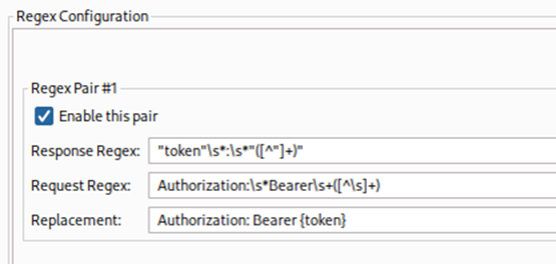
The “Response Regex” field is where you define the value to pull from the response. The pattern that is matched here will be used later in the “Replacement” field, which is the {token} field. The “Request Regex” field is where you define what values to match in the requests sent (as defined in the Extension Control settings). And lastly, the “Replacement” field is what replaces the match from the “Request Regex”. Again, use {token} to add the value obtained from the Response.

You can test your regex patterns in the extension with the “Test Token Request” feature.
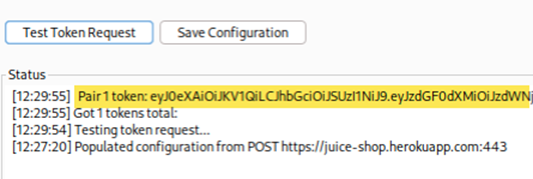
The “Response Regex” regex matched the JWT.

Handles multiple values — That is all. If you need to match a session token, a CSRF token, and anything else, you can use multiple regex pairs.

Configuration

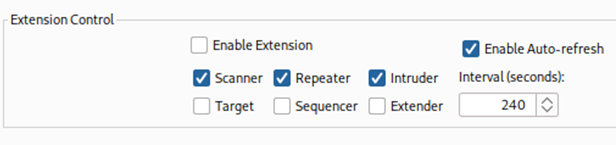
Set the modules that Swapper is needed to replace values in “Extension Control”. Swapper uses time intervals to refresh the values (default is 4 minutes). Modify the time as needed. Unchecking the “Enable Auto-refresh” box will exchange a token for each request.
Logger is Your Friend

If you’re having issues or want to verify the extension is updating the request properly, use Logger/Logger++ to verify your requests are being updated.

And that is all there is to it! If you love regex and app testing, Swapper can be worked into your testing flow for easily matching and replacing items sent in requests. Happy Hacking!


Ready to learn more?

Level up your skills with affordable classes from Antisyphon!

Pay-What-You-Can Training

Available live/virtual and on-demand