







During a recent Breach Assessment engagement, BHIS discovered a highly stealthy and persistent intrusion technique utilized by a threat actor to maintain Command-and-Control (C2) within the client’s network. The attacker had modified Scheduled Tasks in the environment to use a ComHandler to create and execute a method within a registered Component Object Model (COM)1, leveraging custom surrogate DLL files for code execution. The attacker particularly targeted tasks named User_Feed_Synchronization-{GUID} to carry out this technique. BHIS currently tracks this activity under the moniker UKC-1230.
This technique allowed the threat actor to remain persistent in the environment for at least seven months. BHIS also found evidence in the wild that indicates the attacker and associated threat activity have been in use for over a year, with related artifacts dating back nearly two years, as early as January 31, 2024.
During the collection phase of the Breach Assessment, BHIS was made aware of an alert that had fired in the customer’s SOC – an alert on a file hash from an incident that occurred a month prior to the engagement with BHIS.
SHA256 Hash: 407d179f920342312dd526abc8a194b2620d0b19a95032dd36eeb70ec3bf5d65
Filename: C:\ProgramData\Microsoft\Windows\{0759c13d-5d0f-4513-8707-98a6cc3536d5}.dll
BHIS performed a triage collection and analyzed the system. Pivoting on the GUID value associated with the DLL name, a scheduled task named User_Feed_Synchronization-{0759c13d-5d0f-4513-8707-98a6cc3536d5} was uncovered. BHIS inspected the task’s contents which revealed the use of a ComHandler to execute code.
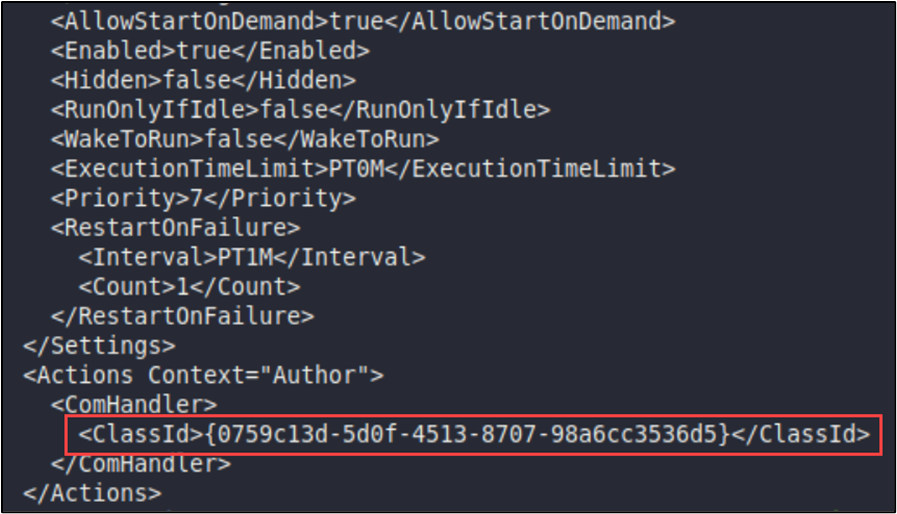
This configuration setting was highly suspicious because although ComHandler activity can be common in certain scheduled tasks on Windows OS’s, it is atypical for tasks of User_Feed_Synchronization-{GUID}.
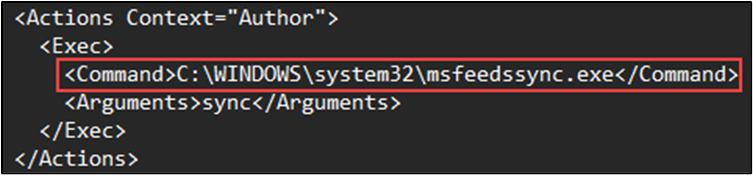
For comparative purposes, a normal/benign User_Feed_Synchronization-{GUID} configuration references the Windows executable file, msfeedsync.exe at C:\WINDOWS\system32\msfeedsync.exe This scheduled task type is a legacy carryover from earlier Windows OS’s and is still found on supported versions of the OS today.
A COM object is typically an in-process COM server (a surrogate DLL, as determined by the ClassId lookup in the Windows Registry); it cannot run on its own and requires a host process to execute its code. This host process is dllhost.exe, also known as the COM Surrogate process, and is a necessary component of the Microsoft Windows OS. It acts as a generic host process for surrogate DLLs.
Knowing the ClassId value, the following registry path can be used to determine where on disk the associated DLL resides:
Registry::HKEY_CLASSES_ROOT\CLSID\{<ClassId-value>}\InprocServer32
The following PowerShell command was used during the Breach Assessment to query the registry key’s value at Registry::HKEY_CLASSES_ROOT\CLSID\{0759c13d-5d0f-4513-8707-98a6cc3536d5}\InprocServer32
Get-ItemProperty -Path 'Registry::HKEY_CLASSES_ROOT\CLSID\{0759c13d-5d0f-4513-8707-98a6cc3536d5}\InprocServer32’

(default)    : C:\ProgramData\Microsoft\Windows\{0759c13d-5d0f-4513-8707-98a6cc3536d5}.dll
The default value of the \InprocServer32 key pointed to the attacker attributed DLL file at C:\ProgramData\Microsoft\Windows\{0759c13d-5d0f-4513-8707-98a6cc3536d5}.dll
BHIS used the following yara rule to scan the environment which uncovered several additional compromised hosts.
rule Detect_COMHandler_ClassId_GUID
{
    meta:
        description = "Detects COM handler ClassId with any GUID inside XML scheduled task files"
        author = "Troy Wojewoda - Black Hills Information Security"
        reference = "Threat actor observed utilizng scheduled tasks to invoke malware via a ComHandler: UKC-1230"

     strings:
        $ascii_comhandler_tag = "<ComHandler>" ascii
        $ascii_classid_guid_regex = /<ClassId>{[0-9a-fA-F]{8}-[0-9a-fA-F]{4}-[0-9a-fA-F]{4}-[0-9a-fA-F]{4}-[0-9a-fA-F]{12}}<\/ClassId>/ ascii

        $wide_comhandler_tag = "<ComHandler>" wide
        $wide_classid_guid_regex = /<ClassId>{[0-9a-fA-F]{8}-[0-9a-fA-F]{4}-[0-9a-fA-F]{4}-[0-9a-fA-F]{4}-[0-9a-fA-F]{12}}<\/ClassId>/ wide

     condition:
        all of ($ascii_*) or all of ($wide_*)
}
It should be noted that the above yara rule can be applied to any scheduled task; however, care should be taken to avoid scheduled tasks where a ComHandler may be used legitimately.
BHIS found that scanning efforts scoped to target scheduled tasks at c:\Windows\System32\Tasks\User_Feed_Synchronization-{* proved to have the highest fidelity detection from a true positive perspective since this task is: a.) native to Windows, and b.) designed to invoke msfeedsync.exe (i.e., not execute via a ComHandler).
In one instance, an administrator logged onto a server, triggering an attacker-modified scheduled task. The system then attempted to beacon to the address 38[.]180[.]143[.]167 which at the time was resolved from the domain push[.]techdataservice[.]us
For each attacker-modified scheduled task found, BHIS collected the location of the surrogate DLL cataloged in the registry at Registry::HKEY_CLASSES_ROOT\CLSID\{<ClassId-value>}\InprocServer32
In all instances but one, the surrogate DLL was located at:
C:\ProgramData\Microsoft\Windows\{GUID}.dll
One host was found with the associated DLL located at:
C:\Users\<%UserProfile%>\AppData\Local\Microsoft\Windows\{GUID}.dll
Every surrogate DLL found in the environment was named with the pattern {GUID}.dll
Additionally, each attacker-attributed DLL file was found to have a different file hash, indicating that searching/hunting via file hashes is the least effective approach in detecting this activity. Conversely, the one consistent observable was that all the DLL files shared the same Import Table Hash (imphash), c4f69d93110080cc2432c9cc3d2c58ab This proved to be a solid indicator and was also used by BHIS to discover additional related DLLs in the wild.
Furthermore, looking for file creation events where the filename matches the regular expression (regex) pattern, {[0-9a-fA-F]{8}-[0-9a-fA-F]{4}-[0-9a-fA-F]{4}-[0-9a-fA-F]{4}-[0-9a-fA-F]{12}}\.dll, could be used as an alternative for hunting efforts if the imphash is not an option. BHIS used this method in both the compromised environment as well as threat hunting against BHIS SOC customers’ telemetry; no false positives were identified using those methodologies.
The earliest indicator of compromise found in the Breach Assessment environment was a scheduled task modified on March 19, 2025, at 16:00:25 UTC, with the associated surrogate DLL created seven minutes later at 16:07:24 UTC.
Because the environment lacked historical log collection for the affected systems and this technique persisted for several months prior to BHIS’s involvement, efforts to identify the initial entry vector proved inconclusive.
The domain techdataservice[.]us was registered on September 5, 2024, with push[.]techdataservice[.]us still resolving to 38[.]180[.]143[.]167 when this blog article was published. BHIS found several other FQDNs and IP addresses associated with the techdataservice[.]us domain, which are listed in the IOC table below.
All surrogate DLLs discovered in the environment had the same imphash of c4f69d93110080cc2432c9cc3d2c58ab This enabled BHIS to uncover additional files in the wild – all file hashes discovered to date are listed in the IOC table below.
Another interesting artifact was that all the DLLs found had a compile date/time of 2024-01-31 07:04:38 UTC and although this attribute can be modified/spoofed, BHIS observed a related DLL that was “first seen” by VirusTotal the same day, at 2024-01-31 11:27:00 UTC:2
3f5bc475d9394d352341b1f843b85cfb300e363dd27d4ca867e9e6d54317d881
Moreover, BHIS found three executable files that were identified by VirusTotal as having contact with one or more domains of techdataservice[.]us
File 1 (note: identical compile date/time as surrogate DLLs)
SHA256 Hash: 1a783fcab9ae545dee58228b38dc9d4fa0c2d0dc35c23f4f5a9d01303ecabd72
Purported Filename: doc_20240930_Prenuptial_Agreement.exe
First seen: 2024-09-30 17:36:01 UTC
Compiled Date: 2024-01-31 07:04:38 UTC
File 2
SHA256 Hash: 9ed58663f7a0bb91c0d9e058a376e78f6748fa4a88e69a0e4598312b3ba75a0c
Purported Filename: Contract_JBornmann_fully.exe
First seen: 2025-03-05 20:55:04 UTC
Compiled Date: 2023-06-20 08:00:00 UTC
File 3
SHA256 Hash: a68bcf09f8c83c67dfe0b17030367ebccf0905f4f531663c73b990202e2a13b0
Purported Filename: PT-20934_MKhan_Contract_fully.exe
First seen: 2025-03-07 17:27:14 UTC
Compiled Date: 2023-06-20 08:00:00 UTC
Although no evidence of these three files was found in the engagement environment, BHIS believes these malicious files were likely used by UKC-1230 in related campaigns, possibly within other victim networks.
BHIS Active SOC customers are already covered by the activity detailed in this blog.
At the time of this publication, the domains, IP addresses, and surrogate DLL files were found to have very little (if any) malicious reputations when referencing OSINT sources.
For organizations looking to threat hunt or detect this activity, BHIS recommends the following:
Write-Host 'Host:' (hostname); Write-Host 'Result:'; Get-ChildItem 'C:\Windows\System32\Tasks\' -Filter 'User_Feed_Synchronization-*' | ForEach-Object { if (Select-String -Path $.FullName -Pattern '<ClassId>' -Quiet) { Write-Host 'Match in file:' $.FullName; Get-Content $_.FullName | Select-String '<ClassId>' } else {Write-Host 'ClassID not found' } }
{[0-9a-fA-F]{8}-[0-9a-fA-F]{4}-[0-9a-fA-F]{4}-[0-9a-fA-F]{4}-[0-9a-fA-F]{12}}\.dll The following Sigma rule is provided as an example for organizations that utilize Sysmon: title: GUID-Named DLL File Creation
id: <>
status: experimental
description: Detects the creation (or attempts to create) of DLL files named with a GUID pattern, seen in staging or injection techniques.
logsource:
product: windows
service: sysmon
detection:
selection_codes:
EventID:
- 11 # FileCreate
- 27 # FileBlockExecutable
- 29 # FileExecutableDetected
selection_regex:
TargetFilename|re: '.*\\\{[0-9a-fA-F]{8}-[0-9a-fA-F]{4}-[0-9a-fA-F]{4}-[0-9a-fA-F]{4}-[0-9a-fA-F]{12}\}\.dll$'
condition: selection_codes and selection_regex
Note: Sysmon EventID-29 (FileExecutableDetected) contains the imphash of executable files created; therefore, searching/alerting on the imphash c4f69d93110080cc2432c9cc3d2c58ab will yield greater true positive results than filename patterns.
BHIS identified a long-term persistence technique during a breach assessment where a threat actor, tracked as UKC-1230, modified Windows Scheduled Tasks to maintain C2 and access to environment. The attacker replaced the normal execution of msfeedsync.exe in User_Feed_Synchronization-{GUID} tasks with a ComHandler that invoked malicious surrogate DLLs registered as COM objects and executed via the host process dllhost.exe. These DLLs, named using GUID patterns matching their respective scheduled task name, shared the same imphash but had unique file hashes, making file hash-based detection ineffective. The intrusion persisted for at least seven months, with evidence suggesting UKC-1230 was active with this technique for nearly two years and may still be active in other victim environments. Any network traffic associated to the domain techdataservice[.]us and its subdomains should be investigated immediately.
BHIS Active SOC customers are covered by this activity and will receive continual updates as new information is discovered.
For organizations interested in BHIS services, including Active SOC, Breach Assessment, or Incident Response services, please contact BHIS at: https://www.blackhillsinfosec.com/contact-us/
rule Detect_COMHandler_ClassId_GUID
{
    meta:
        description = "Detects COM handler ClassId with any GUID inside XML scheduled task files"
        author = "Troy Wojewoda - Black Hills Information Security"
        reference = "Threat actor observed utilizng scheduled tasks to invoke malware via a ComHandler: UKC-1230"
     strings:
        $ascii_comhandler_tag = "<ComHandler>" ascii
        $ascii_classid_guid_regex = /<ClassId>{[0-9a-fA-F]{8}-[0-9a-fA-F]{4}-[0-9a-fA-F]{4}-[0-9a-fA-F]{4}-[0-9a-fA-F]{12}}<\/ClassId>/ ascii
        $wide_comhandler_tag = "<ComHandler>" wide
        $wide_classid_guid_regex = /<ClassId>{[0-9a-fA-F]{8}-[0-9a-fA-F]{4}-[0-9a-fA-F]{4}-[0-9a-fA-F]{4}-[0-9a-fA-F]{12}}<\/ClassId>/ wide
     condition:
        all of ($ascii_*) or all of ($wide_*)
}
| Indicator | Type | Description |
| 23.95.182.21 | IPv4 Address | IP address associated with C2 traffic (resolved from push.techdataservice [.] us and telemetry.techdataservice [.] us) |
| 38.180.143.167 | IPv4 Address | IP address associated with C2 traffic (resolved from push.techdataservice [.] us, mdns.techdataservice [.] us) |
| 52.129.44.42 | IPv4 Address | IP address associated with C2 traffic (resolved from ch9.techdataservice [.] us) |
| 87.121.61.185 | IPv4 Address | IP address associated with C2 traffic (resolved from ch7.techdataservice [.] us) |
| 87.121.61.251 | IPv4 Address | IP address associated with C2 traffic (resolved from ch6.techdataservice [.] us and ch7.techdataservice [.] us) |
| 88.99.163.99 | IPv4 Address | IP address associated with C2 traffic (resolved from ch3.techdataservice [.] us, console.techdataservice [.] us) |
| 104.225.131.18 | IPv4 Address | IP address associated with C2 traffic (resolved from ch4.techdataservice [.] us, sync.techdataservice [.] us) |
| techdataservice [.] us | Domain | Root domain used for C2. Registered on: 2024-09-05 |
| ch3.techdataservice [.] us | FQDN | Fully qualified domain name associated with malicious DLL files – C2 domain Resolved to: 88.99.163.99 |
| ch4.techdataservice [.] us | FQDN | Fully qualified domain name associated with malicious DLL files – C2 domain Resolved to: 104.225.131.18 |
| ch6.techdataservice [.] us | FQDN | Fully qualified domain name associated with malicious DLL files – C2 domain Resolved to: 87.121.61.251 |
| ch7.techdataservice [.] us | FQDN | Fully qualified domain name associated with malicious DLL files – C2 domain Resolved to: 87.121.61.251, 87.121.61.185 |
| ch9.techdataservice [.] us | FQDN | Fully qualified domain name associated with malicious DLL files – C2 domain Resolved to: 52.129.44.42 |
| console.techdataservice [.] us | FQDN | Fully qualified domain name associated with malicious DLL files – C2 domain Resolved to: 104.225.131.18 |
| mdns.techdataservice [.] us | FQDN | Fully qualified domain name associated with malicious DLL files – C2 domain Resolved to: 38.180.143.167 |
| push.techdataservice [.] us | FQDN | Fully qualified domain name associated with malicious DLL files – C2 domain Resolved to: 38.180.143.167 |
| sync.techdataservice [.] us | FQDN | Fully qualified domain name associated with malicious DLL files – C2 domain Resolved to: 104.225.131.18 |
| telemetry.techdataservice [.] us | FQDN | Fully qualified domain name associated with malicious DLL files – C2 domain Resolved to: 23.95.182.21, 38.180.143.167 |
| 0073473b4baf3c29156597aab6d948fe7dc91972fdf350f88753e1e9e5217009 | SHA256 Hash | SHA256 hash of malicious DLL found in wild (imphash match) First seen: 2025-11-26 16:34:35 UTC Compiled date: 2024-01-31 07:04:38 UTC |
| 1a783fcab9ae545dee58228b38dc9d4fa0c2d0dc35c23f4f5a9d01303ecabd72 | SHA256 Hash | SHA256 hash of file found in wild (attacker-attributed infrastructure). Filename: doc_20240930_Prenuptial_Agreement.exe First seen: 2024-09-30 17:36:01 UTC Compiled Date: 2024-01-31 07:04:38 UTC |
| 1f529a76faea1e7fa56cbc24c66ddeb5a18d025af654c7e92635d9866e22819d | SHA256 Hash | SHA256 hash of malicious DLL file dropped to disk and launched via modified scheduled tasks First seen: <not observed in the wild> Compiled date: 2024-01-31 07:04:38 UTC |
| 3e9efef4121da751f36070a7ffed49eb1b1f72831651e8ecf47e45dd7602c05e | SHA256 Hash | SHA256 hash of malicious DLL found in wild (imphash match) First seen: 2025-11-13 17:14:17 UTC Compiled date: 2024-01-31 07:04:38 UTC |
| 3f5bc475d9394d352341b1f843b85cfb300e363dd27d4ca867e9e6d54317d881 | SHA256 Hash | SHA256 hash of malicious DLL found in wild (imphash match) First seen: 2024-01-31 11:27:00 UTC Compiled date: 2024-01-31 07:04:38 UTC |
| 407d179f920342312dd526abc8a194b2620d0b19a95032dd36eeb70ec3bf5d65 | SHA256 Hash | SHA256 hash of malicious DLL file dropped to disk and launched via modified scheduled tasks First seen: 2025-03-05 20:58:53 UTC Compiled date: 2024-01-31 07:04:38 UTC |
| 498eaa0d4e5dfa6495a8c3308a3f02f38841809b0d3cab86448b559dbbe8e47c | SHA256 Hash | SHA256 hash of malicious DLL found in wild (imphash match) First seen: 2025-11-13 17:22:03 UTC Compiled date: 2024-01-31 07:04:38 UTC |
| 4a85f0d06561ea94150fd84a536993119ba62638e23b95cecac3e17fc21874cb | SHA256 Hash | SHA256 hash of malicious DLL found in wild (imphash match) First seen: 2025-09-12 21:46:12 UTC Compiled date: 2024-01-31 07:04:38 UTC |
| 9ed58663f7a0bb91c0d9e058a376e78f6748fa4a88e69a0e4598312b3ba75a0c | SHA256 Hash | SHA256 hash of file found in wild (attacker-attributed infrastructure). Filename: Contract_JBornmann_fully.exe First seen: 2025-03-05 20:55:04 UTC Compiled date: 2023-06-20 08:00:00 UTC |
| a68bcf09f8c83c67dfe0b17030367ebccf0905f4f531663c73b990202e2a13b0 | SHA256 Hash | SHA256 hash of file found in wild (attacker-attributed infrastructure). Filename: PT-20934_MKhan_Contract_fully.exe First seen: 2025-03-07 17:27:14 UTC Compiled date: 2023-06-20 08:00:00 UTC |
| c4f69d93110080cc2432c9cc3d2c58ab | imphash | Import table hash of malicious DLL files |
*Psst* If you liked this blog, we think you’d enjoy Troy’s class:
Network Forensics and Incident Response
Available live/virtual and on-demand!

此内容由惯性聚合(RSS阅读器)自动聚合整理,仅供阅读参考。 原文来自 — 版权归原作者所有。