惯性聚合 高效追踪和阅读你感兴趣的博客、新闻、科技资讯
阅读原文 在惯性聚合中打开

推荐订阅源

小众软件
小众软件
量子位
博客园 - 叶小钗
Apple Machine Learning Research
U
Unit 42
IT之家
IT之家
F
Fortinet All Blogs
GbyAI
GbyAI
MongoDB | Blog
MongoDB | Blog
H
Hackread – Cybersecurity News, Data Breaches, AI and More
大猫的无限游戏
大猫的无限游戏
freeCodeCamp Programming Tutorials: Python, JavaScript, Git & More
The Register - Security
NISL@THU
NISL@THU
Webroot Blog
Webroot Blog
A
Arctic Wolf
钛媒体:引领未来商业与生活新知
钛媒体:引领未来商业与生活新知
V
Visual Studio Blog
Recent Announcements
Threat Intelligence Blog | Flashpoint
Blog — PlanetScale
Blog — PlanetScale
L
LangChain Blog
P
Palo Alto Networks Blog
Y
Y Combinator Blog
WordPress大学
WordPress大学
让小产品的独立变现更简单 - ezindie.com
AWS News Blog
AWS News Blog
有赞技术团队
有赞技术团队
Engineering at Meta
Engineering at Meta
C
Cybersecurity and Infrastructure Security Agency CISA
aimingoo的专栏
aimingoo的专栏
Know Your Adversary
Know Your Adversary
Cyberwarzone
Cyberwarzone
Martin Fowler
Martin Fowler
The Hacker News
The Hacker News
P
Privacy International News Feed
T
Threat Research - Cisco Blogs
G
GRAHAM CLULEY
宝玉的分享
宝玉的分享
博客园 - 聂微东
cs.CL updates on arXiv.org
Cyber Security Advisories - MS-ISAC
奇客Solidot–传递最新科技情报
奇客Solidot–传递最新科技情报
The GitHub Blog
The GitHub Blog
S
Securelist
T
The Exploit Database - CXSecurity.com
T
Threatpost
Microsoft Azure Blog
The Cloudflare Blog
F
Full Disclosure

Black Hills Information Security, Inc.

Bad Habits: An ANTISOC Operation Same Problem, Different Angles: When Red Team and Blue Team Actually Talk to Each Other How to Identify and Exploit New Vulnerabilities Swapper – A Pure Regex Match/Replace Burp Extension A Practical Guide to BloodHound Data Collection Network Engineering Basics Signed, Trusted, and Abused: Proxy Execution via WebView2 Getting Started In Pentesting – Advice From The BHIS Pentest Lead Cloud Security: Tips and Resources for Securing the Cloud Lessons From A Chatbot Incident How to Lead Effective Tabletops Understanding GRC: How to Navigate Risks and Compliance Standards The “P” in PAM is for Persistence: Linux Persistence Technique Malware Analysis: How to Analyze and Understand Malware OSINT: How to Find, Use, and Control Open-Source Intelligence What to Do with Your First Home Lab When the SOC Goes to Deadwood: A Night to Remember Social Engineering and Microsoft SSPR: The Road to Pwnage is Paved with Good Intentions Common Cyber Threats Finding the Right Penetration Testing Company Deceptive-Auditing: An Active Directory Honeypots Tool The Curious Case of the Comburglar How to Set Smart Goals (That Actually Work For You) Inside the BHIS SOC: A Conversation with Hayden Covington Abusing Delegation with Impacket (Part 3): Resource-Based Constrained Delegation Why You Got Hacked – 2025 Super Edition Abusing Delegation with Impacket (Part 2): Constrained Delegation Abusing Delegation with Impacket (Part 1): Unconstrained Delegation GoSpoof – Turning Attacks into Intel Bypassing WAFs Using Oversized Requests Getting Started with AI Hacking Part 2: Prompt Injection Wrangling Windows Event Logs with Hayabusa & SOF-ELK (Part 2) DomCat: A Domain Categorization Tool Wrangling Windows Event Logs with Hayabusa & SOF-ELK (Part 1) Microsoft Store and WinGet: Security Risks for Corporate Environments Default Web Content MailFail Commonly Abused Administrative Utilities: A Hidden Risk to Enterprise Security Stop Spoofing Yourself! Disabling M365 Direct Send Bypassing CSP with JSONP: Introducing JSONPeek and CSP B Gone Offensive Tooling Cheatsheets: An Infosec Survival Guide Resource DNS Triage Cheatsheet GraphRunner Cheatsheet Burp Suite Cheatsheet Impacket Cheatsheet Wireshark Cheatsheet Hashcat Cheatsheet EyeWitness Cheatsheet Nmap Cheatsheet Netcat (nc) Cheatsheet Hunt for Weak Spots in Your Wireless Network with Airodump-ng from the Aircrack-ng Suite Detecting ADCS Privilege Escalation Vulnerability Scanning with Nmap Getting Started with NetExec: Streamlining Network Discovery and Access How to Use Dirsearch Augmenting Penetration Testing Methodology with Artificial Intelligence – Part 3: Arcanum Cyber Security Bot How to Design and Execute Effective Social Engineering Attacks by Phone Abusing S4U2Self for Active Directory Pivoting Why Use a Macro Pad? Espanso: Text Replacement, the Easy Way Caging Copilot: Lessons Learned in LLM Security Augmenting Penetration Testing Methodology with Artificial Intelligence – Part 2: Copilot Augmenting Penetration Testing Methodology with Artificial Intelligence – Part 1: Burpference Intercepting Traffic for Mobile Applications that Bypass the System Proxy How to Root Android Phones Communicating Security to the C-Suite: A Strategic Approach Offline Memory Forensics With Volatility Getting Started with AI Hacking: Part 1 Go-Spoof: A Tool for Cyber Deception How to Test Adversary-in-the-Middle Without Hacking Tools Canary in the Code: Alert()-ing on XSS Exploits How to Hack Wi-Fi with No Wi-Fi Why Your Org Needs a Penetration Test Program Burp Suite Extension: Copy For Light at the End of the Dark Web Wi-Fi Forge: Practice Wi-Fi Security Without Hardware Avoiding Dirty RAGs: Retrieval-Augmented Generation with Ollama and LangChain Gone Phishing: Installing GoPhish and Creating a Campaign 5 Things We Are Going to Continue to Ignore in 2025 John Strand’s 5 Phase Plan For Starting in Computer Security Questions From a Beginner Threat Hunter GRC for Security Managers: From Checklists to Influence AI Large Language Models and Supervised Fine Tuning Attack Tactics 9: Shadow Creds for PrivEsc w/ Kent & Jordan One Active Directory Account Can Be Your Best Early Warning Introduction to Zeek Log Analysis Indecent Exposure: Your Secrets are Showing Creating Burp Extensions: A Beginner’s Guide Pitting AI Against AI: Using PyRIT to Assess Large Language Models (LLMs) The Top Ten List of Why You Got Hacked This Year (2023/2024) ICS Hard Knocks: Mitigations to Scenarios Found in ICS/OT Backdoors & Breaches Intro to Data Analytics Using SQL Finding Access Control Vulnerabilities with Autorize The Detection Engineering Process Cyber Risk Lessons We Can Learn From Hurricane Preparedness Intro to Desktop Application Testing Methodology What Is Penetration Testing? Adversary in the Middle (AitM): Post-Exploitation Pentesting, Threat Hunting, and SOC: An Overview QEMU, MSYS2, and Emacs: Open-Source Solutions to Run Virtual Machines on Windows
Model Context Protocol (MCP)
BHIS · 2025-10-22 · via Black Hills Information Security, Inc.

Security Consultant, Malware Researcher, New Technology Researcher Evangelist.
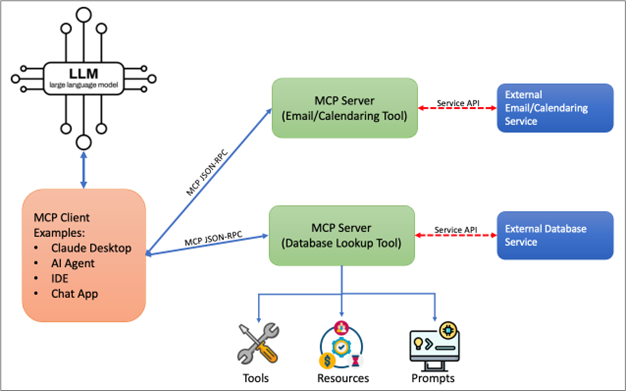
The Model Context Protocol (MCP) is a proposed open standard that provides a two-way connection for AI-LLM applications to interact directly with external data sources. It is developed by Anthropic and aims to simplify AI integrations by reducing the need for custom code for each new system. MCP provides the glue that allows an AI model to interact with external data rather than being isolated or trapped in its own bubble. In this way, MCP servers act as a proxy between an LLM and the external real-world data sources.

MCP is a client-server architecture whereby the AI application acts as a client and MCP servers deliver external service data back to the application. The protocol uses a structured JSON-RPC format to define how AI clients request capabilities and the MCP servers provide capabilities, usually in the form of software functions that can be executed.

An example use case might be vacation or trip planning. There might be one or more MCP servers dedicated to working with your calendar, email, and perhaps even performing hotel and flight booking. The AI can make client requests of these various servers based on their advertised capability during the trip planning process.
MCP Architecture

Anthropic has a dedicated repository with software development kits for multiple languages which you can find here at https://github.com/modelcontextprotocol. Language support is extensive including Typescript, Java, Python, C#, PHP, Ruby, Golang, Rust and more. Extensive documentation about MCP is published here at https://modelcontextprotocol.io.

MCP servers provide functionality through three primary building blocks.

  • Tools are software functions that an LLM can directly call to gain access to external resource data. Tools could, for example, directly interact with a database or use another API to gain access to other service-related data. Tools provide the most powerful functionality to the LLM.
  • Resources are passive data sources that can provide read only access to data for context. A resource might provide some file contents, or a database schema, or perhaps some form of documentation.
  • Prompts are pre-built instruction templates that tell the model how to work with specific tools and resources.

Unfortunately, MCP was designed with functionality front of mind without addressing information security at all. Being a very open and easy-to-use specification leaves implementations vulnerable to multiple risks and attack vectors. Furthermore, it is common knowledge that developers are under pressure to enable business functionality, with security measures often taking a back seat.

It is critically important that we keep the context of these technologies in mind. AI-LLMs are by nature a probabilistic technology. The transformer generative decoder architecture produces a probabilistic distribution for next token (often “next word”) prediction but will not typically produce the same result given the same repeated prompting.

In the MCP context, we are connecting a probabilistic generative language technology to deterministic tools to take direct actions. There is already a degree of unpredictability introduced, even before the LLM makes choices as to what MCP tool to use, and what parameters to supply.

The next challenge with MCP is that trust is typically assumed but not enforced. Due to the unpredictability of the input, it is even more critical that MCP servers be implemented with strict security controls. MCP is a trust boundary because MCP directly allows AI models to:

  • Discover tools via machine readable manifests.
  • Gain an understanding of how to use the tool via a natural language description.
  • Directly execute/trigger a tool by inferring required parameters from a user prompt.
  • Chain tool output together to trigger further actions.

This entire mix of capability leads to multiple potential avenues of attack.

Attack Scenarios and Impacts

Some possible attack scenarios and impacts include things like:

Credential/Account Impersonation and Theft

MCP servers are likely going to have items like OAuth tokens, API keys, and/or other service credentials to enable access to upstream services. This could be anything from Google account credentials, Slack credentials, or cloud storage credentials for example. It is not unusual to see developers hard code credentials directly into scripts, and/or AI prompt templates risking exposure.

Stored Prompt Injection / Tool Poisoning

MCP servers are often implemented to blindly execute an action without checking input leading to successful O/S command injection, SQL injection, and execution of any other input against any third-party API that the MCP server is leveraging. Making this worse, it is entirely feasible that the AI-LLM is fetching its prompt from something like a helpdesk ticketing system leading to a situation not dissimilar in nature from stored Cross Site Scripting (XSS). In this sort of scenario, one description is “stored prompt injection” although the ramifications go far before the prompt itself that is stored.

Overprivileged MCP Tools / Excessive Capability

MCP tools by design need access to external data sources, however, there are no specific role-based access controls defined in the standard. This leaves access controls in the hands of the developer. It is not unusual to find that overprivileged tokens are used for service access, or that no controls are implemented around an operating system command execution.

Lack of Logging and Visibility

Many of the tools being written today are based upon the example/reference code from Anthropic’s GitHub repository. These examples are not production-ready code. It is the responsibility of tool designers and developers to ensure that logging controls are implemented in all MCP tools. Any actions taken by the LLM in querying and controlling an MCP tool should be clearly logged, making sure that careful choices are made to avoid logging sensitive data.

Denial of Service and Billing Abuse / Denial of Wallet

Through prompting, it is feasible that an MCP tool continuously loops and consumes resources of a third-party service in the process. If there are no billing quotas and/or rate limits imposed in the implementation, this will lead to excessive usage and the associated billing with that third-party service.

MCP Architecture

Many tool implementations are written to interact with calendaring and email solutions as these are attractive services to integrate in a workflow. It is not unusual for there to exist multiple different MCP tool resources in a sort of ecosystem. Thus, it is not hard to imagine a scenario whereby sensitive data is sourced from one tool that perhaps does database lookups, and then exfiltrated via an MCP email service tool, for example.

Some Risk Mitigation Guidelines

When developing an internal MCP tool, consider the following guidelines.

  • Use standard input/output (STDIO) for transport of data for local MCP tools rather than a network socket. If your design requires you to use a network socket, consider using a Unix domain socket for inter-process communications, or bind the network socket only to 127.0.0.1.
  • Because an MCP tool represents a trust boundary, ensure that you validate and properly sanitize all external inputs. This would include data used in prompt construction, API requests, file system access requests, network requests, and any O/S shell command data.
  • Implement file system restrictions limiting the tool to only specific directories and files.
  • Implement logging being careful to avoid logging any sensitive data such as authorization tokens or API keys.
  • Implement clearly defined access controls on all tool functions and external API calls to ensure that only authorized actions are permitted.
  • Validate the source of data that your MCP agent/tool is receiving to avoid the potential for data source poisoning.
  • Use an external keys and secrets management solution for accessing any authorization secrets, tokens, and API keys.
  • Implement service rate limiting or throttling for any external API calls.

There is a growing ecosystem of tools and community driven projects for assisting in MCP risk mitigation. Here are some examples.

MCPSafetyScanner

MCPSafetyScanner is an open-source tool by the AI Assurance Lab (https://github.com/johnhalloran321/mcpSafetyScanner) that simulates attacker behavior against MCP tool manifests. This tool does the following:

  • Scans tool descriptions for potential prompt injection vectors.
  • Flags unsafe schemas and overly permissive parameters.
  • Detects uncontrolled inputs.

MCP Guardian

MCP Guardian is a security and governance layer that provides visibility and control over how LLMs interact with external tools. It can enforce:

  • OAuth2-based authentication and scope filtering
  • Rate limits and quotas per tool use
  • Schema and parameter validation
  • Logging and telemetry for forensics purposes

MCP Guardian aims to ensure that all MCP tool invocations meet your security policy criteria before execution. In essence, it is a proxy between your MCP clients and the implemented MCP tools/servers.

MCP-Scan

MCP-Scan by Invariant Labs does both static code scanning and runtime proxy enforcement. The static analysis functionality works for local MCP configurations for clients like Claude, Cursor and Windsurf. This can identify prompt injection risks, tool poisoning attacks, and “rug pull” manipulation via hash mismatch or manifest change. The runtime proxy has PII detection, custom rules, secrets blocking, and tool usage policy protection.

MCP Authorization Specification (RFC-9728)

Naturally performing code analysis and implementing runtime proxy-style protections are a good thing, but ultimately authorization controls are required to properly define trust boundaries. The MCP Authorization specification provides a structured method to provide OAuth2-based access control for tool invocation. This helps enforce least privileges, user specific scopes, and multi-tenant separation. Some features are as follows:

  • Protected Resource Metadata (PRM) is a well-known “prm.json” file that declares supported scopes, authorization methods, token introspection, and audience rules.
  • Role separation allows the resource server that exposes tools and the authorization server to be fully decoupled.
  • The specification is interoperable with all standards compliant OAuth 2.1 providers such as Auth0, Descope, AWS Cognito, and Microsoft Entra ID.

Bottom line is that the authorization specification allows you to enforce principles of least privilege.

This is just a brief view of Model Context Protocol and the related challenges. As with all things in the world of AI, at present, we are sure to see rapid change and evolution as adoption continues. As cyber security practitioners, let’s hope that significantly more attention is paid to security and risk mitigation as this aspect of the AI ecosystem evolves further.

References:


Want to keep learning from Joff? Register now for next week’s webcast taking place Thursday, 10/30, at 1:00 PM EDT:

AI Agents and MCP Security Risks