








June 16, 2026
On reclaiming America’s edge in research and public health
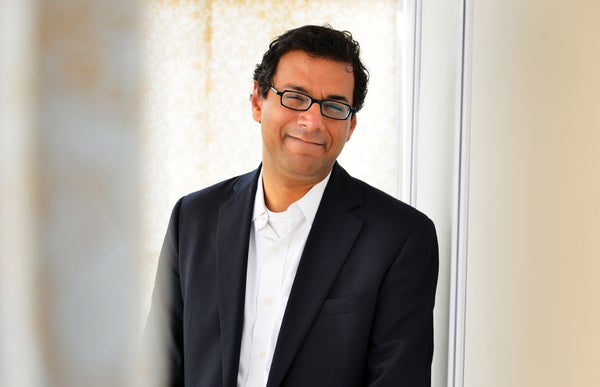
Priyanka Parashar/Mint/Getty Images
Atul Gawande is a surgeon, author and public health expert. He holds the Cynthia and John F. Fish Distinguished Chair in Surgery at Brigham and Women’s Hospital and is Samuel O. Thier Professor of the Practice of Surgery at Harvard Medical School. He previously served as assistant administrator for global health at the U.S. Agency for International Development (USAID) and as co-founder and chair of Ariadne Labs, a joint center for health-systems innovation at Brigham and Women’s and the Harvard T. H. Chan School of Public Health. Gawande has written four best-selling books: Complications (2002), Better (2007), The Checklist Manifesto (2009) and Being Mortal (2014).
An edited transcript of the interview follows.
How would you describe the current state of American science?
If you're enjoying this article, consider supporting our award-winning journalism by subscribing. By purchasing a subscription you are helping to ensure the future of impactful stories about the discoveries and ideas shaping our world today.
Oh, it’s tough. We start out with an amazing base that’s been built up over decades. It’s the talent, it’s the resources, it’s the openness to the world and our brand. We’re recognized as the place to go if you want to do cutting-edge science, make discoveries and make a difference.
But the past year has been gutting. It’s not just the cuts, it’s the weakening of core institutions such as the National Institutes of Health and the National Science Foundation and then the places that deploy discoveries, such as the Centers for Disease Control and Prevention and USAID.
What needs to change in American science?
There are short-term matters that need to change. There’s funding that has been restored to parts of the enterprise but not to important parts of our machine for creating innovation and discovery and new ideas, then turning them into scalable solutions and bringing them to the world.
The larger thing, I’d say, is that we have been losing ground for quite a while in our commitment to research and development and then accelerating the pace at which new discovery moves out into the world. All of that is in a much weaker place than half a century ago. This was a much larger part of our investment in our economy, our investment of federal budgets, and that is a prioritization that we need to return to, or we will erode the kind of leadership that we were providing in the world.
What gives you optimism right now?
The reality is that the demand for people who will bring hard-nosed careful science and the spirit of curiosity, inquiry and problem-solving is there. It’s present in our technology sector in many ways, where the U.S. is driving leadership in the world.
There’s a lot we can bring to the world in solving problems, from finishing the job on polio, HIV, tuberculosis and malaria to advancing our public health systems and primary care systems.
What’s your best advice for an early-career scientist?
I feel for young people in science right now because the hardest-hit positions were the entry-level positions. If you are a young scientist looking to get a scholarship to advance your education, if you are trying to get a position in a laboratory, to get training grants, to be given a chance to learn and experiment, that’s become harder than it ever was. But I ask people not to now decide, “Oh, I’ll go into finance.” Please don’t!
Make a bet on yourself and the fact that you can expect to live a long life. There will be crises that come and go, but the steady need and opportunity is that you, as a young person, will be able to make contributions over the course of your life by applying science to problems.
How has your field changed in the past few years?
My fields are public health, surgery and health-care delivery in the U.S. And what I’d say is, over the past few years, these are spaces where we did not normally think of bringing molecular science and population health science and implementing innovation. But we’re getting dramatic results when we do.
Understanding how to create better systems and ways for teams to collaborate can have extraordinary results. We’ve cut the death rate for surgery by more than a third with some simple changes, including a checklist that has people working together more effectively. And this is happening across many other sectors as we think about how we bring the complexity of an enormous amount of capability into primary care, into childbirth, and beyond.
If you enjoyed this article, I’d like to ask for your support. Scientific American has served as an advocate for science and industry for 180 years, and right now may be the most critical moment in that two-century history.
I’ve been a Scientific American subscriber since I was 12 years old, and it helped shape the way I look at the world. SciAm always educates and delights me, and inspires a sense of awe for our vast, beautiful universe. I hope it does that for you, too.
If you subscribe to Scientific American, you help ensure that our coverage is centered on meaningful research and discovery; that we have the resources to report on the decisions that threaten labs across the U.S.; and that we support both budding and working scientists at a time when the value of science itself too often goes unrecognized.
In return, you get essential news, captivating podcasts, brilliant infographics, can't-miss newsletters, must-watch videos, challenging games, and the science world's best writing and reporting. You can even gift someone a subscription.
There has never been a more important time for us to stand up and show why science matters. I hope you’ll support us in that mission.
此内容由惯性聚合(RSS阅读器)自动聚合整理,仅供阅读参考。 原文来自 — 版权归原作者所有。