


One in four abortions in the U.S. rely on telehealth access to mifepristone, but antiabortion activists want to ban it
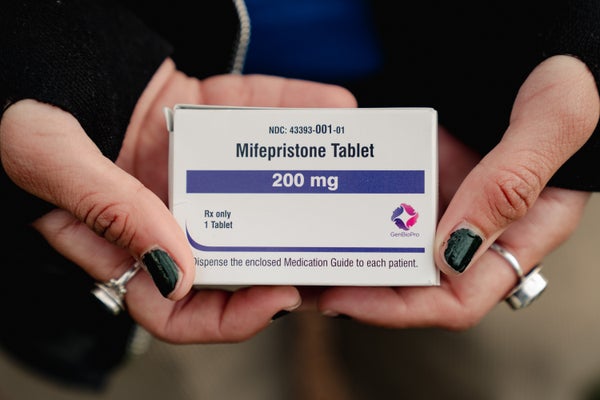
Shuran Huang for The Washington Post via Getty Images
After a tense few weeks during which U.S. courts twice revoked and reinstated telehealth access to the abortion pill mifepristone, the drug remains available without an in-office appointment—for now. But doctors and policy experts worry that uncertainty and any future rollback in access will make things harder for people seeking to end a pregnancy and place added pressure on the health care system.
Since 2022, when the Supreme Court’s ruling in Dobbs v. Jackson Women’s Health Organization overturned the right to abortion enshrined in Roe v. Wade, antiabortion proponents have focused on mifepristone. They claim, despite a wealth of evidence to the contrary, that the drug is unsafe. First approved in the U.S. in 2000, mifepristone is currently used here in combination with the drug misoprostol up to 10 weeks into a pregnancy.
Overwhelming scientific evidence shows that mifepristone is safe and effective, whether the drug is dispensed via telehealth or at an in-person doctor’s visit. “It is incredibly safe; it is one of the most well-studied drugs in reproductive health care,” says Tejasvi Gowda, an obstetrician-gynecologist in Maryland who is also a fellow at Physicians for Reproductive Health, a nonprofit advocacy group. Just more than a quarter of all U.S. abortions currently rely on mifepristone that is prescribed virtually. If the telehealth option is taken away, providers and patients will face tough choices, experts say. In-person care will be much harder to access for some people and inconvenient for the rest. Other patients and providers will likely switch to misoprostol-only abortion, a regimen used before mifepristone’s approval in 2000 that is still safe and effective but could cause more complications than the combination regimen.
If you're enjoying this article, consider supporting our award-winning journalism by subscribing. By purchasing a subscription you are helping to ensure the future of impactful stories about the discoveries and ideas shaping our world today.
Before the start of the COVID pandemic, the U.S. Food and Drug Administration mandated that providers could only prescribe mifepristone after an in-person appointment. That requirement was tied to the FDA’s Risk Evaluation and Mitigation Strategy (REMS) program, which is usually applied only to medications with unusual safety concerns. Mifepristone’s REMS restrictions “have always been political,” says Amy Friedrich-Karnik, director of federal policy at the Guttmacher Institute, a research and policy organization that supports reproductive health and rights. “It was never about the safety and efficacy of the drug.”
But when the COVID pandemic shattered normal health care operations, the FDA temporarily removed that in-person requirement; the change was made permanent in 2023. At that time, Ushma Upadhyay, a public health scientist at the University of California, San Francisco, began studying the safety and efficacy of telehealth abortion medication, eventually gathering data from more than 6,000 patients. Of those individuals, 98 percent needed no additional care for their abortion. Only 0.25 percent (15 people) had a serious complication, such as needing a blood transfusion or hospital stay; no deaths were reported. Today an appointment for a medication abortion unfolds in the same way, whether it’s in person or online.
Without the telehealth option, some people will struggle to be able to attend an appointment. In addition, telehealth medication is the only safe abortion access for many people who live in states that ban or restrict abortion and can’t travel out of state. Since the fall of Roe v. Wade in 2022, 13 states have placed essentially a total ban on abortion, while four others have banned almost all abortions starting at six weeks of gestation.
And misoprostol-only prescriptions could make abortions slightly more complicated. “The majority of side effects from medication abortion happen because of the misoprostol,” says Rachel Jensen, an ob-gyn and fellow at the American College of Obstetricians and Gynecologists (ACOG). When used without mifepristone, a higher dose of misoprostol must be used. It simply is not considered “standard of care” in modern medicine, she and Gowda both emphasize.
The switch could also create new burdens on the health care system, Upadhyay says. Although providers used misoprostol on its own before mifepristone was approved, “it will be new to many providers,” and they will need to update their protocols, she notes. She also worries that providers will need longer to teach patients how to manage the process and that more patients may end up choosing to visit an urgent care or emergency room to ensure their bleeding is normal.
Although mifepristone access currently remains intact, Upadhyay says she’s worried that the chaos in headlines is already affecting abortion access. “There’s fear, and I think that this fear is causing providers to be ultraconservative, even though there’s nothing being enforced right now,” she says.
Experts know the latest ruling is only a temporary reprieve. “The [Supreme] Court, sooner or later, is going to weigh in on mifepristone,” says Mary Ziegler, a professor of law at the University of California, Davis, and an expert on the history of abortion policy. Furthermore, the FDA is conducting its own review of mifepristone’s safety, a process that experts fear will rely on junk science to declare the pill unsafe.
Ob-gyns and reproductive rights advocates say they will respond to whatever unfolds. “We’re used to facing those barriers and are ready to do what we need to do to be able to take care of patients in safe and legal ways,” Jensen says.
Gowda agrees. “People will always find a way to get abortion care,” she says, “and we will always be there to help them.”
If you enjoyed this article, I’d like to ask for your support. Scientific American has served as an advocate for science and industry for 180 years, and right now may be the most critical moment in that two-century history.
I’ve been a Scientific American subscriber since I was 12 years old, and it helped shape the way I look at the world. SciAm always educates and delights me, and inspires a sense of awe for our vast, beautiful universe. I hope it does that for you, too.
If you subscribe to Scientific American, you help ensure that our coverage is centered on meaningful research and discovery; that we have the resources to report on the decisions that threaten labs across the U.S.; and that we support both budding and working scientists at a time when the value of science itself too often goes unrecognized.
In return, you get essential news, captivating podcasts, brilliant infographics, can't-miss newsletters, must-watch videos, challenging games, and the science world's best writing and reporting. You can even gift someone a subscription.
There has never been a more important time for us to stand up and show why science matters. I hope you’ll support us in that mission.
此内容由惯性聚合(RSS阅读器)自动聚合整理,仅供阅读参考。 原文来自 — 版权归原作者所有。