






Smog from wildfires is getting worse across much of the U.S., according to a NASA-funded study
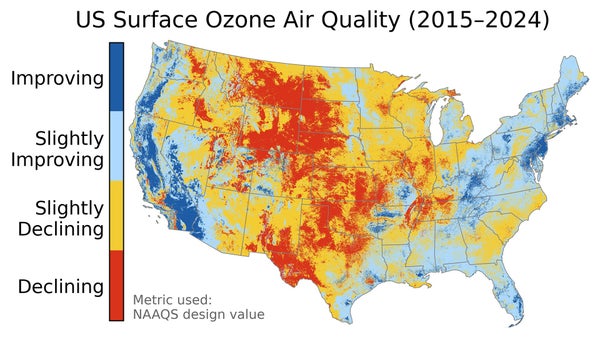
Surface ozone levels in the U.S. have increased by 0.13 part per billion (ppb) annually between 2015 and 2024, researchers calculated in a new study.
Jun Wang lab, University of Iowa
Smog linked to wildfires is getting worse across much of the U.S., playing a role in more than 300 additional premature deaths every year since 2013, researchers say.
The main ingredient in smog is ozone, which is a gas molecule made of three oxygen atoms that, depending on where it forms, can be either helpful or harmful. In the layer of the upper atmosphere called the stratosphere, the gas creates a protective layer that shields Earthlings from harmful ultraviolet rays. But ozone is dangerous when inhaled. So on the ground, the gas can lead to respiratory issues, particularly in people with asthma or other breathing conditions.
This ground-level ozone can form when carbon monoxide gas emitted by wildfires chemically reacts with nitrogen oxides in the presence of sunlight. Wildfires have been on the rise because of climate change, according to NASA. To get a full picture of the effect of this recent increase in wildfire frequency and intensity, a team of researchers fed surface ozone levels and premature death data into a deep-learning model.
If you're enjoying this article, consider supporting our award-winning journalism by subscribing. By purchasing a subscription you are helping to ensure the future of impactful stories about the discoveries and ideas shaping our world today.
The new analysis, funded by NASA, showed that, between 2003 and 2015, ground-level ozone decreased, likely resulting from tightened controls on ozone-forming chemicals released by human activity, such as car tailpipe emissions, the scientists said. Those gains were reversed between 2015 and 2024, when, the model showed, ozone levels increased, particularly in the Midwest and parts of the western U.S.
By looking at different scenarios in their model, the researchers found that, without the addition of wildfires, surface ozone in the Midwest would have continued its downturn after 2015.
The effects of wildfire smoke can spread far and wide, as anyone living in the northeastern or midwestern U.S. in the summer of 2023 knows. Wildfires blazing in Canada that summer clogged the air with smoke and turned the skies an orange hue in both U.S. regions. That fire season, the study showed, exposed 148 million Americans to surface ozone levels above the standards considered safe by the U.S. Environmental Protection Agency. Midwesterners experienced the unsafe levels for more than a week.
“People in the Midwest may think fires burning far away will not affect them,” said study co-author Jun Wang, an atmospheric scientist at the University of Iowa, in a NASA statement. “But once wildfire pollution is in the air, it can move across regions.”
The resulting smog was linked to 7,974 premature deaths in the U.S. in 2023 alone, the researchers calculated.
“These results underscore the escalating public health burden of wildfire-driven [ozone] pollution,” the researchers wrote in their study, which was published online on June 4 in the journal Science.
If you enjoyed this article, I’d like to ask for your support. Scientific American has served as an advocate for science and industry for 180 years, and right now may be the most critical moment in that two-century history.
I’ve been a Scientific American subscriber since I was 12 years old, and it helped shape the way I look at the world. SciAm always educates and delights me, and inspires a sense of awe for our vast, beautiful universe. I hope it does that for you, too.
If you subscribe to Scientific American, you help ensure that our coverage is centered on meaningful research and discovery; that we have the resources to report on the decisions that threaten labs across the U.S.; and that we support both budding and working scientists at a time when the value of science itself too often goes unrecognized.
In return, you get essential news, captivating podcasts, brilliant infographics, can't-miss newsletters, must-watch videos, challenging games, and the science world's best writing and reporting. You can even gift someone a subscription.
There has never been a more important time for us to stand up and show why science matters. I hope you’ll support us in that mission.
此内容由惯性聚合(RSS阅读器)自动聚合整理,仅供阅读参考。 原文来自 — 版权归原作者所有。