

惯性聚合 高效追踪和阅读你感兴趣的博客、新闻、科技资讯
阅读原文 在惯性聚合中打开

推荐订阅源

雷峰网
雷峰网
Security Archives - TechRepublic
奇客Solidot–传递最新科技情报
奇客Solidot–传递最新科技情报
OSCHINA 社区最新新闻
OSCHINA 社区最新新闻
Last Week in AI
Last Week in AI
博客园 - 司徒正美
阮一峰的网络日志
阮一峰的网络日志
WordPress大学
WordPress大学
爱范儿
爱范儿
J
Java Code Geeks
T
Tailwind CSS Blog
Apple Machine Learning Research
人人都是产品经理
人人都是产品经理
宝玉的分享
宝玉的分享
博客园 - 【当耐特】
Exploit-DB.com RSS Feed
Help Net Security
Help Net Security
Hacker News: Ask HN
Hacker News: Ask HN
月光博客
月光博客
S
Secure Thoughts
freeCodeCamp Programming Tutorials: Python, JavaScript, Git & More
K
KPMG report finds enterprise disconnect between AI and its ROI | CIO
博客园 - 聂微东
Hugging Face - Blog
Hugging Face - Blog
V
Visual Studio Blog
博客园 - 三生石上(FineUI控件)
O
OpenAI News
酷 壳 – CoolShell
酷 壳 – CoolShell
N
News and Events Feed by Topic
腾讯CDC
让小产品的独立变现更简单 - ezindie.com
cs.AI updates on arXiv.org
Webroot Blog
Webroot Blog
博客园 - Franky
有赞技术团队
有赞技术团队
美团技术团队
Jina AI
Jina AI
S
Security @ Cisco Blogs
博客园 - 叶小钗
钛媒体:引领未来商业与生活新知
钛媒体:引领未来商业与生活新知
博客园_首页
C
CERT Recently Published Vulnerability Notes
T
Threat Research - Cisco Blogs
Project Zero
Project Zero
A
Arctic Wolf
大猫的无限游戏
大猫的无限游戏
Latest news
Latest news
小众软件
小众软件
IT之家
IT之家
S
Security Affairs

Scientific American

Former deputy surgeon general Erica Schwartz nominated as new CDC chief NASA Artemis II astronauts say thank you to the world Congress grills RFK, Jr., about vaccines and cuts to health budget How the Grand Canyon formed is a surprisingly messy story. Here's the latest clue How far from humanity were the astronauts of Artemis II? The answer will surprise you Effect of antiamyloid Alzheimer’s drugs ‘absent or trivial,’ Cochrane review finds The Trump administration is looking to experts to weigh in on peptides When a naked mole rat queen dies, that usually means war—but not for this colony NASA needs nuclear power for its moon base. Here’s the White House plan to get it Why do older people have fewer seasonal allergies? 250-million-year-old fossil proves mammal ancestors laid eggs A face-swapping illusion can unlock childhood memories 30 years of Pokémon—how the Japanese franchise mirrors real-world science Sperm whales may make their own vowel sounds, similar to human language Colombia will euthanize Pablo Escobar’s invasive ‘cocaine hippos’ NASA’s Artemis III will pit SpaceX against Blue Origin The East Coast could see blazing hot temperatures this week. Here’s why Scientists just discovered 5.6 million bees under a New York State cemetery The real science of Pokémon How chemists engineer the signature smells of luxury perfumes How two mathematicians solved a cryptography mystery The engineering marvels hidden inside six-figure watches Expensive versus affordable binoculars—what’s the difference? How physicists found a new type of magnet hiding in plain sight A hot pair of supplements, creatine and methylene blue dye, may not work together Unlikely paths to discovery The baffling ecological disaster that's killing America’s freshwater mussels Poem: ‘How I Became a Spitfire Pilot during My Cataract Operation’ DARPA built an AI to fact-check enemy weapons claims Mathematicians created an ‘impossible’ shape that shouldn’t exist How cosmic rays are helping mining companies find critical minerals underground New evidence links heart disease to inflammation—and drugs can stop it An asteroid extinguished all the dinosaurs except for birds. Here’s why Math Puzzle: A disassembly job May 2026: Science History from 50, 100 and 150 Years Ago Readers respond to the January 2026 issue How to build a space hotel The humble ham sandwich inspired a math theorem for sharing food fairly Imperiled ‘cloud jaguar’ spotted in Honduran mountains for the first time in a decade Person functionally cured of HIV after bone marrow transplant from sibling Dream Chaser space plane faces uncertain future in NASA’s push for the moon Bizarre ‘compleximers’ break the rules of both glass and plastic This method to reverse cellular aging is about to be tested in humans The Artemis II mission worked—but should we really keep returning to the moon? How DNA forensics is transforming studies of ancient manuscripts Beetle larvae mimic flower scents to attract bee hosts See NASA’s Artemis II mission around the moon in 12 stunning photos New study shows how the brain weighs evidence to make decisions What NASA’s Artemis II tells us about the ‘overview effect,’ moon joy and awe New metal with triple copper’s heat conduction challenges fundamental physics NASA’s Artemis II reveals why humans still love the moon NASA’s Artemis II moon mission splashes down The Expanse authors James S. A. Corey explore alien war in new book The Faith of Beasts New particle mass measurement deepens quantum mystery NASA’s Artemis II crew returns today—here’s what to know ahead of splashdown Why bombing Iran’s nuclear power plant could cause an environmental disaster Mysterious heart neurons maintain blood pressure to prevent fainting NASA’s Dragonfly mission will send a nuclear-powered flying drone to Titan This sci‑fi twist on Moby-Dick will blow your mind Medieval aurora poetry provided clues to historic solar storms White House budget puts 54 NASA science missions on the chopping block NASA’s Artemis II moon mission is on track for Friday splashdown Timeline of the Artemis II moon mission’s return to Earth Why can’t humans regenerate limbs? New research offers a clue How the wildlife trade boosts the chance of a disease jumping from animals to humans Two hundred chimpanzees are embroiled in a ‘civil war’ NASA’s Artemis II moon mission preps for its last full day in space How China could still win the new moon race Lyme disease is spreading, but a new vaccine could curb infections No, Shroud of Turin DNA analysis doesn't show relic's origins, experts say What’s the deal with the Artemis II music? The crew finally gave us some answers The world’s deepest sensors will detect earthquakes around the world from far below Antarctica Why Artemis II’s reentry may be the moon mission’s greatest challenge yet NASA’s Artemis II moon mission is focusing on its return to Earth What is the quantum ‘Ghost Murmur’ purportedly used in Iran? Scientists question CIA’s claim of long-range heartbeat detection How well GLP-1 weight loss drugs work may depend on your genetics NASA’s Artemis moon missions are a game changer for astronomy Tracking Artemis II—after its historic lunar flyby, NASA’s moon mission heads home NASA’s Artemis program has sparked a race to land U.S. rovers on the moon Do people see robots as having race? New studies clash as humanoids enter the real world Health experts warn of rising measles cases in undervaccinated communities In a first, Artemis II moon mission astronauts make ‘ship to ship’ call to ISS The mathematically correct way to slice a pizza See NASA’s Artemis II mission’s first incredible photos of the moon, Earth and a total solar eclipse In an echo of Apollo 8, NASA’s Artemis II astronauts witness stunning ‘Earthrise’ and ‘Earthset’ NASA’s Artemis II astronauts celebrate epic lunar flyby with stunning new images NASA’s Artemis era may finally solve three major moon mysteries NASA’s Artemis II ‘free return’ trajectory lets gravity do the driving Trump speaks with NASA's Artemis II astronauts after historic moon flyby NASA’s Artemis II crew experience total solar eclipse from space NASA’s Artemis II moon mission reaches greatest distance from Earth NASA’s Artemis II astronauts break Apollo’s distance record Watch live—NASA’s Artemis II’s moon flyby is underway Bypass the Strait of Hormuz with nuclear explosives? The U.S. studied that option in the 1960s NASA’s Artemis II mission is about to pass behind the moon NASA’s Artemis II, endangered species and oil, low western U.S. snowpack Where is Artemis II? NASA astronauts near the moon for first time in more than 50 years NASA’s Artemis II laser communications system is beaming 4K video from the moon NASA’s Artemis II moon mission is gearing up for its lunar flyby What will NASA’s Artemis II astronauts see on the moon?
What happened after the fall of Rome? Ancient genomes offer new clues
Emma Gometz · 2026-04-30 · via Scientific American

April 29, 2026

2 min read

Google Logo Add Us On GoogleAdd SciAm

A genomic analysis of people buried on the border of the ancient Roman Empire show how distinct groups combined after the empire’s fall
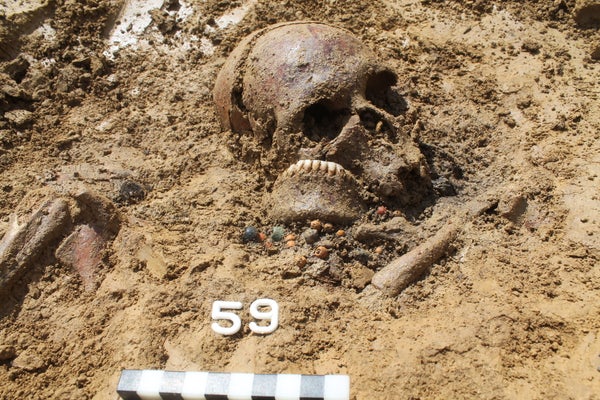
A human skull half buried in the ground.

The skull of an early medieval woman, still resting in her grave and adorned with a necklace of beads.

© Kreisarchäologie Landshut/Richter

When the Western Roman Empire fell in the fifth century C.E., Europe was plunged into chaos as barbarian Germanic forces advanced south—or so the story goes. But a new study shows that some communities on the continent actually coalesced, becoming more cosmopolitan and diverse.

“Traditionally, the whole story ... was seen as a clash of civilizations between Germanic hordes in the north and the Roman Empire in the south,” says Joachim Burger, an anthropologist and a population geneticist at Johannes Gutenberg University Mainz in Germany. But Burger and his colleagues have shown otherwise: in a new study published today in Nature, they found that “it’s actually more a story of peaceful integration,” he says.

The researchers analyzed human remains at various grave sites in Germany and determined that two genetically distinct groups of people—a settlement of ancient Roman soldiers and a neighboring group of people of northern European descent—intermarried and developed a shared culture, including a common burial method, after the fall of Rome in C.E. 476.


On supporting science journalism

If you're enjoying this article, consider supporting our award-winning journalism by subscribing. By purchasing a subscription you are helping to ensure the future of impactful stories about the discoveries and ideas shaping our world today.


The researchers analyzed 258 ancient genomes collected from grave sites on the Roman Empire’s border in what is now southern Germany that dated to between C.E. 400 and 660. They compared these with a reference set of other ancient and modern genomes and revealed that former Roman soldiers, who carried with them a mix of DNA from Italy, southeastern Europe and the Balkans, traveled to villages on the empire’s frontier where people with DNA from areas such as what are now northern Germany, Denmark and the Netherlands lived. The oldest genomes from the burial sites suggest that these two groups didn’t mix much before the fall of Rome. But after that time, they did, with intermixed families being buried together.
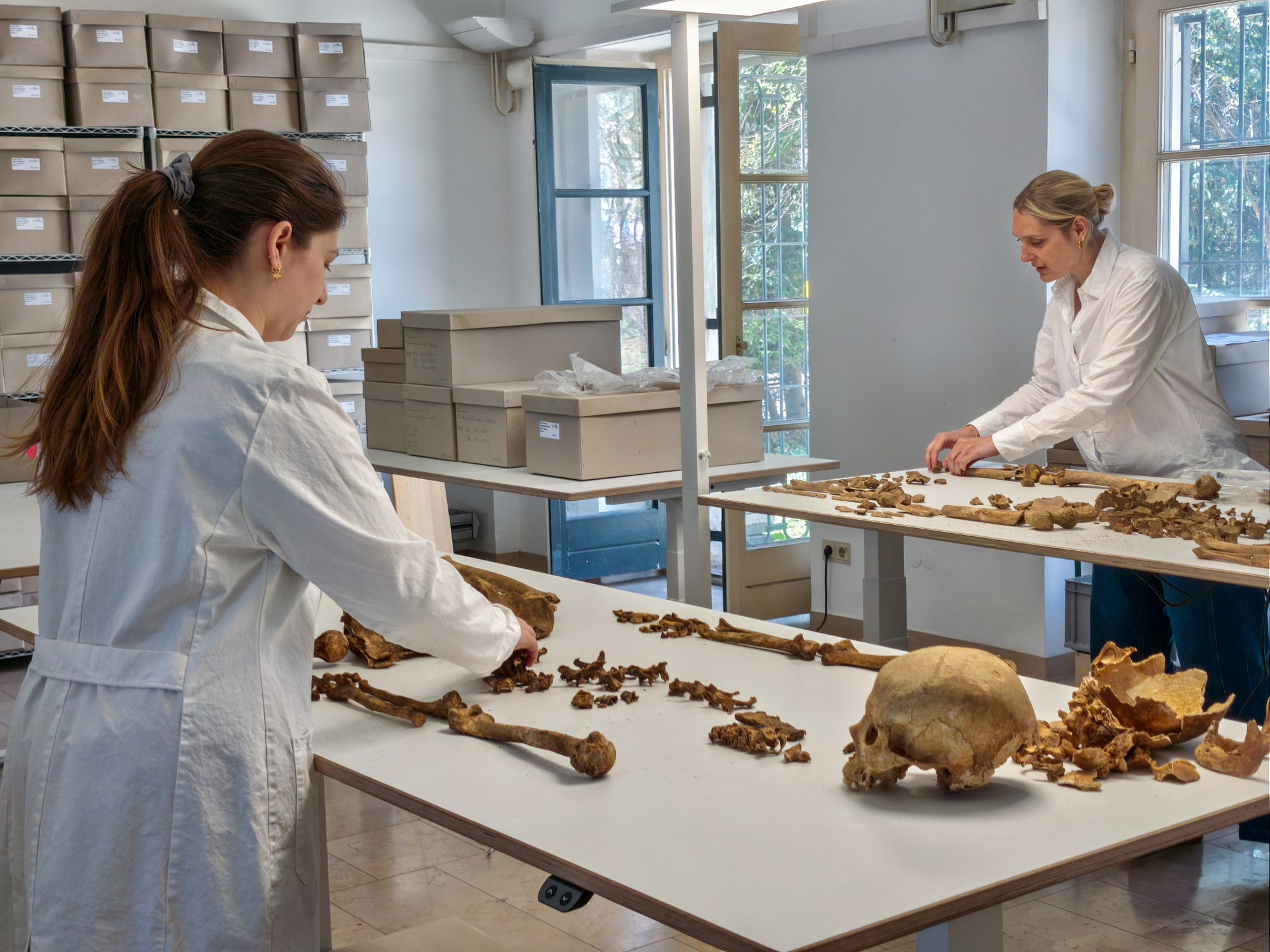
Two people in lab coats organizing unearthed human skeletons on a table

Anthropological examination of skeletons in the State Collection for Anthropology Munich (SAM).

© SAM/Harbeck

These later burials are called row-grave cemeteries because the graves were perfectly parallel to one another. This practice started among communities with northern ancestry but became the norm after the two communities came together. The grave sites also include features that suggest a strong emphasis on monogamy and the nuclear family. And the researchers say these practices, such as kin being entombed together, likely came from Roman culture.

“At the time, this is a quite unique and new pattern that was developed in late Roman society and even codified in laws,” Burger says. “But now we see it ... in an early medieval, presumably Germanic society. So late antiquity isn’t actually finished; it’s just transforming into a new, less urban and more agricultural society.”

“It was really a tight kin group,” says Toomas Kivisild, a professor of human evolutionary genetics at the Catholic University of Leuven (KU Leuven) in Belgium, who was not involved in the study. Other post-Roman communities in Europe, such as in England, do not show such closeness among families, he says. “The kinship intensity in those cemeteries is far less intense compared to [these new findings].”

It’s Time to Stand Up for Science

If you enjoyed this article, I’d like to ask for your support. Scientific American has served as an advocate for science and industry for 180 years, and right now may be the most critical moment in that two-century history.

I’ve been a Scientific American subscriber since I was 12 years old, and it helped shape the way I look at the world. SciAm always educates and delights me, and inspires a sense of awe for our vast, beautiful universe. I hope it does that for you, too.

If you subscribe to Scientific American, you help ensure that our coverage is centered on meaningful research and discovery; that we have the resources to report on the decisions that threaten labs across the U.S.; and that we support both budding and working scientists at a time when the value of science itself too often goes unrecognized.

In return, you get essential news, captivating podcasts, brilliant infographics, can't-miss newsletters, must-watch videos, challenging games, and the science world's best writing and reporting. You can even gift someone a subscription.

There has never been a more important time for us to stand up and show why science matters. I hope you’ll support us in that mission.