






June 16, 2026
The machine-learning guru discusses how politics is undermining U.S. science
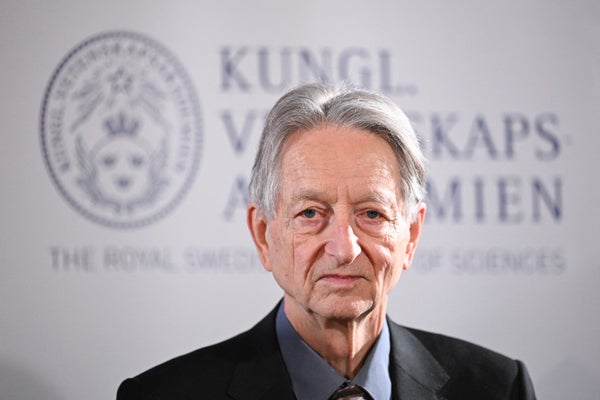
Jonathan Nackstrand/AFP via Getty Images
Join Our Community of Science Lovers!
Geoffrey Hinton is a British‑Canadian computer scientist and cognitive psychologist known for pioneering artificial neural networks and deep learning. A professor at the University of Toronto, he shared the 2024 Nobel Prize in Physics for foundational work enabling modern machine learning.
[This interview was edited for length and clarity.]
How would you describe the current state of American science?
On supporting science journalism
If you're enjoying this article, consider supporting our award-winning journalism by subscribing. By purchasing a subscription you are helping to ensure the future of impactful stories about the discoveries and ideas shaping our world today.
I would say it is in a dire state because Trump is doing everything he can to undermine it.
America is still very good at innovation, but as it loses more and more of its leading scientists, it’s getting worse. The source of really revolutionary innovations is typically graduate students working in a well-informed group at a leading university, and that is exactly what the Trump government is undercutting by making it much harder and less attractive for foreign graduate students to come here and attacking the leading universities.
What needs to change in American science?
They need to stop attacking the major universities. They need to stop preventing scientists from other countries coming and working in the U.S. A lot of the U.S. advantage in science and technology has been because of immigrant scientists. They need to restore all the grants that they’ve cut off after [those grants] were awarded. And they need to stop, for political reasons, espousing views that are known to be wrong on things such as climate change, vaccines and the role of basic science. So all of the advances we’ve had, all of the major advances in our civilization, are to do with scientific advances, which only happen when you have institutions that protect scientific freedom and you get the best scientists.
What gives you optimism right now?
The midterms.
What’s your best advice for an early-career scientist?
That depends on whether they’re an American citizen. If they’re not an American citizen, I would advise them to be very cautious about working in the U.S.
How has your field changed in the past few years?
Artificial intelligence has changed a whole lot in the past few years because people have started really becoming aware of the extraordinary progress and the extraordinary risks that go with it. A good example is what happened when Anthropic made it public that it’s developed a coding agent that is very good at finding major flaws in all of the major operating systems. And that’s just the tip of the iceberg. We can expect a lot more things like that over the next few years.
It’s Time to Stand Up for Science
If you enjoyed this article, I’d like to ask for your support. Scientific American has served as an advocate for science and industry for 180 years, and right now may be the most critical moment in that two-century history.
I’ve been a Scientific American subscriber since I was 12 years old, and it helped shape the way I look at the world. SciAm always educates and delights me, and inspires a sense of awe for our vast, beautiful universe. I hope it does that for you, too.
If you subscribe to Scientific American, you help ensure that our coverage is centered on meaningful research and discovery; that we have the resources to report on the decisions that threaten labs across the U.S.; and that we support both budding and working scientists at a time when the value of science itself too often goes unrecognized.
In return, you get essential news, captivating podcasts, brilliant infographics, can't-miss newsletters, must-watch videos, challenging games, and the science world's best writing and reporting. You can even gift someone a subscription.
There has never been a more important time for us to stand up and show why science matters. I hope you’ll support us in that mission.