


惯性聚合 高效追踪和阅读你感兴趣的博客、新闻、科技资讯
阅读原文 在惯性聚合中打开

推荐订阅源

H
Help Net Security
L
LINUX DO - 最新话题
让小产品的独立变现更简单 - ezindie.com
freeCodeCamp Programming Tutorials: Python, JavaScript, Git & More
罗磊的独立博客
宝玉的分享
宝玉的分享
博客园 - 聂微东
奇客Solidot–传递最新科技情报
奇客Solidot–传递最新科技情报
Cyberwarzone
Cyberwarzone
S
Securelist
博客园_首页
Know Your Adversary
Know Your Adversary
S
Schneier on Security
雷峰网
雷峰网
L
LINUX DO - 热门话题
cs.CL updates on arXiv.org
Simon Willison's Weblog
Last Week in AI
Last Week in AI
P
Privacy & Cybersecurity Law Blog
Scott Helme
Scott Helme
Schneier on Security
钛媒体:引领未来商业与生活新知
钛媒体:引领未来商业与生活新知
P
Proofpoint News Feed
AI
AI
K
Kaspersky official blog
爱范儿
爱范儿
H
Heimdal Security Blog
S
Secure Thoughts
T
Threatpost
B
Blog RSS Feed
NISL@THU
NISL@THU
C
CERT Recently Published Vulnerability Notes
云风的 BLOG
云风的 BLOG
Spread Privacy
Spread Privacy
Microsoft Azure Blog
IT之家
IT之家
Security Latest
Security Latest
V
Vulnerabilities – Threatpost
V2EX - 技术
V2EX - 技术
Cyber Security Advisories - MS-ISAC
Google DeepMind News
Vercel News
Vercel News
人人都是产品经理
人人都是产品经理
Recent Announcements
The Cloudflare Blog
T
Troy Hunt's Blog
Stack Overflow Blog
Stack Overflow Blog
MyScale Blog
MyScale Blog
D
Docker
C
Cyber Attacks, Cyber Crime and Cyber Security

Scientific American

Former deputy surgeon general Erica Schwartz nominated as new CDC chief NASA Artemis II astronauts say thank you to the world Congress grills RFK, Jr., about vaccines and cuts to health budget How the Grand Canyon formed is a surprisingly messy story. Here's the latest clue How far from humanity were the astronauts of Artemis II? The answer will surprise you Effect of antiamyloid Alzheimer’s drugs ‘absent or trivial,’ Cochrane review finds The Trump administration is looking to experts to weigh in on peptides When a naked mole rat queen dies, that usually means war—but not for this colony NASA needs nuclear power for its moon base. Here’s the White House plan to get it Why do older people have fewer seasonal allergies? 250-million-year-old fossil proves mammal ancestors laid eggs A face-swapping illusion can unlock childhood memories 30 years of Pokémon—how the Japanese franchise mirrors real-world science Sperm whales may make their own vowel sounds, similar to human language Colombia will euthanize Pablo Escobar’s invasive ‘cocaine hippos’ NASA’s Artemis III will pit SpaceX against Blue Origin The East Coast could see blazing hot temperatures this week. Here’s why Scientists just discovered 5.6 million bees under a New York State cemetery The real science of Pokémon How chemists engineer the signature smells of luxury perfumes How two mathematicians solved a cryptography mystery The engineering marvels hidden inside six-figure watches Expensive versus affordable binoculars—what’s the difference? How physicists found a new type of magnet hiding in plain sight A hot pair of supplements, creatine and methylene blue dye, may not work together Unlikely paths to discovery The baffling ecological disaster that's killing America’s freshwater mussels Poem: ‘How I Became a Spitfire Pilot during My Cataract Operation’ DARPA built an AI to fact-check enemy weapons claims Mathematicians created an ‘impossible’ shape that shouldn’t exist How cosmic rays are helping mining companies find critical minerals underground New evidence links heart disease to inflammation—and drugs can stop it An asteroid extinguished all the dinosaurs except for birds. Here’s why Math Puzzle: A disassembly job May 2026: Science History from 50, 100 and 150 Years Ago Readers respond to the January 2026 issue How to build a space hotel The humble ham sandwich inspired a math theorem for sharing food fairly Imperiled ‘cloud jaguar’ spotted in Honduran mountains for the first time in a decade Person functionally cured of HIV after bone marrow transplant from sibling Dream Chaser space plane faces uncertain future in NASA’s push for the moon Bizarre ‘compleximers’ break the rules of both glass and plastic This method to reverse cellular aging is about to be tested in humans The Artemis II mission worked—but should we really keep returning to the moon? How DNA forensics is transforming studies of ancient manuscripts Beetle larvae mimic flower scents to attract bee hosts See NASA’s Artemis II mission around the moon in 12 stunning photos New study shows how the brain weighs evidence to make decisions What NASA’s Artemis II tells us about the ‘overview effect,’ moon joy and awe New metal with triple copper’s heat conduction challenges fundamental physics NASA’s Artemis II reveals why humans still love the moon NASA’s Artemis II moon mission splashes down The Expanse authors James S. A. Corey explore alien war in new book The Faith of Beasts New particle mass measurement deepens quantum mystery NASA’s Artemis II crew returns today—here’s what to know ahead of splashdown Why bombing Iran’s nuclear power plant could cause an environmental disaster Mysterious heart neurons maintain blood pressure to prevent fainting NASA’s Dragonfly mission will send a nuclear-powered flying drone to Titan This sci‑fi twist on Moby-Dick will blow your mind Medieval aurora poetry provided clues to historic solar storms White House budget puts 54 NASA science missions on the chopping block NASA’s Artemis II moon mission is on track for Friday splashdown Timeline of the Artemis II moon mission’s return to Earth Why can’t humans regenerate limbs? New research offers a clue How the wildlife trade boosts the chance of a disease jumping from animals to humans Two hundred chimpanzees are embroiled in a ‘civil war’ NASA’s Artemis II moon mission preps for its last full day in space How China could still win the new moon race Lyme disease is spreading, but a new vaccine could curb infections No, Shroud of Turin DNA analysis doesn't show relic's origins, experts say What’s the deal with the Artemis II music? The crew finally gave us some answers The world’s deepest sensors will detect earthquakes around the world from far below Antarctica Why Artemis II’s reentry may be the moon mission’s greatest challenge yet NASA’s Artemis II moon mission is focusing on its return to Earth What is the quantum ‘Ghost Murmur’ purportedly used in Iran? Scientists question CIA’s claim of long-range heartbeat detection How well GLP-1 weight loss drugs work may depend on your genetics NASA’s Artemis moon missions are a game changer for astronomy Tracking Artemis II—after its historic lunar flyby, NASA’s moon mission heads home NASA’s Artemis program has sparked a race to land U.S. rovers on the moon Do people see robots as having race? New studies clash as humanoids enter the real world Health experts warn of rising measles cases in undervaccinated communities In a first, Artemis II moon mission astronauts make ‘ship to ship’ call to ISS The mathematically correct way to slice a pizza See NASA’s Artemis II mission’s first incredible photos of the moon, Earth and a total solar eclipse In an echo of Apollo 8, NASA’s Artemis II astronauts witness stunning ‘Earthrise’ and ‘Earthset’ NASA’s Artemis II astronauts celebrate epic lunar flyby with stunning new images NASA’s Artemis era may finally solve three major moon mysteries NASA’s Artemis II ‘free return’ trajectory lets gravity do the driving Trump speaks with NASA's Artemis II astronauts after historic moon flyby NASA’s Artemis II crew experience total solar eclipse from space NASA’s Artemis II moon mission reaches greatest distance from Earth NASA’s Artemis II astronauts break Apollo’s distance record Watch live—NASA’s Artemis II’s moon flyby is underway Bypass the Strait of Hormuz with nuclear explosives? The U.S. studied that option in the 1960s NASA’s Artemis II mission is about to pass behind the moon NASA’s Artemis II, endangered species and oil, low western U.S. snowpack Where is Artemis II? NASA astronauts near the moon for first time in more than 50 years NASA’s Artemis II laser communications system is beaming 4K video from the moon NASA’s Artemis II moon mission is gearing up for its lunar flyby What will NASA’s Artemis II astronauts see on the moon?
Asking AI to explain your medical results? What doctors want you to know
2026-05-15 · via Scientific American

A third of Americans say they've asked AI to decode their medical results

As more people turn to chatbots for medical guidance, the technology is revealing both its promise and its risks

By Cody Cottier edited by Tanya Lewis
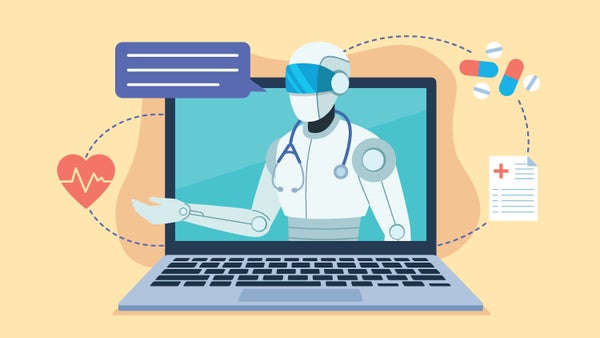
Illustration of a robot dressed as a doctor on a laptop screen, with medical imagery.

Robert Wicher/Getty Images

When Judith Miller received the results of a medical imaging study last year, the 77-year-old Wisconsin resident did what many patients nowadays do: she asked AI to explain them. Claude, a large language model (LLM) developed by the company Anthropic, obligingly laid out possible interpretations. With the chatbot’s analysis in hand, Miller went into her follow-up appointment feeling prepared for a productive conversation with her doctor. As she puts it, Claude’s responses “enabled me to better understand my health and engage more fully in shared decision-making.”

This scene has become commonplace in clinics around the country. Two recent polls both found that a third of American adults have turned to LLMs for health information—to make sense of lab results, diagnose symptoms, research treatment options or inquire about prescription drugs. “The use of tools like these has doubled in the past year,” says Robert Wachter, a physician at the University of California, San Francisco. “I suspect they’ll double again next year.”

But these chatbots can also provide misleading or inaccurate advice, so experts urge caution when using them. Anthropic, for its part, agrees. "Claude is not designed or marketed for making clinical diagnoses," according to a spokesperson for the company. Its proper use is "helping people prepare for conversations with their doctors, not replacing them."


On supporting science journalism

If you're enjoying this article, consider supporting our award-winning journalism by subscribing. By purchasing a subscription you are helping to ensure the future of impactful stories about the discoveries and ideas shaping our world today.


For many patients, AI is a welcome solution to the problems posed by the glut of personal health data supplied by the 21st Century Cures Act, which mandates immediate online access to medical records, such as test results and clinical notes. “If you’ve ever looked at that stuff,” says Dave deBronkart, a health care blogger and activist, “you know it leaves you with the gigantic question: What does all this mean?” Just a few years ago the meaning lay hidden behind a wall of medical jargon that only doctors could comprehend. And because patients can now view results online before speaking with a doctor, they’re often left anxiously wondering what to make of it all. Today, however, general-purpose chatbots and a host of specialized health models can translate the jargon into plain language within seconds, potentially allaying unfounded fears.

Yet they may also heighten anxiety unnecessarily—or worse. LLMs remain prone to mistakes. They can present falsehoods as facts and sycophantically reinforce users’ prior (and sometimes misguided) beliefs. Though these character flaws may lessen as the models grow more powerful, many experts express concern about the potential risks of using today’s AI models in this way. “There aren’t a lot of guardrails around breaking them, pushing them to tell you actual misinformation,” says Cait DesRoches, executive director of OpenNotes, a nonprofit that promotes patients’ access to medical records. She adds that there is little research on what happens when people treat an LLM as a health authority: “I don’t think we have any idea how well it works for average patients.”

Worst-case scenarios have already surfaced. In December a 75-year-old Seattle man died of a treatable type of leukemia; he reportedly refused treatment on the basis of AI-generated evidence that incorrectly suggested he had a rare complication. Some of the preliminary research on how people use AI for medical diagnosis is sobering. In a Nature Medicine study published in February, researchers asked participants to diagnose a hypothetical condition with the help of various LLMs. They reached the right conclusion only about a third of the time.

Still, most experts agree that chatbots can be helpful to people seeking medical information, if used cautiously. “I don’t think people should avoid using them,” DesRoches says, “but I do think people should use them with their eyes open.” Adam Rodman, a general internist at Beth Israel Deaconess Medical Center, goes even further: “I would argue that LLMs, if used appropriately—that’s a big caveat—are the best tool for patient empowerment ever invented.”

Hoping to harness this technology without compromising safety, researchers have developed a suite of strategies to counteract AI’s shortcomings. For example, they suggest telling chatbots to take on the persona of a doctor. This may “prompt the model to collect data in a physicianlike manner,” Rodman says. Other tactics include asking an LLM to rigorously reevaluate its own reasoning and seeking a “second opinion” from a different model. Rodman stresses the importance of removing personal information, such as your name and Social Security number, from any chatbot input to protect your privacy.

Ideally, after all that digital dialogue, patients would wind up with better-informed questions for their doctors. Wachter describes this trend as “generally healthy,” though he sometimes loses valuable time debunking Dr. Chatbot’s faulty advice. “I’ve got 15 minutes for this appointment,” he says, “and I’m going to have to spend the first 10 minutes talking the patient down from what GPT told them to do.”

In many cases LLMs are likely replacing real-life clinical advice altogether, particularly for those who are uninsured or face long wait times to get an appointment. “The access issue is at crisis level,” says Laura Adams, a senior adviser to the National Academy of Medicine on AI matters. Despite the technology’s limitations, she argues we must compare it not to perfection but to reality, in which the alternative may be no care at all. “It’s better than nothing,” she says.

With AI and medical advice, Adams notes that “the horse is way out of the barn.” As more people lean on chatbots to manage their health, researchers and patient advocates say this moment demands a new form of AI literacy. “The remedy is not to keep people ignorant,” deBronkart says. “It’s to teach them how to do it better” by educating children and adults alike. On top of that, newer LLMs will likely improve in medical uses—Wachter suggests that some models might eventually undergo board certification, as actual physicians do.

For now, people like Miller are already approaching AI just as DesRoches recommends: with eyes open, aware of its tendency to hallucinate and confirm user biases. Sophisticated as chatbots’ responses may be, they are stitched together from statistical patterns in large datasets—an impressive trick but one that still falls short of the breadth and reliability in human-level clinical reasoning. “It’s just following up words that were probable,” Miller says. “I’m not looking at it as a source of absolute truth.”

It’s Time to Stand Up for Science

If you enjoyed this article, I’d like to ask for your support. Scientific American has served as an advocate for science and industry for 180 years, and right now may be the most critical moment in that two-century history.

I’ve been a Scientific American subscriber since I was 12 years old, and it helped shape the way I look at the world. SciAm always educates and delights me, and inspires a sense of awe for our vast, beautiful universe. I hope it does that for you, too.

If you subscribe to Scientific American, you help ensure that our coverage is centered on meaningful research and discovery; that we have the resources to report on the decisions that threaten labs across the U.S.; and that we support both budding and working scientists at a time when the value of science itself too often goes unrecognized.

In return, you get essential news, captivating podcasts, brilliant infographics, can't-miss newsletters, must-watch videos, challenging games, and the science world's best writing and reporting. You can even gift someone a subscription.

There has never been a more important time for us to stand up and show why science matters. I hope you’ll support us in that mission.