





A cold, cherry-blossom-hued exoplanet supports bizarre clouds chock-full of salts
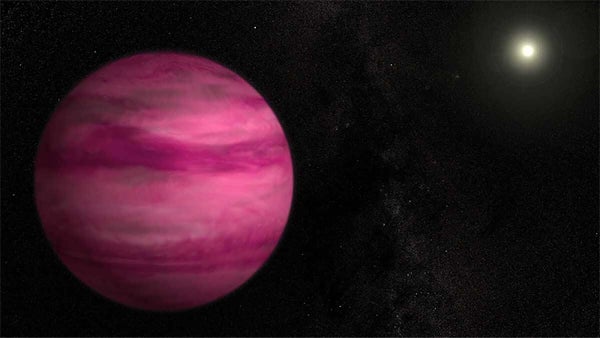
The so-called pink planet, or GJ504b, is still glowing from the heat generated during its formation, hence its magenta glow in this artistic conception of the orb.
NASA/Goddard Space Flight Center
A veil of salty clouds has been discovered on a puffy “pink planet” that has evaded imaging for more than a decade because it’s so cold, astronomers say.
If you were to travel the 57 light-years to “see” the object, called GJ504b, you would view a world still glowing from the heat of its formation. The color, astronomers say, is akin to a dark, cherry-blossom hue.
Despite its moniker, GJ504b might not actually be a planet at all; it’s about 25 times the mass of Jupiter, according to the new research. This mass straddles the line between that of gas giants and brown dwarf stars, leading astronomers to call the object a planetary-mass companion.
If you're enjoying this article, consider supporting our award-winning journalism by subscribing. By purchasing a subscription you are helping to ensure the future of impactful stories about the discoveries and ideas shaping our world today.
Astronomers haven’t been able to learn much about the “pink planet” from direct imaging with ground-based telescopes because the light from the sunlike star that it orbits (at about the same distance between Pluto and our sun) overwhelms its relatively faint glow. Most directly imaged exoplanets are much hotter, at around 1,000 to 2,000 degrees Fahrenheit. Meanwhile temperatures on GJ504b reach just 550 degrees F.
In the new study, Aneesh Baburaj, a postdoctoral associate at Northwestern University, and his colleagues used the James Webb Space Telescope (JWST) to capture the dim light emanating from the object. After accounting for the light from GJ504b’s bright host star, the team could look at data on the wavelengths, or colors, of light coming only from the companion object. Each color in the resulting spectrum is tied to a specific element. The atmosphere, the researchers found, is full of the heavy elements carbon, oxygen, nitrogen and sulfur, Baburaj says. (Astronomers refer to any chemical element that’s heavier than hydrogen and helium as a heavy element.)
The detected elements were likely part of compounds such as water vapor, methane, carbon dioxide, ammonia and others. But after feeding the information into a computer model, the team was puzzled.
“Atmospheres of giant companions generally show a decrease in temperature as one goes higher up in the atmosphere. In the absence of clouds, our models indicated the presence of a small region of the atmosphere where the temperature is constant,” or isothermal, Baburaj says. “The presence of the isothermal region is physically implausible.”
After adding salty clouds to the model, “the isothermal region in our model disappeared, making the results plausible,” Baburaj says. The researchers think the clouds are full of chloride salts, such as potassium chloride, and/or sulfide salts, such as manganese sulfide.
They also discovered that GJ504b is very old: the object likely formed between four billion and 2.5 billion years ago, which would explain its chilly temperatures.
Mysteries still surround this pink puffball. “We are curious about what kind of salt clouds might be present in its atmosphere, but we probably need additional JWST time to answer this question,” Baburaj says.
The team also hopes to resolve the companion’s actual nature, whether it’s a giant planet or a brown dwarf star. “There are other ongoing JWST studies on this object that might be able to answer [that] question,” Baburaj says.
The study, a collaboration between researchers at Northwestern and scientists at the Space Telescope Science Institute, was published today in the Astrophysical Journal.
If you enjoyed this article, I’d like to ask for your support. Scientific American has served as an advocate for science and industry for 180 years, and right now may be the most critical moment in that two-century history.
I’ve been a Scientific American subscriber since I was 12 years old, and it helped shape the way I look at the world. SciAm always educates and delights me, and inspires a sense of awe for our vast, beautiful universe. I hope it does that for you, too.
If you subscribe to Scientific American, you help ensure that our coverage is centered on meaningful research and discovery; that we have the resources to report on the decisions that threaten labs across the U.S.; and that we support both budding and working scientists at a time when the value of science itself too often goes unrecognized.
In return, you get essential news, captivating podcasts, brilliant infographics, can't-miss newsletters, must-watch videos, challenging games, and the science world's best writing and reporting. You can even gift someone a subscription.
There has never been a more important time for us to stand up and show why science matters. I hope you’ll support us in that mission.
此内容由惯性聚合(RSS阅读器)自动聚合整理,仅供阅读参考。 原文来自 — 版权归原作者所有。