






In an open letter, thousands of researchers criticized the White House’s firing of the research agency’s board as ‘an alarming attack’ on U.S. science
By Dan Vergano edited by Claire Cameron
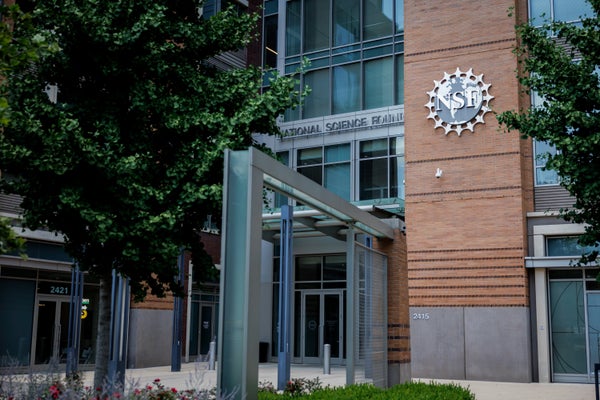
The former NSF headquarters.
Ting Shen/Bloomberg/Getty Images
Join Our Community of Science Lovers!
Some 1,500 members of the U.S. National Academy of Sciences, Medicine and Engineering on Monday denounced the White House’s dismissal of the National Science Board (NSB) longstanding expert board that oversees the National Science Foundation (NSF).
The NSB was fired without notice on April 24. In the open letter, the signatories—who include 37 Nobel prize winners—said the NSB’s firing was “an alarming attack on the ability of the US to engage in basic and applied research.” They called on Congress to oppose the move.
Since 1950, the NSF has funded U.S. basic research, from astronomy to vulcanology, under guidance of the board which has historically been filled with “eminent” scientists. The board is designed to be apolitical and members are appointed to six-year terms by the president. It is required by statute to approve the NSF’s budget, which was $9 billion in 2026. However, the White House said last year that those decisions will now be made by political appointees. The administration has also moved to cut the NSF’s budget by about 50 percent in 2027 and dissolve its social sciences arm.
On supporting science journalism
If you're enjoying this article, consider supporting our award-winning journalism by subscribing. By purchasing a subscription you are helping to ensure the future of impactful stories about the discoveries and ideas shaping our world today.
Despite Congress overriding similar calls from the administration in January, NSF had largely stalled its distribution of grants into April, according to Nature. Four agency civil servants, speaking anonymously to Scientific American due to fear of retribution, say funding has largely been held up except for seemingly favored research into artificial intelligence, quantum computing and related technologies.
The board’s ouster comes amid a purge of independent scientific and research groups whose purpose is to advise the federal government’s science and health policies. Other moves include Health and Human Services Secretary Robert F. Kennedy Jr.’s 2025 decision to fire all the members of an influential vaccine advisory committee; Kennedy recently said he intends to overhaul the U.S. Preventive Medicine Task Force, which sets standards for health insurance reimbursements for medical tests. And in March of this year, the White House revealed that the President’s Council on Science and Technology, long staffed with academic experts, is now led by tech industry figures such as Meta chief executive Mark Zuckerberg and Oracle’s Larry Ellison—just one academic is on the council.
The White House has sought to justify the dismissal of all 22 NSB members (typically there are 25—the board was lacking two ordinary members and an agency chief member) by pointing to a 2021 Supreme Court patent court ruling that limits the power of federal officials not appointed by the U.S. Senate. Still, the board had emphasized after that high court decision that its positions were recommendations, not orders. Congress had in 2011 removed the requirement for Senate confirmation of NSB members, who work part-time and without pay.
In February, the Trump administration announced the nomination of hedge fund investor Jim O’Neill to lead NSF. He would be the first non-scientist to head the agency, if confirmed by the U.S. Senate.
“NSF is supposed to be an independent agency, and the board is supposed to provide that independence,” says Colette Delawalla of the science advocacy group Stand Up for Science, which helped organize the open letter alongside an unofficial group of National Academies of Sciences experts. The group fears the administration will seek to fill the board with industry figures who may prioritize their own firms’ agendas instead of basic science. “The dismissal of the board might seem like a bureaucratic move, but it is a bellwether of the administration removing expertise and independence from our democracy,” Delawalla says.
Editor’s Note: This story is in development and may be updated.
It’s Time to Stand Up for Science
If you enjoyed this article, I’d like to ask for your support. Scientific American has served as an advocate for science and industry for 180 years, and right now may be the most critical moment in that two-century history.
I’ve been a Scientific American subscriber since I was 12 years old, and it helped shape the way I look at the world. SciAm always educates and delights me, and inspires a sense of awe for our vast, beautiful universe. I hope it does that for you, too.
If you subscribe to Scientific American, you help ensure that our coverage is centered on meaningful research and discovery; that we have the resources to report on the decisions that threaten labs across the U.S.; and that we support both budding and working scientists at a time when the value of science itself too often goes unrecognized.
In return, you get essential news, captivating podcasts, brilliant infographics, can't-miss newsletters, must-watch videos, challenging games, and the science world's best writing and reporting. You can even gift someone a subscription.
There has never been a more important time for us to stand up and show why science matters. I hope you’ll support us in that mission.