





Researchers have created the first high-resolution global map of the extent of one of Earth’s largest—and least visible—living networks
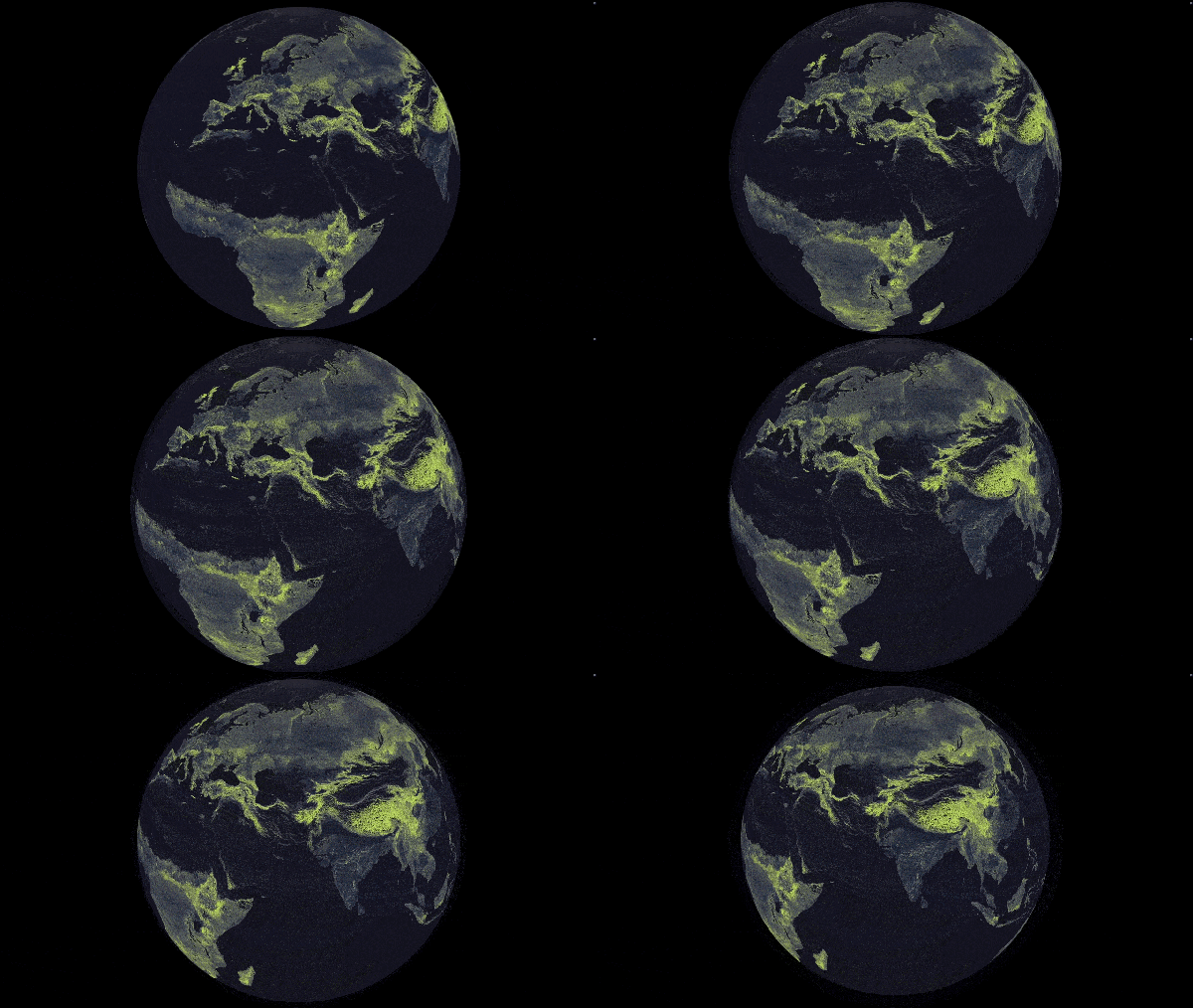
Researchers and data visualization experts plotted the dense map of arbuscular mycorrhizal fungi around the world, down to each square kilometer. Visit the interactive map here.
Moritz Stefaner - Truth & Beauty/Society for the Protection of Underground Networks
If you’ve never heard of arbuscular mycorrhizal (AM) fungi before, I wouldn’t blame you—unless you happen to be a ficus. With symbiotic trade relationships spanning roughly 70 percent of plant species on Earth, these charismatic topsoil denizens should be on the radar of any self-respecting photosynthesizer. Yet although AM fungi haul roughly four billion metric tons of carbon from plants into the soil each year, there’s still a lot we humans don’t know about this type of fungus, starting with how much of it there actually is.
Until now: in a new paper published in Science, researchers combined data from more than 300 studies to estimate the total global biomass of AM fungi. The task is deceptively difficult. Biomass depends in part on the thickness of fungal filaments, meaning that even small errors in estimating their average diameter can dramatically affect the final calculation. To illustrate the challenge, co-author Justin D. Stewart, a data scientist at the Society for the Protection of Underground Networks (SPUN), offers an analogy: Imagine lying beneath a tree and trying to determine the average width of all its branches. Some are long and incredibly thin, while others are short and thick.

A microscopic view of mycorrizhal fungi, colorized for legibility. Spores are visible as circular structures.
Tomás Munita
If you're enjoying this article, consider supporting our award-winning journalism by subscribing. By purchasing a subscription you are helping to ensure the future of impactful stories about the discoveries and ideas shaping our world today.
To tackle the problem, the team used a custom-built robot named Prince, which captured more than 300,000 measurements of growing fungal networks. (For those interested, other robotic residents of the lab include Donna Summer and Aretha Franklin.) Combined with mathematical modeling and published data from around the world, those measurements let the researchers estimate global fungal biomass and, with data visualizer Moritz Stefaner, create an interactive mycorrhizal infrastructure map covering Earth’s landmasses down to each square kilometer.
“We’re surrounded by numbers and data,” says Stefaner, who was immediately drawn to the aesthetic qualities of the dataset. “Everybody wants to make sense of it. Everybody wants to see the big picture.”
So how much of this type of fungus is there?
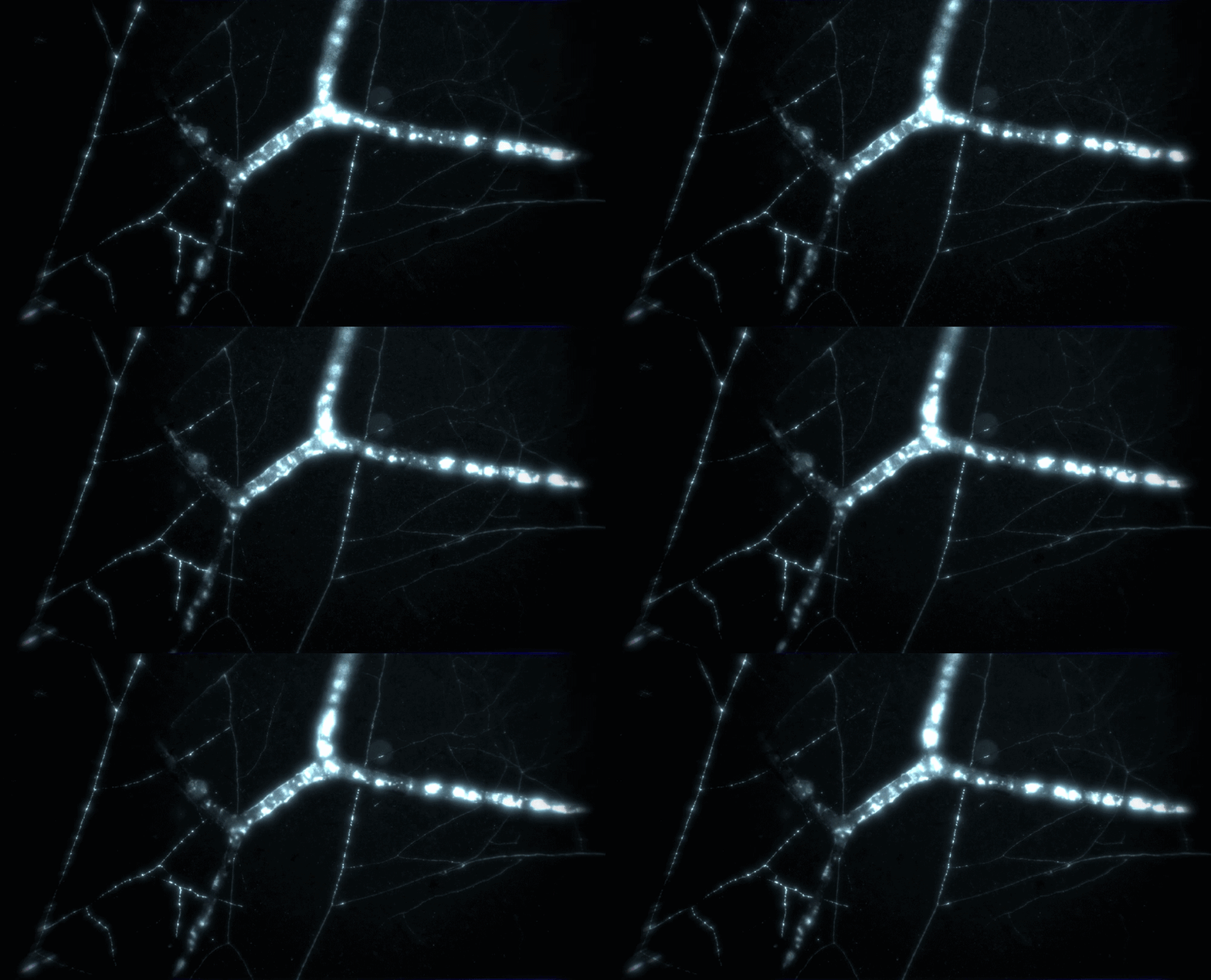
Real-time flow of carbon through an arbuscular mycorrhizal fungal network.
Rachael Cargill and Loreto Oyarte Galvez/VU Amsterdam, AMOLF
The answer is simultaneously more and less than you might expect. By biomass, the world’s AM fungi weigh roughly five times as much as all humans combined. That’s substantial but not nearly as much as many researchers anticipated.
“I was kind of surprised that the numbers weren’t higher,” says Kara Skye Gibson, a postdoctoral researcher at Northern Arizona University, who was not involved in the study.
Stewart says the research team felt much the same way. “When we first calculated how heavy these fungi were,” he says, “I think we spent two or three weeks recalculating it to make sure we weren’t missing zeros.”
Perhaps mass is the wrong way to think about it. In terms of length, the numbers become genuinely absurd. Earth’s topsoil contains an estimated 110 quadrillion kilometers of AM fungi laid end to end— enough to stretch from Earth to our neighboring star Proxima Centauri and back or to reach the 11.9 light-years to Tau Ceti, the setting of Andy Weir’s sci‑fi hit Project Hail Mary.

Expansion of a fungal network over time.
Corentin Bisot/VU Amsterdam, AMOLF
Yet despite such staggering numbers, Stewart is just as eager to discuss what the researchers haven’t found. “We’re treating these maps as living documents, not static images,” he says, emphasizing the importance of the nearly 200 researchers working with SPUN to fill in the remaining gaps. To help identify those gaps, the team created supplemental “maps of ignorance” that highlight where the estimates are most uncertain.
“I'm very comfortable with uncertainty, as long as we quantify what type of uncertainty it is and how large it is,” Stewart says. “These maps of ignorance are also treasure maps of where we need to go sample data in the future.”
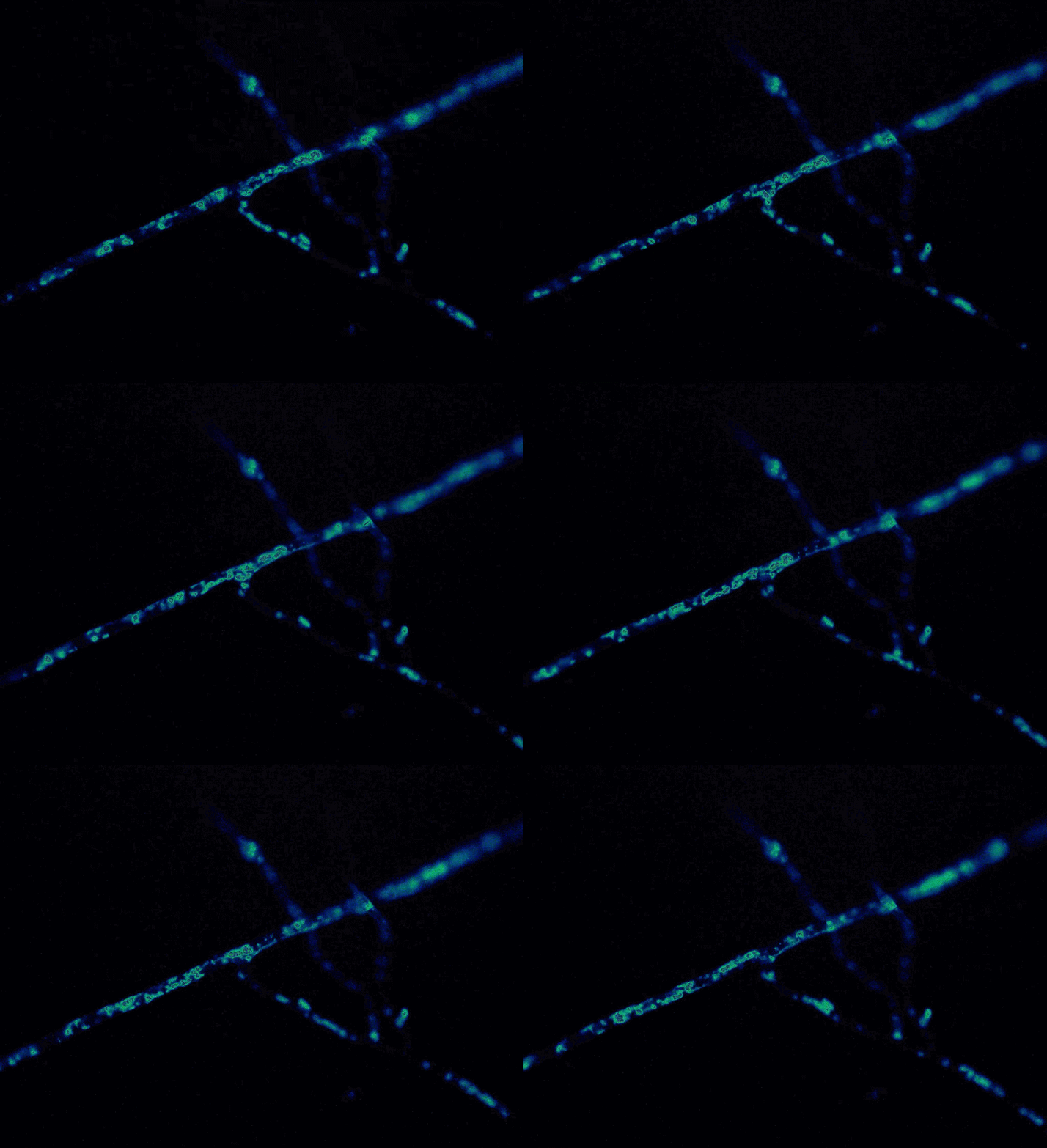
Nutrient flows inside Rhizophagus irregularis, a type of AM fungus.
Victoria Terry/VU Amsterdam, AMOLF
If you enjoyed this article, I’d like to ask for your support. Scientific American has served as an advocate for science and industry for 180 years, and right now may be the most critical moment in that two-century history.
I’ve been a Scientific American subscriber since I was 12 years old, and it helped shape the way I look at the world. SciAm always educates and delights me, and inspires a sense of awe for our vast, beautiful universe. I hope it does that for you, too.
If you subscribe to Scientific American, you help ensure that our coverage is centered on meaningful research and discovery; that we have the resources to report on the decisions that threaten labs across the U.S.; and that we support both budding and working scientists at a time when the value of science itself too often goes unrecognized.
In return, you get essential news, captivating podcasts, brilliant infographics, can't-miss newsletters, must-watch videos, challenging games, and the science world's best writing and reporting. You can even gift someone a subscription.
There has never been a more important time for us to stand up and show why science matters. I hope you’ll support us in that mission.
此内容由惯性聚合(RSS阅读器)自动聚合整理,仅供阅读参考。 原文来自 — 版权归原作者所有。