









The best blood test for herpes is only available at a single lab. What would it take for that to change?
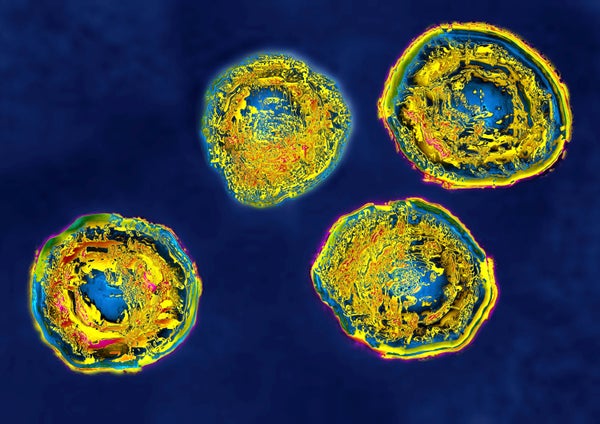
The Herpes Simplex Virus 2 is responsible for the majority of cases of genital herpes, yet the most common screening tests are prone to false positives.
BSIP/UIG Via Getty Images
Last fall Alexa started seeing a man she met on a dating app. He asked her to get tested for sexually transmitted infections before they began having sex. The first thing she noticed on her screening panel was the word “HIGH” in red text: the test had detected elevated antibodies against HSV-2, the form of herpes simplex virus that causes most genital herpes.
This result prompted the lab to run a confirmation test, which determined that Alexa (who asked to be identified with a pseudonym) did not have the virus. She received both results at the same time, but the initial label on the panel was enough to scare off her prospective partner. The false positive “ruined a connection because of how bad the stigma is,” Alexa says.
This prejudice persists despite the high prevalence of herpes. An estimated 12 percent of people in the U.S. aged 14 to 49 have genital herpes caused by HSV-2, but most are unaware of their condition, according to the Centers for Disease Control and Prevention. While there is no cure for herpes and the condition can recur throughout a person’s life, many people have few or no symptoms.
If you're enjoying this article, consider supporting our award-winning journalism by subscribing. By purchasing a subscription you are helping to ensure the future of impactful stories about the discoveries and ideas shaping our world today.
In the absence of active lesions to swab for HSV itself, tests must evaluate the immune response to the virus in a patient’s blood, typically by screening for the immunoglobulin G (IgG) antibody. But the tests are prone to false positives, and the U.S. Preventive Services Task Force, an independent body that sets evidence-based clinical practice standards, recommends against screening asymptomatic individuals.
More accurate automated herpes blood tests have emerged in recent years, but not all commercial labs have adopted them, says Jeffrey Klausner, a clinical professor at the University of Southern California Keck School of Medicine and president of the nonprofit Herpes Cure Advocacy, which was founded in 2020 to promote research into diagnostics and treatments. The “gold standard” test for herpes infection, a type of assay called a Western blot, requires a human to read it and is performed solely at the University of Washington (UW) Virology Laboratory; it’s not widely available to consumers. But researchers are hoping to change that.
“From a very basic humanistic perspective, people have a right to know about their status of infection,” Klausner says of herpes screening, noting that better, more widespread testing could help doctors counsel patients on how to prevent viral spread with medication and condom use.
Some commercial labs do offer a confirmatory test, like the one that gave Alexa a negative result, but these have similar targets to the initial screen. “You’re basically confirming the test with a similar test, which isn’t good laboratory medical practice,” Klausner says.
For people who don’t get a negative confirmatory result at the same time as their false positive, the period between tests can cause anxiety given the stigma around a herpes diagnosis, says Terri Warren, a retired nurse practitioner who runs an online forum for people who have herpes or suspect they might. She has had patients who test positive on an IgG test experience a lot of pain and trauma and then turn out to be negative.
Warren helps those seeking a definitive diagnosis access the UW Western blot test. A Western blot is a routine laboratory assay, but that doesn’t mean other universities or commercial labs can start performing these herpes tests overnight. Labs would need to invest time and resources to meet federal regulatory standards. UW professor Alex Greninger describes the situation as a “vicious cycle” in which herpes screening is rarely ordered because of poor testing options, but labs lack incentive to improve tests because of low demand.
Interpreting the results of these tests is also complex and currently requires multiple trained lab members. Unlike the automated HSV assays offered at commercial labs that target just a single herpes virus protein, the Western blot screens for antibodies against multiple proteins. “The [result] is this complex banding pattern,” says Pavitra Roychoudhury, a research assistant professor at UW who collaborates with the virology lab. “Being able to interpret those subtle differences takes quite a lot of training.”
Roychoudhury, Greninger and their colleagues are streamlining the test interpretation with an AI-powered tool called BlotDx, which they describe in a preliminary study published in March in the Journal of Virological Methods. Roychoudhury says she hopes to continue refining BlotDx so that it can interpret more ambiguous blots and says that the tool might eventually enable other labs to offer the Western blot test.
In the meantime, patients have flocked to online forums such as Reddit to share resources and experiences. “You’ve definitely seen the HSV community get much more activated in the last few years,” Greninger says.
The topic has received some federal attention: the CDC and National Institutes of Health have solicited funding applications for HSV screening projects in recent years. One of the investigators who received this funding, Andrew Levin of Kephera Diagnostics, leads a team that developed a prototype lateral flow assay, which works like a home pregnancy test but uses blood instead of urine. He says the assay performs about as well as existing commercial screens, with a comparable false positive rate. “The challenge really will be to try to get to the level of performance that the Western blot currently delivers,” Levin says of the next phase of research, which would depend on additional funding. He adds that development would need to continue for at least two years before the lab could seek approval from the Food and Drug Administration.
“Transforming a prototype into a finished product involves a lot of heavy lifting,” Levin says. “You have to work on improving performance percent by percent until you get to where it needs to be.”
Another researcher who received NIH funding, Ronit Freeman of the University of North Carolina at Chapel Hill, says her lab hopes to complete validation of their prototype rapid antigen test strip within the next year.
Better testing could bring relief to people like Alexa, who has since become preoccupied with testing herself and her potential partners for herpes and had a second false positive scare in February. “I just don’t know why there isn’t a decent, affordable, accurate test that’s not going to have such a high false positive rate,” she says.
此内容由惯性聚合(RSS阅读器)自动聚合整理,仅供阅读参考。 原文来自 — 版权归原作者所有。