








This teensy creature was discovered along a deep-sea mountain
By Jeanna Bryner edited by Claire Cameron
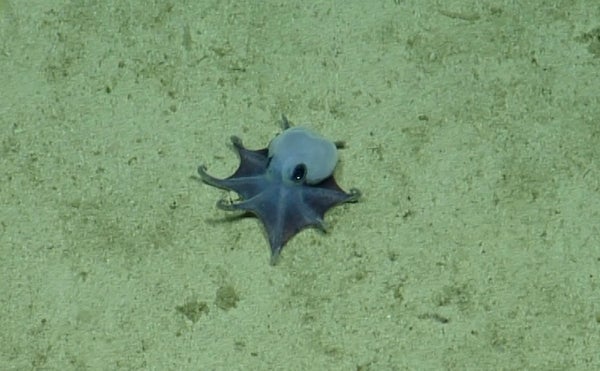
This new species, a golf-ball-sized octopus, was discovered on the deep seafloor of the Pacific Ocean.
Courtesy of the Charles Darwin Foundation
It’s tiny. It’s blue. And it has scientists awe-struck. A golf-ball-size octopus found on the deep seafloor off the Galápagos Islands is an entirely new species, scientists just announced.
In July 2015, during a 10-day expedition in the Pacific Ocean, researchers onboard the E/V Nautilus launched a robotic sub called Hercules just off the coast of Darwin Island, part of the Galápagos archipelago. On an underwater mountainside some 1,773 meters below the sea’s surface, the team discovered a little blue octopus. On a video of the excursion, the scientists can be heard chuckling and cooing over the creature: “Is that a cute little guy or what?” said one team member. Another followed, “Oh, my goodness, that is adorable.”
After collecting some specimens to analyze back at their lab at the Charles Darwin Foundation’s (CDF’s) Charles Darwin Research Station, the scientists realized they couldn’t identify the blue cephalopod. They sent an image to octopus expert Janet Voight, curator emerita of invertebrates at the Field Museum in Chicago. “Right away, I knew it was something really special,” said Voight, lead author of a new paper that describes the finding in Zootaxa, in a statement. “I’d never seen anything like it.”
If you're enjoying this article, consider supporting our award-winning journalism by subscribing. By purchasing a subscription you are helping to ensure the future of impactful stories about the discoveries and ideas shaping our world today.
The team looked at the octopus’s internal organs using micro computed tomography (micro-CT) scanning, a technique that collects thousands of x-ray image slices of an object that can then be put together to create a superhigh-resolution virtual model. Details of the octopus such as the relatively few suckers on its arms, its smooth skin, beak features and the coloring around its organs and parts of the mantle indicated a new species, now called Microeledone galapagensis. Turns out, this “cute little guy” also had 13 eggs in its ovaries.
“Discoveries like these remind us how much of the deep ocean in Galápagos remains unexplored,” said study co-author Salome Buglass, who is now at the University of California, Los Angeles, and was formerly at the CDF, in the same statement.
The Galápagos Islands, sitting off the coast of Ecuador, are famous for the unique animals and plants that live on them. They are also home to Darwin’s finches, which were discovered in Charles Darwin’s famous 1830s survey of the area onboard the HMS Beagle.
If you enjoyed this article, I’d like to ask for your support. Scientific American has served as an advocate for science and industry for 180 years, and right now may be the most critical moment in that two-century history.
I’ve been a Scientific American subscriber since I was 12 years old, and it helped shape the way I look at the world. SciAm always educates and delights me, and inspires a sense of awe for our vast, beautiful universe. I hope it does that for you, too.
If you subscribe to Scientific American, you help ensure that our coverage is centered on meaningful research and discovery; that we have the resources to report on the decisions that threaten labs across the U.S.; and that we support both budding and working scientists at a time when the value of science itself too often goes unrecognized.
In return, you get essential news, captivating podcasts, brilliant infographics, can't-miss newsletters, must-watch videos, challenging games, and the science world's best writing and reporting. You can even gift someone a subscription.
There has never been a more important time for us to stand up and show why science matters. I hope you’ll support us in that mission.
此内容由惯性聚合(RSS阅读器)自动聚合整理,仅供阅读参考。 原文来自 — 版权归原作者所有。