






June 16, 2026
Creating artificial-intelligence tools for cancer detection
Jessine Hein
Join Our Community of Science Lovers!
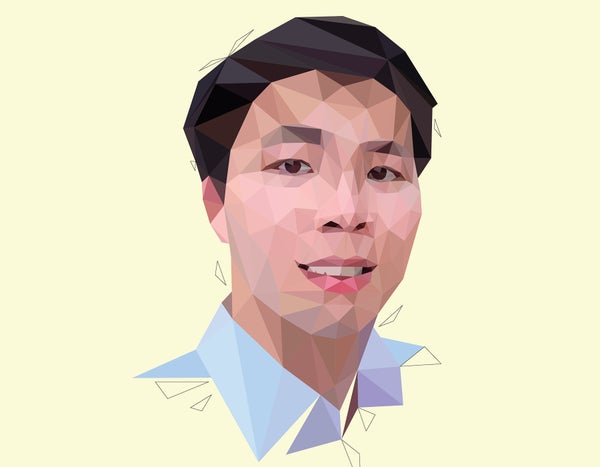
Computer scientist Jieneng Chen wants to digitize the physical world. He is the inventor of TransUNet, an artificial-intelligence tool that helps to map the boundaries of cancerous tumors while accounting for their relation to surrounding organ systems. TransUNet blends two popular computing architectures. The first is a convolutional neural network, which is traditionally used for understanding images. The second is a transformer—the “T” in GPT and the innovation responsible for much of the recent progress in large language models. Combining the two makes the tool useful to radiologists, enabling them to identify boundaries more accurately in CT scans or magnetic resonance imaging.
As a young boy, Chen would often disassemble toy cars in the miniature lab he had set up in his house in Quanzhou, China. His interest in the inner workings of machines ultimately led him to study mechanical engineering and then computer science in Shanghai. In his junior year of college he flew 7,400 miles to Johns Hopkins University to work on AI for early detection of cancer. There Chen developed models that could identify millimeter-scale tumors, which he says would be almost impossible for humans to discern visually from medical scans. “If we want to help the patients or help as many families as possible, we need to develop the AI tools that can detect cancers in early stages,” he says.
On supporting science journalism
If you're enjoying this article, consider supporting our award-winning journalism by subscribing. By purchasing a subscription you are helping to ensure the future of impactful stories about the discoveries and ideas shaping our world today.

Jeffery DelViscio
After returning to China, he started his doctorate at Johns Hopkins remotely amid the coronavirus pandemic. Because of the time difference, he’d stay up until midnight a few days each week to take his classes online. During this period he developed TransUNet, which has become the basis of detection systems for lung, pancreatic, liver and breast abnormalities. He built on that work after returning to Baltimore to finish his studies in person. “Great science is not always putting in many years on one project,” Chen says. “Instead it’s, you know, it’s kind of a spark, right?”
This article is part of “The Young American Scientists,” an editorially independent project that was produced with financial support from Regeneron.
It’s Time to Stand Up for Science
If you enjoyed this article, I’d like to ask for your support. Scientific American has served as an advocate for science and industry for 180 years, and right now may be the most critical moment in that two-century history.
I’ve been a Scientific American subscriber since I was 12 years old, and it helped shape the way I look at the world. SciAm always educates and delights me, and inspires a sense of awe for our vast, beautiful universe. I hope it does that for you, too.
If you subscribe to Scientific American, you help ensure that our coverage is centered on meaningful research and discovery; that we have the resources to report on the decisions that threaten labs across the U.S.; and that we support both budding and working scientists at a time when the value of science itself too often goes unrecognized.
In return, you get essential news, captivating podcasts, brilliant infographics, can't-miss newsletters, must-watch videos, challenging games, and the science world's best writing and reporting. You can even gift someone a subscription.
There has never been a more important time for us to stand up and show why science matters. I hope you’ll support us in that mission.