






NASA needs new space suits to land astronauts on the moon by 2028, but development is behind and in danger of slipping further, according to a report from the agency’s Office of Inspector General
By Claire Cameron edited by Lee Billings
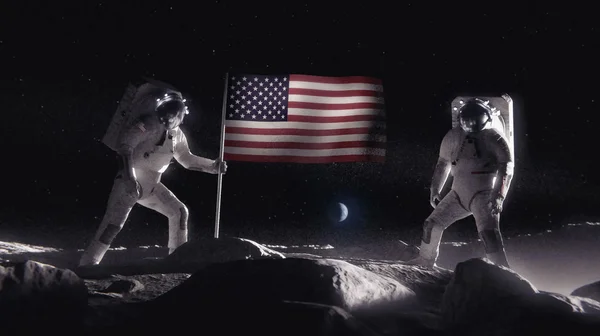
NASA/Daniel O’Neal
NASA’s plan to use new space suits for its anticipated 2028 moon landing mission is in jeopardy, according to a new report issued by the agency’s Office of Inspector General (OIG), an independent federal watchdog, on Monday.
NASA’s current space suits for space walks on the International Space Station (ISS) were designed more than a half-century ago and have received no major updates in at least 20 years. The space agency’s Apollo-era moon suits are unfit for use. In 2022 NASA commissioned two companies, Axiom Space and Collins Aerospace, to develop new space suits for use on the moon, as well as new suits for microgravity conditions on the ISS or other space stations. Under the contracts, which have a collective maximum value of $3.1 billion, the companies would effectively rent the suits to NASA for use on space missions.
Since then the project has been marred by delays. Indeed, Collins Aerospace dropped out in 2024 because it was unable to meet NASA’s deadlines for the suits, leaving Axiom Space as the lone provider. Originally, the space agency had targeted 2025 for demonstrations of the lunar variants, followed by tests of the microgravity versions via an ISS space walk in 2026. This timeline, however, was “overly optimistic and ultimately unachievable,” according to the new report.
If you're enjoying this article, consider supporting our award-winning journalism by subscribing. By purchasing a subscription you are helping to ensure the future of impactful stories about the discoveries and ideas shaping our world today.
The NASA OIG report criticizes the agency’s decision to farm out the suits’ development to private companies and to then rent the products instead of bringing the effort in-house, in part because of the minimal market demand for space suits. Other space suit designs have independently emerged, however, such as a suit designed by SpaceX that is meant for microgravity conditions. A variant of SpaceX’s suit was even tested for extravehicular activity (EVA) use during 2024’s private Polaris Dawn mission, and the company says its suits could be tweaked for operations on the moon.
“Axiom Space welcomes the Inspector General’s review and shares its commitment to delivering next-generation spacesuits that meet NASA’s Artemis and ISS requirements,” said Jonathan Cirtain, CEO and President of Axiom Space, in a statement. A “qualification unit” for the company’s spacesuit will be delivered this year, he said, and Axiom Space is “working toward in-space, spacesuit evaluation demonstrations in 2027.” The company’s focus “remains on delivering a safe, capable spacesuit that enables American astronauts to return to and explore the lunar surface.”
The clock is ticking. NASA wants to test the new microgravity suits on the ISS before its retirement, which is currently set to occur as soon as 2030. And the agency’s Artemis mission timeline means the lunar space suits must be ready by 2028. That’s when NASA’s Artemis IV mission is meant to bring astronauts back to the moon’s surface for the first time since 1972.
If Axiom Space’s work encounters further delays, the report warns, both types of suits are likely to be available no earlier than 2031.
“The NASA OIG’s concerns about meeting schedules are not surprising,” says Cathleen Lewis, curator of International Space Programs and Spacesuits at the Smithsonian Institution’s National Air and Space Museum. “Historically, the space suit has been the last piece of the human spaceflight puzzle.”
Jordan Bimm, a space historian at the University of Chicago, says the report raises the question of what NASA should prioritize as it pushes to land humans back on the moon by 2028 and, eventually, to establish a more permanent presence there. The agency has also seen delays to the development of the Human Landing System—the spacecraft that would transport astronauts from an Orion spacecraft in lunar orbit to the moon’s surface.
“This report makes me wonder which will be the critical bottleneck to a crewed lunar landing in 2028: the landing system or the EVA suit,” he says. “Would they do a lunar landing without an EVA? I seriously doubt it, but this makes you wonder.”
Lewis agrees. “One issue driving design delays is the integration of the suits into the lunar lander systems,” she says. “With the final design of the Artemis lander still TBD, related developments remain unresolved as well.”
The report recommends that NASA seek industry input on its current space suit contracts and that it develop a plan to make sure the Artemis architecture can work with whatever suits are on hand, whatever they might look like.
In response, the space agency concurred with the report’s recommendations. “NASA’s spacesuit interoperability is a foundational requirement for astronaut safety during space missions, and NASA’s ongoing efforts to mature next-generation lunar spacesuits and ensure compatibility across spacecraft interfaces are vital to the success of future missions. Safety remains NASA’s top priority for the agency and its partners as they develop critical
hardware elements,” the agency said in a statement included in the report.
Editor’s Note (4/21/26): This story was updated to include statements from NASA and from Axiom Space.
If you enjoyed this article, I’d like to ask for your support. Scientific American has served as an advocate for science and industry for 180 years, and right now may be the most critical moment in that two-century history.
I’ve been a Scientific American subscriber since I was 12 years old, and it helped shape the way I look at the world. SciAm always educates and delights me, and inspires a sense of awe for our vast, beautiful universe. I hope it does that for you, too.
If you subscribe to Scientific American, you help ensure that our coverage is centered on meaningful research and discovery; that we have the resources to report on the decisions that threaten labs across the U.S.; and that we support both budding and working scientists at a time when the value of science itself too often goes unrecognized.
In return, you get essential news, captivating podcasts, brilliant infographics, can't-miss newsletters, must-watch videos, challenging games, and the science world's best writing and reporting. You can even gift someone a subscription.
There has never been a more important time for us to stand up and show why science matters. I hope you’ll support us in that mission.
此内容由惯性聚合(RSS阅读器)自动聚合整理,仅供阅读参考。 原文来自 — 版权归原作者所有。
