








In a first, the American College of Obstetricians & Gynecologists released its own vaccine schedule
aire images/Getty Images
Join Our Community of Science Lovers!
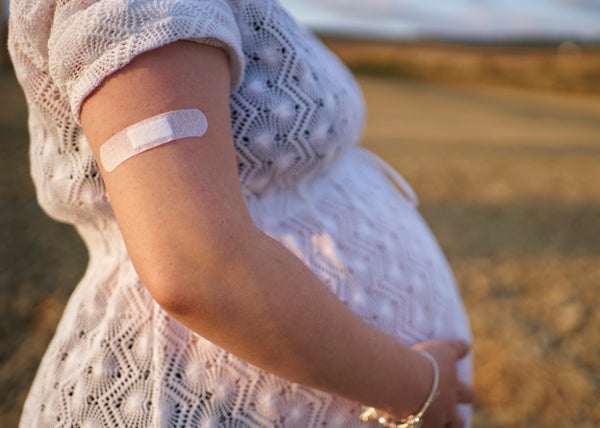
A coalition of maternal health groups on Wednesday recommended four shots for pregnant people, including COVID and flu immunizations. The American College of Obstetricians & Gynecologists (ACOG) immunization schedule, endorsed by 13 other medical organizations, goes beyond what’s recommended by the U.S. Centers for Disease Control and Prevention, which leaves out a universal recommendation for a COVID shot.
“Maternal vaccines are one of the most effective ways to protect not only the mother but her newborn as well,” said Andrew Racine, president of the American Academy of Pediatrics (AAP), in a statement on the recommendations. Babies with a still-developing immune system depend on adults getting vaccinated to prevent the child’s infection with dangerous illnesses, he said. The AAP was one of the organizations that endorsed the ACOG recommendations; others include the American Academy of Family Physicians and the American College of Nurse-Midwives.
The CDC withdrew its recommendation that all pregnant people get a COVID vaccine in 2025. And it only recommends a flu shot during flu season, not any time of the year and in any trimester, as the ACOG recommendations do.
On supporting science journalism
If you're enjoying this article, consider supporting our award-winning journalism by subscribing. By purchasing a subscription you are helping to ensure the future of impactful stories about the discoveries and ideas shaping our world today.
Overall, the ACOG schedule calls for the Tdap (tetanus, diphtheria and pertussis) shot between 27 and 36 weeks of pregnancy and the respiratory syncytial virus (RSV) shot from weeks 32 to 36 during a first pregnancy. Pregnant people with risk factors may need pneumococcal, meningococcal and hepatitis shots as well, the group advises. Three other vaccinations—those against human papillomavirus, measles, mumps and rubella, and chickenpox—should be received before or after pregnancy, including while breastfeeding, according to the recommendations.
The ACOG immunization schedule comes as a survey released by Harvard University and the de Beaumont Foundation on Tuesday finds that only 12 percent of Americans say they trust CDC recommendations “a great deal.” Outside medical groups, on the other hand, such as the American Heart Association, were trusted “somewhat” or “a great deal” by 80 percent of survey respondents.
“Changing national recommendations coupled with rampant vaccine misinformation are resulting in confusion for both patients and health care professionals,” said ACOG president Camille A. Clare in the statement announcing the recommendations. “It is incredibly important for the public to have access to reliable, evidence-based information on maternal immunizations from a trusted source.”
Editor’s Note (6/11/26): This story is in development and may be updated.
It’s Time to Stand Up for Science
If you enjoyed this article, I’d like to ask for your support. Scientific American has served as an advocate for science and industry for 180 years, and right now may be the most critical moment in that two-century history.
I’ve been a Scientific American subscriber since I was 12 years old, and it helped shape the way I look at the world. SciAm always educates and delights me, and inspires a sense of awe for our vast, beautiful universe. I hope it does that for you, too.
If you subscribe to Scientific American, you help ensure that our coverage is centered on meaningful research and discovery; that we have the resources to report on the decisions that threaten labs across the U.S.; and that we support both budding and working scientists at a time when the value of science itself too often goes unrecognized.
In return, you get essential news, captivating podcasts, brilliant infographics, can't-miss newsletters, must-watch videos, challenging games, and the science world's best writing and reporting. You can even gift someone a subscription.
There has never been a more important time for us to stand up and show why science matters. I hope you’ll support us in that mission.