


惯性聚合 高效追踪和阅读你感兴趣的博客、新闻、科技资讯
阅读原文 在惯性聚合中打开

推荐订阅源

S
Security @ Cisco Blogs
Scott Helme
Scott Helme
Threat Intelligence Blog | Flashpoint
T
Threat Research - Cisco Blogs
AWS News Blog
AWS News Blog
Spread Privacy
Spread Privacy
D
Darknet – Hacking Tools, Hacker News & Cyber Security
Security Latest
Security Latest
Simon Willison's Weblog
C
Cybersecurity and Infrastructure Security Agency CISA
G
GRAHAM CLULEY
cs.CL updates on arXiv.org
I
Intezer
S
Securelist
Google DeepMind News
S
Schneier on Security
T
Troy Hunt's Blog
Help Net Security
Help Net Security
Microsoft Azure Blog
V
V2EX
Security Archives - TechRepublic
O
OpenAI News
博客园 - Franky
G
Google Developers Blog
Stack Overflow Blog
Stack Overflow Blog
TaoSecurity Blog
TaoSecurity Blog
MyScale Blog
MyScale Blog
P
Privacy International News Feed
K
KPMG report finds enterprise disconnect between AI and its ROI | CIO
Google Online Security Blog
Latest news
Latest news
Vercel News
Vercel News
T
The Blog of Author Tim Ferriss
博客园_首页
S
Security Affairs
PCI Perspectives
PCI Perspectives
WordPress大学
WordPress大学
C
Cisco Blogs
Recent Announcements
L
LangChain Blog
GbyAI
GbyAI
F
Fortinet All Blogs
N
News and Events Feed by Topic
T
Tor Project blog
IT之家
IT之家
P
Palo Alto Networks Blog
D
DataBreaches.Net
小众软件
小众软件
宝玉的分享
宝玉的分享
F
Full Disclosure

Scientific American

Former deputy surgeon general Erica Schwartz nominated as new CDC chief NASA Artemis II astronauts say thank you to the world Congress grills RFK, Jr., about vaccines and cuts to health budget How the Grand Canyon formed is a surprisingly messy story. Here's the latest clue How far from humanity were the astronauts of Artemis II? The answer will surprise you Effect of antiamyloid Alzheimer’s drugs ‘absent or trivial,’ Cochrane review finds The Trump administration is looking to experts to weigh in on peptides When a naked mole rat queen dies, that usually means war—but not for this colony NASA needs nuclear power for its moon base. Here’s the White House plan to get it Why do older people have fewer seasonal allergies? 250-million-year-old fossil proves mammal ancestors laid eggs A face-swapping illusion can unlock childhood memories 30 years of Pokémon—how the Japanese franchise mirrors real-world science Sperm whales may make their own vowel sounds, similar to human language Colombia will euthanize Pablo Escobar’s invasive ‘cocaine hippos’ NASA’s Artemis III will pit SpaceX against Blue Origin The East Coast could see blazing hot temperatures this week. Here’s why Scientists just discovered 5.6 million bees under a New York State cemetery The real science of Pokémon How chemists engineer the signature smells of luxury perfumes How two mathematicians solved a cryptography mystery The engineering marvels hidden inside six-figure watches Expensive versus affordable binoculars—what’s the difference? How physicists found a new type of magnet hiding in plain sight A hot pair of supplements, creatine and methylene blue dye, may not work together Unlikely paths to discovery The baffling ecological disaster that's killing America’s freshwater mussels Poem: ‘How I Became a Spitfire Pilot during My Cataract Operation’ DARPA built an AI to fact-check enemy weapons claims Mathematicians created an ‘impossible’ shape that shouldn’t exist How cosmic rays are helping mining companies find critical minerals underground New evidence links heart disease to inflammation—and drugs can stop it An asteroid extinguished all the dinosaurs except for birds. Here’s why Math Puzzle: A disassembly job May 2026: Science History from 50, 100 and 150 Years Ago Readers respond to the January 2026 issue How to build a space hotel The humble ham sandwich inspired a math theorem for sharing food fairly Imperiled ‘cloud jaguar’ spotted in Honduran mountains for the first time in a decade Person functionally cured of HIV after bone marrow transplant from sibling Dream Chaser space plane faces uncertain future in NASA’s push for the moon Bizarre ‘compleximers’ break the rules of both glass and plastic This method to reverse cellular aging is about to be tested in humans The Artemis II mission worked—but should we really keep returning to the moon? How DNA forensics is transforming studies of ancient manuscripts Beetle larvae mimic flower scents to attract bee hosts See NASA’s Artemis II mission around the moon in 12 stunning photos New study shows how the brain weighs evidence to make decisions What NASA’s Artemis II tells us about the ‘overview effect,’ moon joy and awe New metal with triple copper’s heat conduction challenges fundamental physics NASA’s Artemis II reveals why humans still love the moon NASA’s Artemis II moon mission splashes down The Expanse authors James S. A. Corey explore alien war in new book The Faith of Beasts New particle mass measurement deepens quantum mystery NASA’s Artemis II crew returns today—here’s what to know ahead of splashdown Why bombing Iran’s nuclear power plant could cause an environmental disaster Mysterious heart neurons maintain blood pressure to prevent fainting NASA’s Dragonfly mission will send a nuclear-powered flying drone to Titan This sci‑fi twist on Moby-Dick will blow your mind Medieval aurora poetry provided clues to historic solar storms White House budget puts 54 NASA science missions on the chopping block NASA’s Artemis II moon mission is on track for Friday splashdown Timeline of the Artemis II moon mission’s return to Earth Why can’t humans regenerate limbs? New research offers a clue How the wildlife trade boosts the chance of a disease jumping from animals to humans Two hundred chimpanzees are embroiled in a ‘civil war’ NASA’s Artemis II moon mission preps for its last full day in space How China could still win the new moon race Lyme disease is spreading, but a new vaccine could curb infections No, Shroud of Turin DNA analysis doesn't show relic's origins, experts say What’s the deal with the Artemis II music? The crew finally gave us some answers The world’s deepest sensors will detect earthquakes around the world from far below Antarctica Why Artemis II’s reentry may be the moon mission’s greatest challenge yet NASA’s Artemis II moon mission is focusing on its return to Earth What is the quantum ‘Ghost Murmur’ purportedly used in Iran? Scientists question CIA’s claim of long-range heartbeat detection How well GLP-1 weight loss drugs work may depend on your genetics NASA’s Artemis moon missions are a game changer for astronomy Tracking Artemis II—after its historic lunar flyby, NASA’s moon mission heads home NASA’s Artemis program has sparked a race to land U.S. rovers on the moon Do people see robots as having race? New studies clash as humanoids enter the real world Health experts warn of rising measles cases in undervaccinated communities In a first, Artemis II moon mission astronauts make ‘ship to ship’ call to ISS The mathematically correct way to slice a pizza See NASA’s Artemis II mission’s first incredible photos of the moon, Earth and a total solar eclipse In an echo of Apollo 8, NASA’s Artemis II astronauts witness stunning ‘Earthrise’ and ‘Earthset’ NASA’s Artemis II astronauts celebrate epic lunar flyby with stunning new images NASA’s Artemis era may finally solve three major moon mysteries NASA’s Artemis II ‘free return’ trajectory lets gravity do the driving Trump speaks with NASA's Artemis II astronauts after historic moon flyby NASA’s Artemis II crew experience total solar eclipse from space NASA’s Artemis II moon mission reaches greatest distance from Earth NASA’s Artemis II astronauts break Apollo’s distance record Watch live—NASA’s Artemis II’s moon flyby is underway Bypass the Strait of Hormuz with nuclear explosives? The U.S. studied that option in the 1960s NASA’s Artemis II mission is about to pass behind the moon NASA’s Artemis II, endangered species and oil, low western U.S. snowpack Where is Artemis II? NASA astronauts near the moon for first time in more than 50 years NASA’s Artemis II laser communications system is beaming 4K video from the moon NASA’s Artemis II moon mission is gearing up for its lunar flyby What will NASA’s Artemis II astronauts see on the moon?
Timnit Gebru
Megha Satyanarayana · 2026-06-16 · via Scientific American

June 16, 2026

On safeguarding independent research in the age of big tech
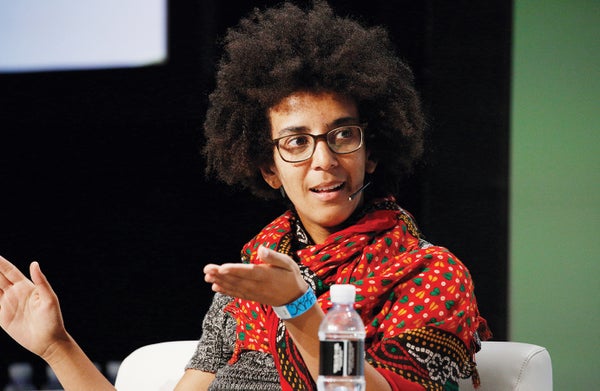
Portrait photograph of Timnit Gebru provided by Kimberly White/Getty Images.

Kimberly White/Getty Images

Timnit Gebru is a computer scientist, an engineer, and founder and executive director of the Distributed AI Research Institute, an independent organization conducting community-rooted research into technological tools and systems. She is also co-founder of Black in AI, a nonprofit that works to increase the presence, inclusion, visibility and health of Black people in the field of artificial intelligence. Gebru is the treasurer for AddisCoder, a nonprofit dedicated to teaching algorithms and computer programming to Ethiopian high school students.

An edited transcript of the interview follows.

How would you describe the current state of American science?


On supporting science journalism

If you're enjoying this article, consider supporting our award-winning journalism by subscribing. By purchasing a subscription you are helping to ensure the future of impactful stories about the discoveries and ideas shaping our world today.


I’m in the field of AI, and in my field, I would describe it as corporate-driven and sloppy. There are a lot of basic practices—for example, not testing on your training data, transparency, appropriate documentation—that are just not being followed. So it’s also misleading.

What needs to change in American science?

I think that, number one, the incentive needs to be decoupled from corporations or the military. The incentives need to be about primarily scientific curiosity but also people’s well-being. That’s the number-one thing: the funding needs to come from a different place. That’s where I’ll start and stop.

What gives you optimism right now?

The ingenuity of small organizations and younger people. I am constantly inspired by little, tiny organizations, such as a [New Zealand–based] company called Te Hiku Media. Using its small budget, it builds tools for language revitalization and a whole bunch of other things. We’ve tried to adopt some of its practices to our thing, and we are hoping somebody else can get inspired by us. So I’m inspired by how fast movements can spread like this, with small organizations talking to and inspiring one another.

One of the things they did was build their own cluster, which is kind of like a small data center, instead of using Google and Amazon and whatever other cloud services. It reminded me that there is a lot of stuff that you can do with a small budget. The constraints breed innovation. You can get very discouraged thinking about the amount of money and resources it takes to do science. So when you see these small organizations and what they are able to achieve with few resources, then you can be inspired to pursue a specific curiosity of yours with [limited] resources as well.

What’s your best advice for an early-career scientist?

Question everything, question the source of information that you get. Don’t believe any kind of hype that you hear from companies. Just follow all the rabbit holes. Being a scientist is really asking why and how and, Is this really true? So just have patience and ask all the questions. Don’t settle for answers that you get from the media. Question incentive structures, question where you’re getting the information from, and just don’t stop going down the rabbit holes when you’re doing experiments or asking questions.

That, to me, is like what science is about, right? You spend years and years and years still asking the same question or following a specific rabbit hole that other people are too tired to follow. And that’s really where there is no shortcut to scientific discovery or innovation. You have to struggle.

How has your field changed in the past few years?

I think, first, it has not only entered but overtaken the mainstream discourse.

For me, not just AI but the field of computer science as a whole was attractive because I was very excited about asking questions such as, What is the fastest way to do something? What is the most efficient way to do something? How few resources can I use to achieve this goal? How little memory can I use? You would have the brute-force way, which is the least complicated way, and then the clever way, which is where algorithms come in. It was always like solving a puzzle, and that was really exciting.

And then in the past few years, because of this corporate-driven agenda, we’ve seen kind of the opposite. If we pretend that we have all the data in the world, all the resources in the world, all the chips that one can ever get, what can we do? That’s not exciting to me, and I think you cannot innovate that way.

It’s Time to Stand Up for Science

If you enjoyed this article, I’d like to ask for your support. Scientific American has served as an advocate for science and industry for 180 years, and right now may be the most critical moment in that two-century history.

I’ve been a Scientific American subscriber since I was 12 years old, and it helped shape the way I look at the world. SciAm always educates and delights me, and inspires a sense of awe for our vast, beautiful universe. I hope it does that for you, too.

If you subscribe to Scientific American, you help ensure that our coverage is centered on meaningful research and discovery; that we have the resources to report on the decisions that threaten labs across the U.S.; and that we support both budding and working scientists at a time when the value of science itself too often goes unrecognized.

In return, you get essential news, captivating podcasts, brilliant infographics, can't-miss newsletters, must-watch videos, challenging games, and the science world's best writing and reporting. You can even gift someone a subscription.

There has never been a more important time for us to stand up and show why science matters. I hope you’ll support us in that mission.