







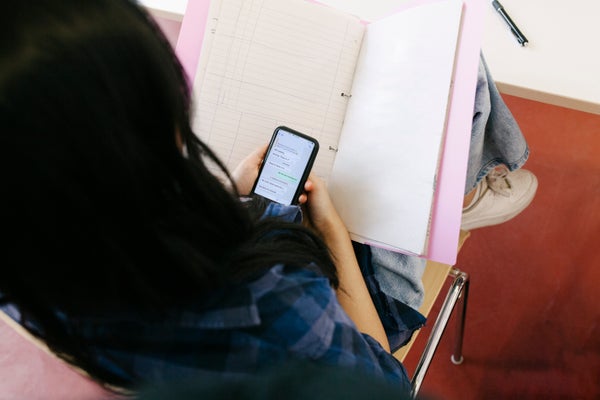
Banning cell phones in schools has been touted as a silver bullet for poor test scores and low student well-being and attendance, but new research suggests the results are more mixed
By Claire Cameron edited by Jeanna Bryner
Willie B. Thomas/Getty Images
Join Our Community of Science Lovers!
Cell phone bans in schools are working—at least as far as keeping kids off their phones during school, according to a new working paper. But the bans, which have been touted by researchers, educators and policymakers as a way to boost children’s attendance and academic achievement and to combat mental health issues and online bullying, aren’t delivering on all those promises, the findings reveal.
In the years since cell phone bans went into effect in schools, students and teachers at those schools have reported higher levels of well-being, but average test scores and attendance records haven’t budged. Perceived levels of online bullying have also not improved, according to the paper.
The research was released on Monday by a nonprofit called the National Bureau of Economic Research. The study authors looked specifically at schools where kids have been required to keep their smartphones in magnetically sealed pouches that are not unlocked until the end of the school day. They then compared these schools with others that have not enforced pouches—more than 40,000 schools overall between 2019 and 2026. The researchers analyzed schools’ test data, attendance reports, discipline records, GPS data, and student and teacher surveys.
On supporting science journalism
If you're enjoying this article, consider supporting our award-winning journalism by subscribing. By purchasing a subscription you are helping to ensure the future of impactful stories about the discoveries and ideas shaping our world today.
As of 2026, about two thirds of U.S. states have passed laws to curb cell phone access in schools—and they are not entirely popular with kids. A recent Pew Research Center survey found that 41 percent of U.S. teens aged 13 to 17 supported banning middle and high school students from using their cell phones during class, while about half totally opposed it. Even fewer supported restricting cell phones for the entire school day—about one in five said phones should be banned all day, including during lunch and between classes, while 73 percent opposed such policies.
In the new paper, the researchers found that when schools first adopted the pouches, suspensions tended to rise, and students’ reported well-being fell—but that these trends didn’t last long and that, with time, discipline leveled out to baseline, and well-being rose.
The analysis has some limitations, the researchers wrote. Test scores and surveys don’t necessarily capture all the outcomes of the phone restrictions. And even in the schools that had been enforcing the pouch system for the longest amount of time, the researchers had no more than three years of postadoption data to consider. And some schools have used other forms of phone restriction that might have different effects than the pouches.
“Evaluating the longer-run impacts of phone restrictions and comparing alternative policy designs are important priorities as schools continue to experiment with approaches to managing digital access,” the researchers wrote.
It’s Time to Stand Up for Science
If you enjoyed this article, I’d like to ask for your support. Scientific American has served as an advocate for science and industry for 180 years, and right now may be the most critical moment in that two-century history.
I’ve been a Scientific American subscriber since I was 12 years old, and it helped shape the way I look at the world. SciAm always educates and delights me, and inspires a sense of awe for our vast, beautiful universe. I hope it does that for you, too.
If you subscribe to Scientific American, you help ensure that our coverage is centered on meaningful research and discovery; that we have the resources to report on the decisions that threaten labs across the U.S.; and that we support both budding and working scientists at a time when the value of science itself too often goes unrecognized.
In return, you get essential news, captivating podcasts, brilliant infographics, can't-miss newsletters, must-watch videos, challenging games, and the science world's best writing and reporting. You can even gift someone a subscription.
There has never been a more important time for us to stand up and show why science matters. I hope you’ll support us in that mission.