


There are bright futures ahead for our first-ever Young American Scientist honorees
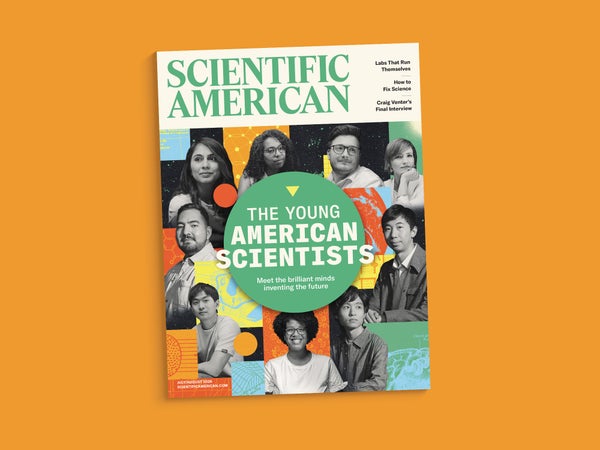
Scientific American, July/August 2026
Alice Stanton might have been born with an inclination to be a scientist; growing up in Erie, Pa., she spent her childhood exploring nature and collecting insects. But it was watching her grandmother cope with the aftermath of a stroke that cemented a desire to devote her life to research. Today, at Harvard Medical School, Stanton is working with models of the human brain that she created, which could help to develop new therapies that might someday benefit millions.
Her journey is just one of the 28 extraordinary stories featured in our inaugural class of Young American Scientists, a group of early-career researchers poised to change the world. To find these remarkable people, we asked hundreds of the world’s top scientists to tell us whom they saw as the future of their field: the up-and-comers who are innovating and making amazing discoveries and whose work may define the decades to come.
The nominees could work in academia or industry, for profit or charity, in pure research or applied product development—anywhere, as long as they were doing important science.
If you're enjoying this article, consider supporting our award-winning journalism by subscribing. By purchasing a subscription you are helping to ensure the future of impactful stories about the discoveries and ideas shaping our world today.
We received nominations for people such as Colin Carlson, a Yale University epidemiologist running a National Science Foundation research project called Verena, which looks for emerging viral threats; Tonima Tasmin Ananna, who used the rolling blackouts of her childhood home, Bangladesh, as an opportunity to gaze at the stars and now studies black holes at Wayne State University; and Dmitrii Kochkov, an AI scientist at Google Research building innovative tools for monitoring weather.
All of our honorees share two important characteristics: they’re all starting out in their careers, and they’re all doing research right here in the U.S.
That’s not an easy job these days. Young scientists face some of the most challenging career prospects in the country’s history, defined by funding crises, brain drain, and rampant misinformation causing a public crisis of trust. So while we celebrate our future, this issue also takes an unflinching look at the threats we are facing.
In “State of American Science,” journalist Adam Rogers examines how the “existential vibe” of research is changing as federal grants are frozen and the decades-old compact between science and society is challenged. Pulitzer Prize winner Deborah Blum reminds us in “The Past Is Our Future” that science has weathered hostile political eras before, and she suggests what the future might hold.
This issue also features interviews with several leaders in today’s scientific community, who share their concerns, hopes and advice for the next generation. Most poignant is our final interview with Craig Venter, the geneticist who helped to lead the first sequencing of the human genome. Speaking just a month before his death in April, Venter remained characteristically blunt, warning that the U.S. is “shooting [itself] in the foot” by blocking international talent. Yet he remained optimistic for the future and urged young scientists to never stop taking risks.
You’ll find more optimism in “Bright Spots,” where Scientific American contributing editor Rebecca Boyle highlights fields where American discovery is still flourishing. And in “The Lab of the Future Runs Itself,” reporter Patrick Sisson explores how AI and robotics keep labs running at all hours.
There’s much more of this special report about the present and future of science at sciam.com/youngscientists. Please browse the dozens of interviews, extended profiles of our 28 honorees, and hours of video and audio you can find only there.
The Young American Scientists enterprise was produced with support from our presenting sponsor, Regeneron, and couldn’t have happened without help from the many nominating scientists who gave us their wisdom and time. My thanks to all of them and, especially, to Scientific American’s exceptional staff.
If you enjoyed this article, I’d like to ask for your support. Scientific American has served as an advocate for science and industry for 180 years, and right now may be the most critical moment in that two-century history.
I’ve been a Scientific American subscriber since I was 12 years old, and it helped shape the way I look at the world. SciAm always educates and delights me, and inspires a sense of awe for our vast, beautiful universe. I hope it does that for you, too.
If you subscribe to Scientific American, you help ensure that our coverage is centered on meaningful research and discovery; that we have the resources to report on the decisions that threaten labs across the U.S.; and that we support both budding and working scientists at a time when the value of science itself too often goes unrecognized.
In return, you get essential news, captivating podcasts, brilliant infographics, can't-miss newsletters, must-watch videos, challenging games, and the science world's best writing and reporting. You can even gift someone a subscription.
There has never been a more important time for us to stand up and show why science matters. I hope you’ll support us in that mission.
此内容由惯性聚合(RSS阅读器)自动聚合整理,仅供阅读参考。 原文来自 — 版权归原作者所有。