



A survey found that more than 60 percent of respondents “strongly support” making psychedelics easier to study, reflecting a growing consensus that some could have therapeutic use
By Jackie Flynn Mogensen edited by Claire Cameron
Cannabis-Pic/Getty Images
Most U.S. voters want to make it easier to study psychedelics, and almost half think psychedelics should be legalized for therapeutic use, a new survey finds. The results suggest a broad surge in support for loosening restrictions on research into substances such as psilocybin and MDMA to probe their potential for medical use.
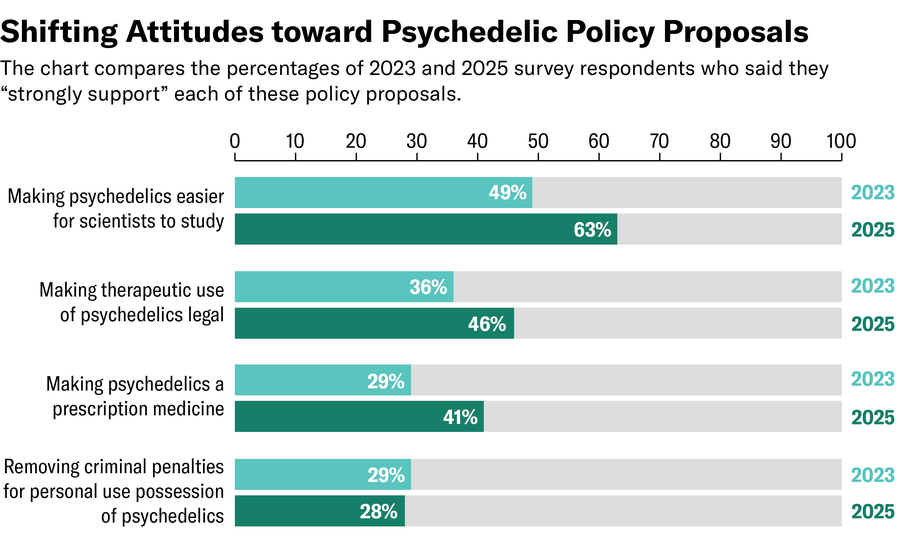
The poll included more than 1,500 U.S. voters and was conducted by the U.C. Berkeley Center for the Science of Psychedelics (BCSP) at the University of California, Berkeley, in April 2025. Some 63 percent of respondents said they “strongly support” lowering the barriers to study psychedelics—a jump of about 14 percent from a similar poll conducted in 2023, when 49 percent of respondents reported the same.
And 46 percent of voters also said they “strongly support” making the therapeutic use of psychedelics legal compared with 36 percent in 2023. Forty-one percent said they’d strongly support making psychedelics available by prescription, which polled at just 29 percent in 2023. Support for decriminalizing psychedelics, meanwhile, has remained relatively flat at around 28 percent. Currently, possession of psychedelics such as LSD, MDMA and psilocybin is illegal at the federal level in the U.S.
If you're enjoying this article, consider supporting our award-winning journalism by subscribing. By purchasing a subscription you are helping to ensure the future of impactful stories about the discoveries and ideas shaping our world today.
Amanda Montañez; Source: A Rising Tide of Cautious Support. Tyrone J. Sgambati et al. U.C. Berkeley Center for the Science of Psychedelics, University of California, Berkeley, May 13, 2026 (data)
The findings reflect “increasing public acceptance” of psychedelic treatments, says Mason Marks, a senior fellow of a project on psychedelics at the Petrie-Flom Center for Health Law Policy, Biotechnology, and Bioethics at Harvard Law School. But he notes that concepts such as “decriminalization” and legalization for “therapeutic use” may hold distinct meanings to different people, and further research could seek to understand why people answered those questions the way they did.
“People are being flooded with information, and increasingly so, it seems, about psychedelics,” says Tyrone Sgambati, a co-author of the report and a postdoctoral research scientist at BCSP. “I think that kind of piques people’s curiosity and spurs a desire for more information and potentially to better understand purported benefits.” Still, the findings suggest there doesn’t seem to be as great of an appetite for changing these drugs’ status under the law, he says, which suggests some caution remains.
More information as to these substances’ potential could be coming. In April President Donald Trump signed an executive order aimed at boosting research on psychedelic therapies, which experts say could help lower barriers to studying psilocybin, MDMA, ibogaine, and more.
Although the survey was conducted before Trump’s executive order in April, the results indicate that, from 2023 to 2025 at least, there was “increasing public appetite” for the kind of policies laid out in that order, Sgambati says. “They do seem to be pointing in the same direction.”
If you enjoyed this article, I’d like to ask for your support. Scientific American has served as an advocate for science and industry for 180 years, and right now may be the most critical moment in that two-century history.
I’ve been a Scientific American subscriber since I was 12 years old, and it helped shape the way I look at the world. SciAm always educates and delights me, and inspires a sense of awe for our vast, beautiful universe. I hope it does that for you, too.
If you subscribe to Scientific American, you help ensure that our coverage is centered on meaningful research and discovery; that we have the resources to report on the decisions that threaten labs across the U.S.; and that we support both budding and working scientists at a time when the value of science itself too often goes unrecognized.
In return, you get essential news, captivating podcasts, brilliant infographics, can't-miss newsletters, must-watch videos, challenging games, and the science world's best writing and reporting. You can even gift someone a subscription.
There has never been a more important time for us to stand up and show why science matters. I hope you’ll support us in that mission.
此内容由惯性聚合(RSS阅读器)自动聚合整理,仅供阅读参考。 原文来自 — 版权归原作者所有。