
惯性聚合 高效追踪和阅读你感兴趣的博客、新闻、科技资讯
阅读原文 在惯性聚合中打开

推荐订阅源

WordPress大学
WordPress大学
Vercel News
Vercel News
博客园_首页
Y
Y Combinator Blog
美团技术团队
Cyber Security Advisories - MS-ISAC
阮一峰的网络日志
阮一峰的网络日志
aimingoo的专栏
aimingoo的专栏
H
Hackread – Cybersecurity News, Data Breaches, AI and More
MyScale Blog
MyScale Blog
GbyAI
GbyAI
人人都是产品经理
人人都是产品经理
T
Tailwind CSS Blog
MongoDB | Blog
MongoDB | Blog
D
DataBreaches.Net
博客园 - Franky
Engineering at Meta
Engineering at Meta
量子位
The GitHub Blog
The GitHub Blog
F
Fortinet All Blogs
freeCodeCamp Programming Tutorials: Python, JavaScript, Git & More
钛媒体:引领未来商业与生活新知
钛媒体:引领未来商业与生活新知
酷 壳 – CoolShell
酷 壳 – CoolShell
N
Netflix TechBlog - Medium

Scientific American

Former deputy surgeon general Erica Schwartz nominated as new CDC chief NASA Artemis II astronauts say thank you to the world Congress grills RFK, Jr., about vaccines and cuts to health budget How the Grand Canyon formed is a surprisingly messy story. Here's the latest clue How far from humanity were the astronauts of Artemis II? The answer will surprise you Effect of antiamyloid Alzheimer’s drugs ‘absent or trivial,’ Cochrane review finds The Trump administration is looking to experts to weigh in on peptides When a naked mole rat queen dies, that usually means war—but not for this colony NASA needs nuclear power for its moon base. Here’s the White House plan to get it Why do older people have fewer seasonal allergies? 250-million-year-old fossil proves mammal ancestors laid eggs A face-swapping illusion can unlock childhood memories 30 years of Pokémon—how the Japanese franchise mirrors real-world science Sperm whales may make their own vowel sounds, similar to human language Colombia will euthanize Pablo Escobar’s invasive ‘cocaine hippos’ NASA’s Artemis III will pit SpaceX against Blue Origin The East Coast could see blazing hot temperatures this week. Here’s why Scientists just discovered 5.6 million bees under a New York State cemetery The real science of Pokémon How chemists engineer the signature smells of luxury perfumes How two mathematicians solved a cryptography mystery The engineering marvels hidden inside six-figure watches Expensive versus affordable binoculars—what’s the difference? How physicists found a new type of magnet hiding in plain sight A hot pair of supplements, creatine and methylene blue dye, may not work together Unlikely paths to discovery The baffling ecological disaster that's killing America’s freshwater mussels Poem: ‘How I Became a Spitfire Pilot during My Cataract Operation’ DARPA built an AI to fact-check enemy weapons claims Mathematicians created an ‘impossible’ shape that shouldn’t exist
Poem: ‘Horseshoe Crab’
2026-05-19 · via Scientific American

Science in meter and verse

By Henry Stimpson edited by Clara Moskowitz & Dava Sobel

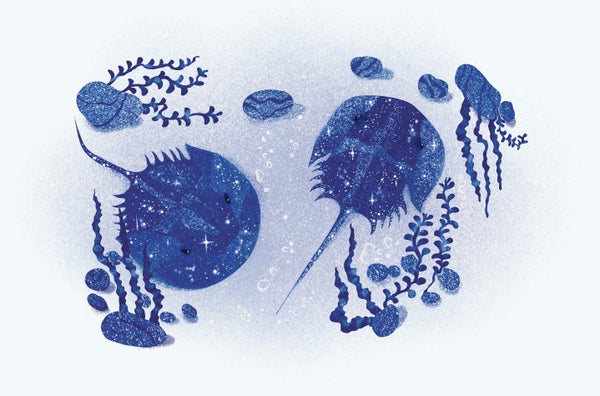
A drawing of two sparkling blue horseshoe crabs with floating kelp around them.

Masha Foya

Join Our Community of Science Lovers!

An alien’s bumper car with strange bulging eyes
but no anti-gravity plasma engine,
just ten unseen spidery legs

that have churned the seas for eons
before we named it the horseshoe crab
in a failure of imagination.

Its fierce-looking sword is a rudder.
Not knowing you shouldn’t use it to pick one up,
I did, once, but luckily it swam off unscathed.


On supporting science journalism

If you're enjoying this article, consider supporting our award-winning journalism by subscribing. By purchasing a subscription you are helping to ensure the future of impactful stories about the discoveries and ideas shaping our world today.


It lays soft blobs of pale green eggs
that feed ravenous red knots,
and its bright blue blood flags germs.

Survivor of two mass extinctions,
unchanged for 250 million years,
Limulus polyphemus can’t be improved.

Once I caught their mating. Hundreds stormed
the shallows of a high-tide beach,
two or three males clinging to each female.

Mesmerized by that full-moon spring orgy,
I laughed, stupidly
unreasonably happy.

It’s Time to Stand Up for Science

If you enjoyed this article, I’d like to ask for your support. Scientific American has served as an advocate for science and industry for 180 years, and right now may be the most critical moment in that two-century history.

I’ve been a Scientific American subscriber since I was 12 years old, and it helped shape the way I look at the world. SciAm always educates and delights me, and inspires a sense of awe for our vast, beautiful universe. I hope it does that for you, too.

If you subscribe to Scientific American, you help ensure that our coverage is centered on meaningful research and discovery; that we have the resources to report on the decisions that threaten labs across the U.S.; and that we support both budding and working scientists at a time when the value of science itself too often goes unrecognized.

In return, you get essential news, captivating podcasts, brilliant infographics, can't-miss newsletters, must-watch videos, challenging games, and the science world's best writing and reporting. You can even gift someone a subscription.

There has never been a more important time for us to stand up and show why science matters. I hope you’ll support us in that mission.