





June 16, 2026
The M.I.T. cosmologist shares his thoughts on physics, the federal funding of science and the resilience of the scientific community
Rick Friedman/rickfriedman.com/Corbis via Getty Images
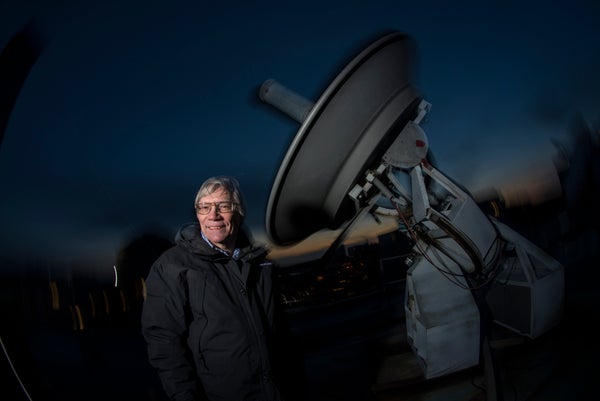
Alan Guth is an American theoretical physicist and cosmologist at the Massachusetts Institute of Technology. He is best known for proposing the theory of cosmic inflation, a concept that transformed modern understanding of the early universe and the evolution of the big bang.
[This interview was edited for length and clarity.]
How would you describe the current state of American science?
If you're enjoying this article, consider supporting our award-winning journalism by subscribing. By purchasing a subscription you are helping to ensure the future of impactful stories about the discoveries and ideas shaping our world today.
I think the scientific community is amazingly strong. I think the level of funding from the federal government is unfortunately very much in jeopardy right now. And I think I’m very worried that we are in a downhill stretch. I certainly hope it will be turned around at the next elections, but we have to see if that happens or not.
What needs to change in American science?
The main thing that I think needs to change is the attitude toward science on the part of the federal government and maybe, to some extent, on the part of the public as well. And I find it totally absurd to hear Trump talking about the “climate hoax.” In the scientific community, there are a few outliers, but by and large, there’s a pretty universal agreement among scientists that the climate crisis is real and important. That’s something that needs to be addressed, and I think what we need is a government that recognizes that.
What’s your best advice for an early-career scientist?
I think what I’d say is that physics is for people who love it. To those people, I would say, “Keep fighting, and hopefully you’ll succeed.” At the same time, I would warn those people that there’s always a chance that it will not work out; they should only pursue it if they love it so much that they would feel that they still benefited even if they only got to work on it for six, seven years and then got pushed out of the field.
I would also say that the people who have been pushed out of the field, the ones I know, found things that they’re happy with. There are other interesting problems that often involve many of the same techniques that we’ve developed as theoretical physicists or experimental physicists. So there certainly is a good chance of a soft landing, even for those who are ultimately in a position where they find themselves without a job.
How has your field changed in the past few years?
In cosmology itself, there has been quite a bit of progress in the past five years to develop the theoretical techniques to understand these three-dimensional data that have been gathered by new devices…. With new techniques, we’re able to unravel, to make sense out of, what we’re observing. A lot of progress has been made on those lines, so in terms of the physics of the field, I think things are going great. But to me, the real problem is the prospects for future funding.
If you enjoyed this article, I’d like to ask for your support. Scientific American has served as an advocate for science and industry for 180 years, and right now may be the most critical moment in that two-century history.
I’ve been a Scientific American subscriber since I was 12 years old, and it helped shape the way I look at the world. SciAm always educates and delights me, and inspires a sense of awe for our vast, beautiful universe. I hope it does that for you, too.
If you subscribe to Scientific American, you help ensure that our coverage is centered on meaningful research and discovery; that we have the resources to report on the decisions that threaten labs across the U.S.; and that we support both budding and working scientists at a time when the value of science itself too often goes unrecognized.
In return, you get essential news, captivating podcasts, brilliant infographics, can't-miss newsletters, must-watch videos, challenging games, and the science world's best writing and reporting. You can even gift someone a subscription.
There has never been a more important time for us to stand up and show why science matters. I hope you’ll support us in that mission.
此内容由惯性聚合(RSS阅读器)自动聚合整理,仅供阅读参考。 原文来自 — 版权归原作者所有。