







The El Niño climate event is due to return this year, with U.S. forecasters predicting an 82 percent chance of it coming in May through July and a 96 percent chance for it doing so in December through February 2027
By Jackie Flynn Mogensen edited by Claire Cameron
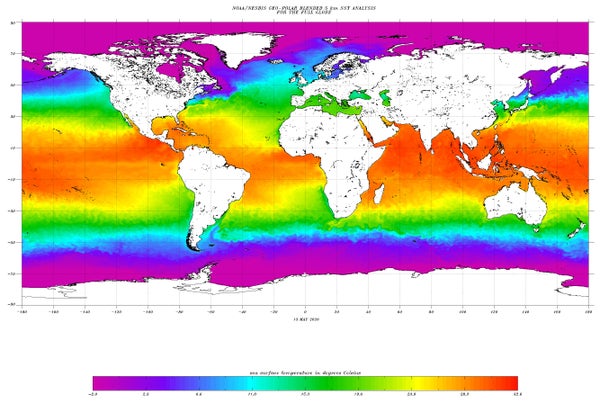
Sea surface temperatures for May 13, 2026.
Join Our Community of Science Lovers!
El Niño is almost certain to make its return this year, and it may stick around through the winter, the National Weather Service (NWS) announced on Thursday.
There’s an 82 percent chance that El Niño will “emerge” between May and July and a 96 percent chance it will continue from December through February 2027. It’s still unclear, however, how long or how strong this El Niño might be.
El Niño is a cyclic climate event that is fueled by ocean temperatures and wind. It can throw off weather patterns and drive up global temperatures, so preparation is key. In 2023 and 2024 the planet saw record-high temperatures in part because of an El Niño event that amplified the effects of climate change.
On supporting science journalism
If you're enjoying this article, consider supporting our award-winning journalism by subscribing. By purchasing a subscription you are helping to ensure the future of impactful stories about the discoveries and ideas shaping our world today.
Federal forecasters rely on a combination of measurements—sea surface temperatures and changes in wind patterns—to predict when El Niño will come back. To be an official El Niño year, ocean temperatures in a section of the Pacific Ocean must rise and stay about 0.5 degree Celsius higher than normal, according to the National Oceanic and Atmospheric Administration, which houses the National Weather Service.
Just a few months ago, in March, the United Nations’ World Meteorological Organization estimated that the chances of an El Niño return in May through July were about 40 percent. The most recent forecast indicates a much more elevated risk of early arrival.
It’s Time to Stand Up for Science
If you enjoyed this article, I’d like to ask for your support. Scientific American has served as an advocate for science and industry for 180 years, and right now may be the most critical moment in that two-century history.
I’ve been a Scientific American subscriber since I was 12 years old, and it helped shape the way I look at the world. SciAm always educates and delights me, and inspires a sense of awe for our vast, beautiful universe. I hope it does that for you, too.
If you subscribe to Scientific American, you help ensure that our coverage is centered on meaningful research and discovery; that we have the resources to report on the decisions that threaten labs across the U.S.; and that we support both budding and working scientists at a time when the value of science itself too often goes unrecognized.
In return, you get essential news, captivating podcasts, brilliant infographics, can't-miss newsletters, must-watch videos, challenging games, and the science world's best writing and reporting. You can even gift someone a subscription.
There has never been a more important time for us to stand up and show why science matters. I hope you’ll support us in that mission.