






Here’s what MAHA voters really want from healthcare policy
A new KFF poll found that voters aligned with the “Make America Healthy Again” movement consider the cost of health care as their top policy priority
By Jackie Flynn Mogensen edited by Claire Cameron
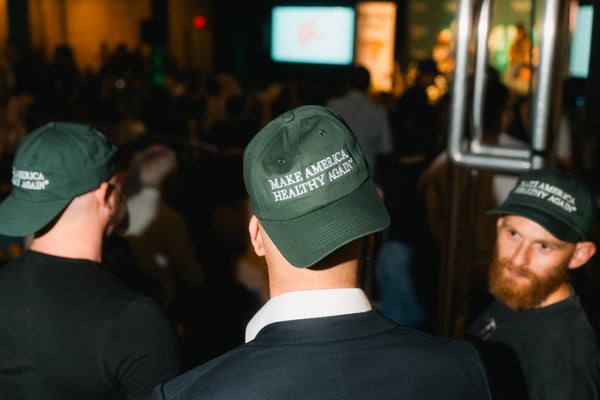
Attendees wear "Make American Healthy Again" hats during an "Eat Real Food" rally at Brazos Hall in Austin, Texas, US, on Thursday, Feb. 26, 2026.
Jordan Vonderhaar/Bloomberg/Getty Images
Join Our Community of Science Lovers!
“Make America Healthy Again” (MAHA) voters across the political spectrum say lower health care costs are their top policy priority, according to a new poll—outranking signature MAHA issues like vaccine safety and pesticide-free foods.
The MAHA movement, spearheaded by Health Secretary Robert F. Kennedy, Jr., promotes policies such as shifting away from processed foods and encouraging regular exercise. But it’s also sparked controversy and criticism from public health experts and doctors because some MAHA figures, including Kennedy, question the science underlying vaccines and the causes of conditions such as autism.
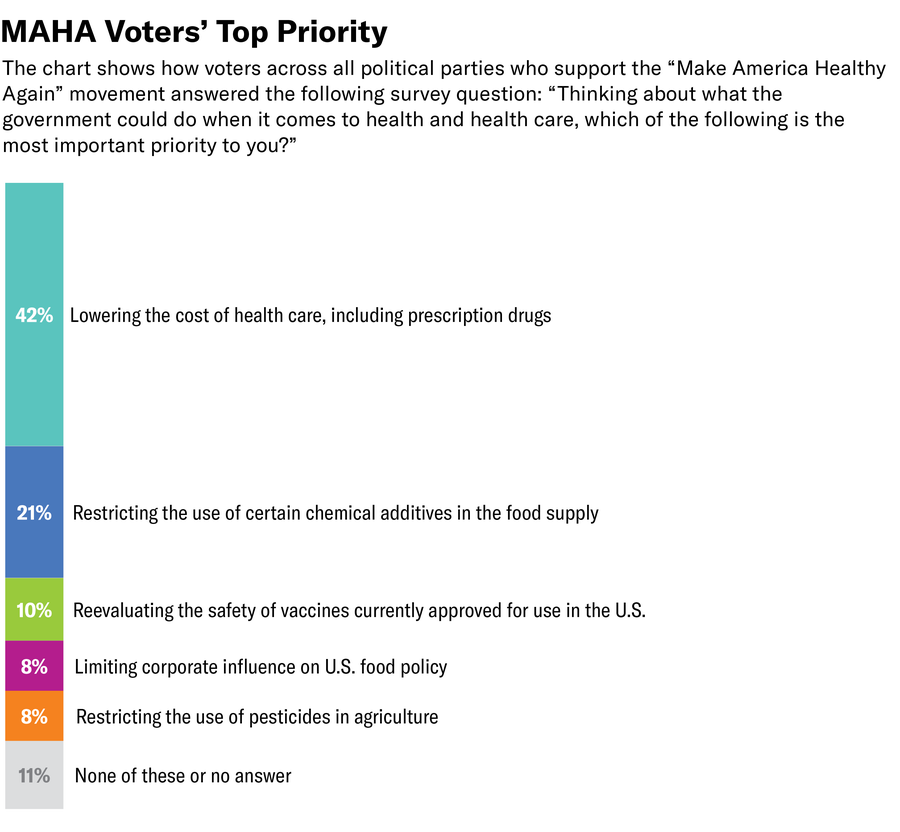
The new poll, released Wednesday by KFF, asked voters who support the MAHA movement about their top policy priorities. Overall, 42 percent said that “lowering the cost of health care, including prescription drugs” was their number one issue. Cutting back on “chemical additives in the food supply” came in second, with 21 percent of MAHA voters listing it as their top priority, followed by “reevaluating the safety of vaccines” in the U.S., which was ranked first by 10 percent of MAHA voters.
On supporting science journalism
If you're enjoying this article, consider supporting our award-winning journalism by subscribing. By purchasing a subscription you are helping to ensure the future of impactful stories about the discoveries and ideas shaping our world today.
Amanda Montañez; Source: KFF (data)
Interestingly, support for lower health care costs carried across political parties. About half of MAHA voters in the poll were registered Republicans, nearly a third were Independents, and 15 percent were Democrats. But all of these groups, including 57 percent of Democrat MAHA voters and 40 percent of Republicans, listed health care as their top priority. KFF conducted the poll in April 2026, and it involved more than 1,300 people.
Health care costs were so important to MAHA voters, in fact, that the majority, 56 percent, said it would have a “major impact” on who they will vote for in the upcoming 2026 midterm election. About half of MAHA voters said it would impact whether they head to the polls at all.
Heath care is expensive—it costs the U.S. nearly $15,000 per person, according to the American Medical Association. That's more than other wealthy countries spend, including Switzerland (about $10,000 per person), Germany (about $9,400), and the Netherlands (about $8,400), KFF estimates. Drug prices are also nearly three times higher in the U.S. than in similar countries, according to a 2024 Health and Human Services (HHS) report.
It’s Time to Stand Up for Science
If you enjoyed this article, I’d like to ask for your support. Scientific American has served as an advocate for science and industry for 180 years, and right now may be the most critical moment in that two-century history.
I’ve been a Scientific American subscriber since I was 12 years old, and it helped shape the way I look at the world. SciAm always educates and delights me, and inspires a sense of awe for our vast, beautiful universe. I hope it does that for you, too.
If you subscribe to Scientific American, you help ensure that our coverage is centered on meaningful research and discovery; that we have the resources to report on the decisions that threaten labs across the U.S.; and that we support both budding and working scientists at a time when the value of science itself too often goes unrecognized.
In return, you get essential news, captivating podcasts, brilliant infographics, can't-miss newsletters, must-watch videos, challenging games, and the science world's best writing and reporting. You can even gift someone a subscription.
There has never been a more important time for us to stand up and show why science matters. I hope you’ll support us in that mission.