







On Thursday Knicks fans are flocking to Manhattan for a ticker-tape parade. But where did ticker tape even come from?
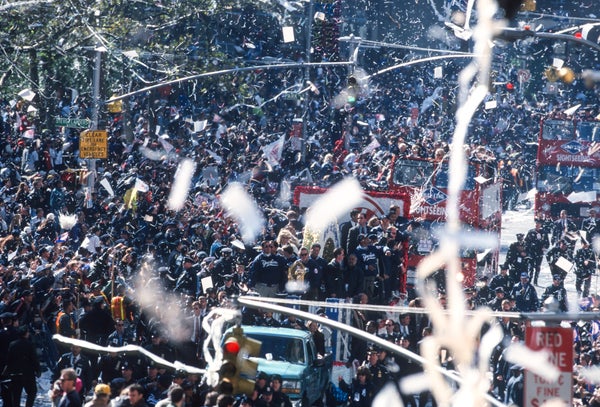
New Yorkers celebrate the New York Yankees during a ticker-tape parade in New York City in 1998.
Simon M Bruty/Getty Images
Knicks fans are flocking to lower Manhattan on Thursday to celebrate the New York Knicks winning the National Basketball Association (NBA) championship—the team’s first title in more than a half-century—with a distinctly New York City tradition: a ticker-tape parade.
But what even is ticker tape? And why do New Yorkers throw it at parades? It’s more important to the country’s history than you might think.
Ticker-tape parades started in 1886, when New York City celebrated the dedication of the Statue of Liberty. Then Manhattan workers threw bits of paper—ticker tape—like wedding confetti from office building windows as the parade passed below them. The parade route along Broadway has since become known as the “Canyon of Heroes”—and the ticker-tape tradition has stuck.
If you're enjoying this article, consider supporting our award-winning journalism by subscribing. By purchasing a subscription you are helping to ensure the future of impactful stories about the discoveries and ideas shaping our world today.
“When the Knicks won, and I heard that they were going to have a ticker-tape parade, I thought, ‘Oh, my god, ticker tape—good grief, nobody even knows what that is anymore,’” jokes Joseph Janes, an associate professor at the University of Washington Information School and host of the podcast Documents That Changed the World.
Ticker tape gets its name from the stock ticker, or stock printer, a kind of telegraph machine that was first invented in 1867 by the American Telegraph Company’s Edward A. Calahan—who created a design that was later improved upon by Thomas Edison. Stock printers received information about stock prices over telegraph wires and printed them out on a ribbon of paper—ticker tape. The name “ticker” caught on because of the tick tick tick sound the device made while printing, Janes says.

Ticker tape, circa 1970.
Blank Archives/Getty Images
“Prior to tickers, you needed to be either close to a stock exchange or in the stock exchange to get any idea of what current market prices were,” says Kristin Aguilera, deputy director of the Museum of American Finance in Boston. “If you were not in one of those areas, you would have to wait until they printed the stock prices at the end of each day and then wait to receive it by mail, messenger, carrier pigeon [or] flag signals,” she says.
At the time, the stock ticker, which worked using preexisting telegraph lines, was a “huge innovation,” she says. For the first time, people could transmit stock prices in “very close to real time,” Aguilera says. By the turn of the century, tickers were everywhere—in brokerages, wealthy investors’ homes, news offices, and more, she says. “Anybody who needed access to up-to-date financial information would have a ticker.”
But the ticker could only print so fast: And at extremely high trade volumes, it’d fall behind. This wasn’t much of a problem when the market was up, Janes says. But during the market crash of 1929, it fanned the flames of panic.
As the market was crashing, stock tickers were delayed, at some points by as much as hours. “People freaked and sold and sold and sold, and that just drove the market down further,” Janes says. One day, as Janes chronicles in an episode of Documents That Changed the World, tourist buses made trips to the city to see a ravaged Wall Street, littered with ticker paper. “Tourists were picking up pieces of stock orders and ticker tape because they’re just lying in the street,” Janes says.

A constant shower of ticker tape emerges from a machine at the Toronto Stock Exchange, circa 1955.
Evans/Three Lions/Getty Images
Over the years, inventors improved on the design with faster models (such as an iteration described in a 1930 Scientific American article). Ultimately, the stock ticker was used until the 1960s. Excess tape was employed for parades—fueling the New York City tradition. Today, however, shredded paper is used in place of ticker tape.
Since the 19th century, the city has held hundreds of ticker-tape parades, according to the Downtown Alliance. The most recent was in 2025 to honor Gotham Football Club’s victory in the National Women’s Soccer League finals that year. This year will be the Knicks’ first; when the team won the NBA’s championships in 1970 and 1973, for one reason or another, the city didn’t hold a ticker-tape parade. (The mayor typically determines when to host one.)
And although we don’t use stock tickers today, their legacy hasn’t been lost. The stock-trading banner that runs at the bottom of television news broadcasts is still called the “ticker,” and stock movements are called “ticks,” Janes says.
Technologies used today, from the TV news “ticker” to Bitcoin, are “a factor of where we’ve come from, the people who have come before us” and the inventions of the past, Aguilera says. “Whenever you’re talking about a technology, nothing is born out of thin air. All of these inventions built on the ones that came before them.”
If you enjoyed this article, I’d like to ask for your support. Scientific American has served as an advocate for science and industry for 180 years, and right now may be the most critical moment in that two-century history.
I’ve been a Scientific American subscriber since I was 12 years old, and it helped shape the way I look at the world. SciAm always educates and delights me, and inspires a sense of awe for our vast, beautiful universe. I hope it does that for you, too.
If you subscribe to Scientific American, you help ensure that our coverage is centered on meaningful research and discovery; that we have the resources to report on the decisions that threaten labs across the U.S.; and that we support both budding and working scientists at a time when the value of science itself too often goes unrecognized.
In return, you get essential news, captivating podcasts, brilliant infographics, can't-miss newsletters, must-watch videos, challenging games, and the science world's best writing and reporting. You can even gift someone a subscription.
There has never been a more important time for us to stand up and show why science matters. I hope you’ll support us in that mission.
此内容由惯性聚合(RSS阅读器)自动聚合整理,仅供阅读参考。 原文来自 — 版权归原作者所有。