











The Lyrid meteor shower hits its peak from April 21 to April 22. Here’s everything you need to know about this annual celestial light show
By Claire Cameron edited by Jeanna Bryner
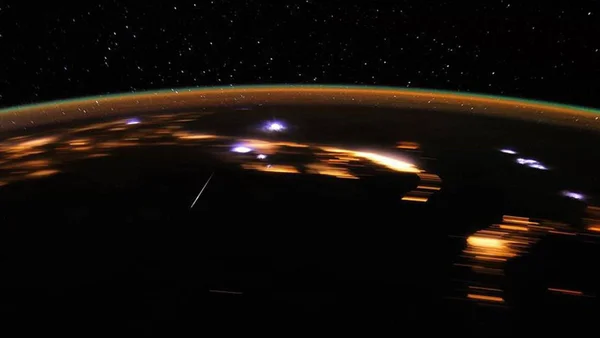
NASA/JSC/D. Pettit
Join Our Community of Science Lovers!
It’s April, spring is springing, and the Lyrid meteor shower is here to light up the night sky in celebration. One of the oldest known meteor showers, the Lyrids have attracted awe from sky watchers for more than 2,700 years, according to NASA. And it’s easy to see why: this meteor shower is known for its bright, fast meteors and an occasional fireball.
During meteor showers, Earthlings ooh and aah over bits of rock that have broken off comets or asteroids as the travel around the sun. Every year our planet passes through these debris trails. And when these particles hit our atmosphere, they fall and burn up, creating the luminous streaks in the night sky that we call shooting stars. The Lyrids are the product of Comet C/1861 G1 Thatcher, which was discovered in 1861.
Sometimes the Lyrids produce spectacular showers with as many as 100 meteors visible in an hour, but they are usually a little less showy, with 18 or so meteors per hour.
On supporting science journalism
If you're enjoying this article, consider supporting our award-winning journalism by subscribing. By purchasing a subscription you are helping to ensure the future of impactful stories about the discoveries and ideas shaping our world today.
This year the Lyrids will peak on the nights of April 21 and April 22, with the maximum hitting at about 4 P.M. EDT on Wednesday. But the show will be visible in the early hours of the morning or after sunset around that time. Although the shower is the product of a comet, the meteors will appear to originate in the night sky near the constellation Lyra, close to its brightest star, Vega. According to NASA, it’s actually better to look slightly away from this point to see the meteors streak across the sky.
For the best chance of viewing the Lyrids, find a dark, safe area with as little light pollution as possible. Give your eyes 30 minutes to adjust to the dark. Lie on your back with your feet to the east, look up and enjoy.
It’s Time to Stand Up for Science
If you enjoyed this article, I’d like to ask for your support. Scientific American has served as an advocate for science and industry for 180 years, and right now may be the most critical moment in that two-century history.
I’ve been a Scientific American subscriber since I was 12 years old, and it helped shape the way I look at the world. SciAm always educates and delights me, and inspires a sense of awe for our vast, beautiful universe. I hope it does that for you, too.
If you subscribe to Scientific American, you help ensure that our coverage is centered on meaningful research and discovery; that we have the resources to report on the decisions that threaten labs across the U.S.; and that we support both budding and working scientists at a time when the value of science itself too often goes unrecognized.
In return, you get essential news, captivating podcasts, brilliant infographics, can't-miss newsletters, must-watch videos, challenging games, and the science world's best writing and reporting. You can even gift someone a subscription.
There has never been a more important time for us to stand up and show why science matters. I hope you’ll support us in that mission.