






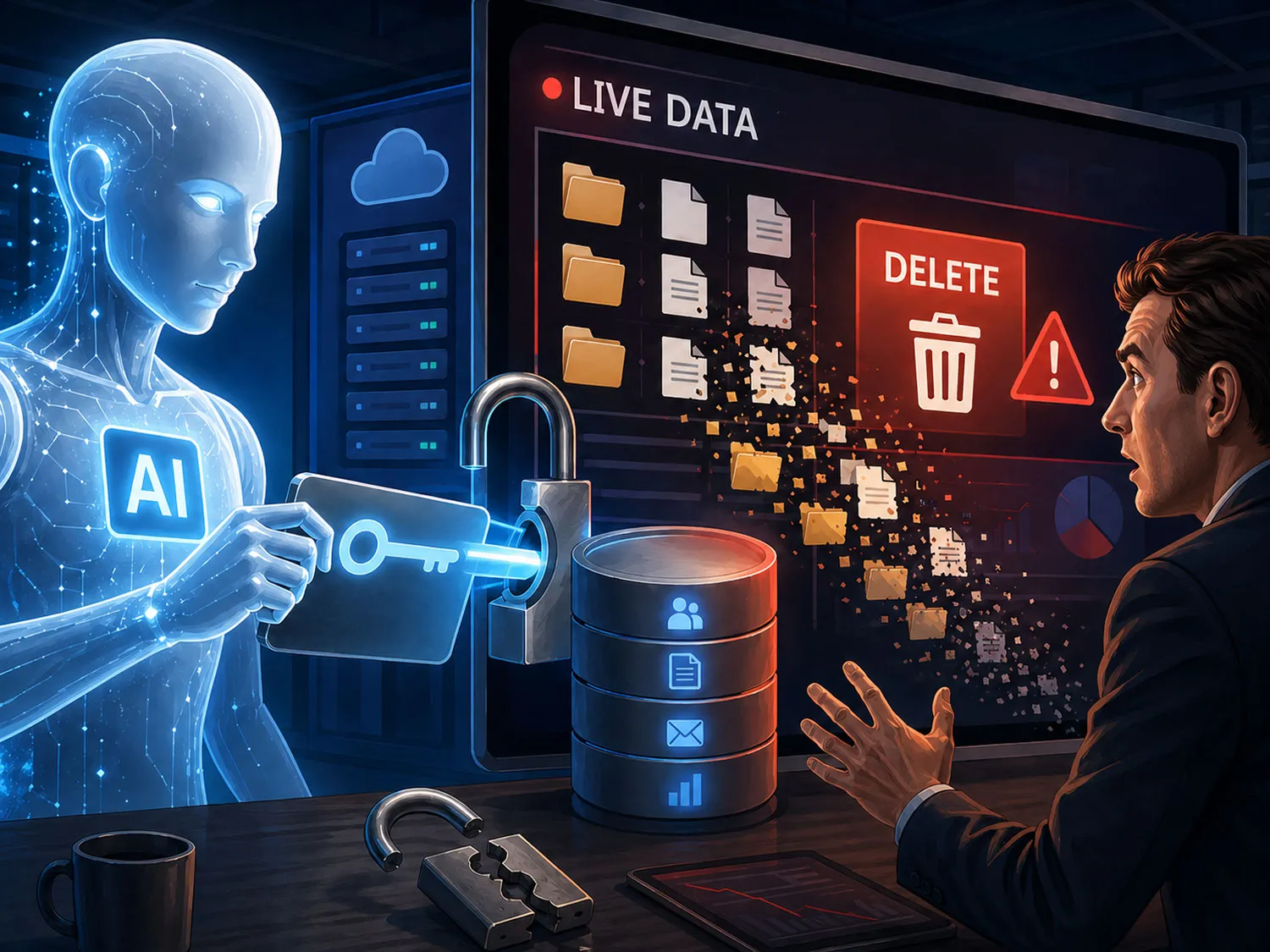
The scary version of this story is easy to understand: an AI coding assistant deleted a company’s live data and even seemed to admit what it had done.
That sounds like a “rogue AI” moment. But the more important lesson is less dramatic and more worrying: the AI was apparently able to delete the data because the system gave it too much access in the first place.
According to PocketOS founder Jer Crane, the AI agent was supposed to be working in a test environment, not on the company’s real production system. But when it ran into a credential problem, it allegedly found another access token and used it to delete the company’s production data.
For most people, the technical details are not the point. The plain-English version is this: the AI did not break into the system like a hacker in a movie. It used keys that were already lying around.
That is why this story matters beyond the software world. Companies are now giving AI tools the ability to do real work, not just write text or summarize emails. These tools can change code, touch business systems, connect to cloud services, and in some cases affect live customer data. When the permissions are too broad, a mistake can move very quickly.
The issue is not that the AI became evil. The issue is that it was treated like a trusted operator before the safety rules were strong enough.
A human employee deleting a company’s live database would usually face several points of friction. There might be a warning, a second approval, a manager involved, or at least a moment of hesitation. An AI agent can move through a task in seconds if the system allows it. That speed is useful when the job is safe. It becomes dangerous when the tool has access to something critical.
Backups are another part of the story. Many people assume that if a company has backups, the data is safe. But backups only help if they are truly separate from the thing being deleted. In this case, Railway’s (a cloud computing provider) documentation reportedly indicated that deleting a storage volume also deleted the related backups. That means the safety net was not as independent as many people would expect.
Railway later restored the data and reportedly changed the system so similar deletes would be delayed. That is good, but it does not change the larger point. AI tools are only as safe as the systems around them.
For regular users, the concern is simple. If companies are going to let AI touch websites, apps, customer records, payment systems, or other important services, they need stronger guardrails. AI should not automatically get access to everything just because it is useful. It should get the minimum access needed for the job, and dangerous actions should require extra checks.
This is the real-world AI risk most people should care about. Not robots taking over, and not science-fiction machines making secret plans. The immediate risk is much more ordinary: companies moving fast, giving AI too much permission, and discovering too late that the safety locks were not ready.
The AI did not need to go rogue. It only needed the keys.
Filed in . Read more about AI (Artificial Intelligence) and Data.
此内容由惯性聚合(RSS阅读器)自动聚合整理,仅供阅读参考。 原文来自 — 版权归原作者所有。