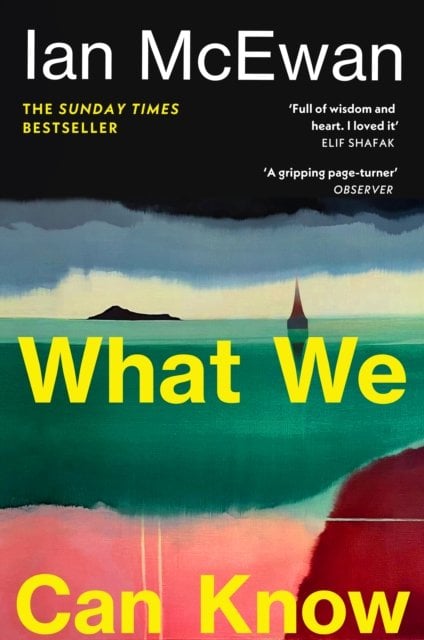
This is Ian McEwan’s second foray into science fiction after his alternative history novel, Machines Like Me. I enjoyed that book but it was far too eager to show off its worldbuilding—at one point a character practically looks at the camera like Tim in The Office.
There’s a bit of that in What We Can Know with its expository passages explaining what’s been happening in the 21st and 22nd centuries, but it mostly works.
As with all McEwan’s work, it’s extremely English. He just has to have some clashing of the classes in there.
The book has an unusual structure, switching between the present day and a climate-ravaged future one hundred years from now. A future scholar is obsessed with a poem from our time period that was never published. At times the book feels like a whodunnit, complete with all the suspects assembled together in a country house.
If the structure is unusual, the tonal swings are really something. We go from high-brow pondering of the utility of art in the face of catastrophe to downright schlocky soap-opera shenanigans. My eyebrows may have gotten whiplash.
But I guess it all worked somehow because I found myself turning the pages, eager to reach the final revelations.
Still, there was one thing that really bothered me. In order for the plot to work, our future scholar needs to have access to emails, chats, and other digital artificats from today. We get an explanation of how the cryptography has been cracked by quantum computers, but it’s simply taken as given that the files themselves would be available, having survived in “The Cloud”.
I can’t really blame Ian McEwan here; here’s just repeating the oft-retold advice that you should be careful what you put online because it’ll be there forever. But that warning simply isn’t true. The Cloud dissolves very, very quickly. Just ask the folks at the Internet Archive.
But if your credulity can stretch to accept the naïvely optimistic depiction of digital preservation in What We Can Know, it’s an enjoyable romp.
The Culture is a utopia: a future you might actually want to live in. It offers a coherent political vision. This isn’t subtle or allegorical; on the page, citizens of the Culture very frequently articulate and defend their values. (Their enthusiasm for their own politics is considered annoying by most other civilizations.)
Coherent political vision doesn’t require a lot, just some sense of “this is what we ought to do”, yet it is absent from plenty of science fiction that dwells only in the realm of the cautionary tale.
I don’t have much patience left for that genre. I mean … we have been, at this point, amply cautioned.
Comparing and contrasting two different takes on long-term thinking in sci-fi: Dune and Foundation.
In a moment of broader cultural gloominess, Dune’s perspective may resonate more with the current movie-going public. Its themes of long-term ecological destruction, terraforming, and the specter of religious extremism seem in many ways ripped out of the headlines, while Asimov’s technocratic belief in scholarly wisdom as a shining light may be less in vogue. Ultimately, though, the core appeal of these works is not in how each matches with the fashion of today, but in how they look forward through thousands of years of human futures, keeping our imagination of long-term thinking alive.
It is common to refer to universally popular social media sites like Facebook, Instagram, Snapchat, and Pinterest as “walled gardens.” But they are not gardens; they are walled industrial sites, within which users, for no financial compensation, produce data which the owners of the factories sift and then sell. Some of these factories (Twitter, Tumblr, and more recently Instagram) have transparent walls, by which I mean that you need an account to post anything but can view what has been posted on the open Web; others (Facebook, Snapchat) keep their walls mostly or wholly opaque. But they all exercise the same disciplinary control over those who create or share content on their domain.
Professor Alan Jacobs makes the case for the indie web:
We need to revivify the open Web and teach others—especially those who have never known the open Web—to learn to live extramurally: outside the walls.
What do I mean by “the open Web”? I mean the World Wide Web as created by Tim Berners-Lee and extended by later coders. The open Web is effectively a set of protocols that allows the creating, sharing, and experiencing of text, sounds, and images on any computer that is connected to the Internet and has installed on it a browser that can interpret information encoded in conformity with these protocols.
This resonated strongly with me:
To teach children how to own their own domains and make their own websites might seem a small thing. In many cases it will be a small thing. Yet it serves as a reminder that the online world does not merely exist, but is built, and built to meet the desires of certain very powerful people—but could be built differently.