
惯性聚合 高效追踪和阅读你感兴趣的博客、新闻、科技资讯
阅读原文 在惯性聚合中打开

推荐订阅源

G
GRAHAM CLULEY
Recorded Future
Recorded Future
Cyber Security Advisories - MS-ISAC
小众软件
小众软件
Microsoft Azure Blog
博客园 - 叶小钗
A
About on SuperTechFans
让小产品的独立变现更简单 - ezindie.com
月光博客
月光博客
MongoDB | Blog
MongoDB | Blog
Apple Machine Learning Research
罗磊的独立博客
人人都是产品经理
人人都是产品经理
Engineering at Meta
Engineering at Meta
WordPress大学
WordPress大学
博客园 - Franky
Google DeepMind News
Security Latest
Security Latest
Exploit-DB.com RSS Feed
Project Zero
Project Zero
N
News and Events Feed by Topic
I
Intezer
C
Check Point Blog
V
Visual Studio Blog
T
Tenable Blog
博客园 - 司徒正美
钛媒体:引领未来商业与生活新知
钛媒体:引领未来商业与生活新知
PCI Perspectives
PCI Perspectives
H
Help Net Security
www.infosecurity-magazine.com
The Cloudflare Blog
SecWiki News
SecWiki News
Vercel News
Vercel News
爱范儿
爱范儿
Recent Announcements
Spread Privacy
Spread Privacy
T
Threatpost
Last Week in AI
Last Week in AI
V
V2EX
O
OpenAI News
M
MIT News - Artificial intelligence
博客园 - 【当耐特】
腾讯CDC
Forbes - Security
Forbes - Security
Microsoft Security Blog
AI
AI
Hacker News - Newest:
Hacker News - Newest: "LLM"
F
Full Disclosure
C
CXSECURITY Database RSS Feed - CXSecurity.com
P
Palo Alto Networks Blog

Mapping the <mark>Internet</mark> on Netlas: Comprehensive Internet-Wide Scanning & OSINT Platform

Weaponized RMM: Hunting the Adversary Abuse of Remote Monitoring Tools Device Code Phishing: Technical Analysis and Proactive Hunting via Netlas Discovering Data Exposure with Netlas Telegram Bot API Abuse - Netlas Blog Using OWASP Amass with Netlas Module - Netlas Blog Using Uncover with Netlas.io module - Netlas Blog Netlas Updates Terms and API & Data License Agreement - Netlas Blog Top 10 Hacking Devices for Ethical Hackers in 2026 - Netlas Blog Inside ClickFix: How Fake Prompts Took Over the Web Top 10 Critical Threat Actors to Watch in 2026: Ransomware, APTs & Defensive Strategies - Netlas Blog Bug Bounty 101 - A Complete Bug Bounty Roadmap for Beginners (2026) - Netlas Blog Supply Chain Attack - How Attackers Weaponize Software Supply Chains - Netlas Blog The Evolution of C2: Centralized to On-Chain - Netlas Blog From Starlink to Star Wars - The Real Cyber Threats in Space - Netlas Blog LLM Vulnerabilities: Why AI Models Are the Next Big Attack Surface - Netlas Blog When AI Turns Criminal: Deepfakes, Voice-Cloning & LLM Malware - Netlas Blog Zero-Click Exploits - Netlas Blog When Patches Fail: An Analysis of Patch Bypass and Incomplete Security - Netlas Blog I Analysed Over 3 Million Exposed Databases Using Netlas - Netlas Blog Post-Quantum Now: From AES & RSA to ML-KEM Hybrids - Netlas Blog Bug Bounty 101: Top 10 Reconnaissance Tools - Netlas Blog Mapping Dark Web Infrastructure - Netlas Blog Top Vibe-Coding Security Risks - Netlas Blog From Chaos to Control: Kanvas Incident Management Tool - Netlas Blog Bug Bounty 101: The Best Courses to Get Started in 2025 - Netlas Blog I, Robot + NIST AI RMF = Complete Guide on Preventing Robot Rebellion - Netlas Blog The $1.5B Bybit Hack & How OSINT Led to Its Attribution - Netlas Blog Hannibal Stealer: A Deep Technical Analysis - Netlas Blog Proactive Threat Hunting: Techniques to Identify Malicious Infrastructure - Netlas Blog The Pyramid of Pain: Beyond the Basics - Netlas Blog SOCMINT: Intelligence in the Social Media Era - Netlas Blog Hannibal Stealer vs. Browser Security - Netlas Blog The Largest Data Breach Ever? How Hackers Stole 16 Billion Credentials - Netlas Blog DNS Cache Poisoning – Is It Still Relevant? - Netlas Blog Modern Cybercrime: Who’s Behind It and Who’s Stopping It - Netlas Blog AI-Driven Attack Surface Discovery - Netlas Blog Netlas vs Urlscan: Tools Comparison - Netlas Blog Track Adversary Infrastructure Challenge 2025 Recap - Netlas Blog What is Threat Intelligence - Netlas Blog Netlas vs IPinfo: Tools Comparison - Netlas Blog Best Nmap Alternatives - Netlas Blog Whois History: How to Check the Domain Owner History - Netlas Blog Top WHOIS & RDAP Tools for Fast IP Address Lookup - Netlas Blog ASN Lookup Explained: Tools, Methods & Insights - Netlas Blog How to Detect CVEs Using Nmap Vulnerability Scan Scripts - Netlas Blog Nmap Cheat Sheet: Top 10 Scan Techiques - Netlas Blog Netlas vs ZoomEye: Platforms Comparison - Netlas Blog Top 6 Most Widely Used Port Scanners in Cybersecurity - Netlas Blog FAQ: Understanding Root DNS Servers and the Root Zone - Netlas Blog Domain Recon: Must-Know Tools for Security Professionals - Netlas Blog DNS History: Exploring Domains Past by Inspecting DNS Trails - Netlas Blog DNSSEC: Should You Use It? An Expert’s View on the Pros, Cons, and When to Implement - Netlas Blog Which DNS Servers Offer the Best Balance of Speed, Security, and Privacy? - Netlas Blog theHarvester: a Classic Open Source Intelligence Tool - Netlas Blog - Netlas Blog Top 15 OSINT Tools for Expert Intelligence Gathering - Netlas Blog A Deep Dive into the Open Web Application Security Project Top 10 Vulnerabilities - Netlas Blog Using Subfinder with Netlas Module - Netlas Blog Netlas Chrome and Firefox Extensions - Netlas Blog Netlas vs Censys: Platforms Comparison - Netlas Blog OSINT in Cybersecurity: Exploring Its Spectrum and Tech - Netlas Blog Best Honeypots for Detecting Network Threats - Netlas Blog Using Maltego with Netlas Module - Netlas Blog Using theHarvester with Netlas - Netlas Blog Using TLDFinder with Netlas - Netlas Blog Netlas vs Fofa: Platforms Comparison - Netlas Blog Netlas vs Shodan: Platforms Comparison - Netlas Blog Google Dorking in Cybersecurity - Netlas Blog 7 Tools for Web Penetration Testing - Netlas Blog Using DNS History in Cybersecurity - Netlas Blog Mastering Online Camera Searches - Netlas Blog Best Attack Surface Visualization Tools - Netlas Blog Complete Guide on Attack Surface Discovery - Netlas Blog How to find unprotected databases with Netlas.io: Chapter 2 - Netlas Blog
How we hunt C2 infrastructure at RST Cloud using Netlas - Netlas Blog
Alex Gould, Yury Sergeev · 2026-03-20 · via Mapping the <mark>Internet</mark> on Netlas: Comprehensive Internet-Wide Scanning & OSINT Platform

Command-and-control (C2) infrastructure is the nervous system of most advanced attacks. Track it well and you get ahead of active campaigns before victims know they’re targeted. Track it poorly and you’re constantly reacting to stale indicators. At RST Cloud, C2 tracking is a core part of how we produce actionable threat intelligence, and Netlas is one of the tools that makes it work at scale.

This post walks through our C2 tracking methodology and shows how Netlas fits into the workflow with concrete search examples.
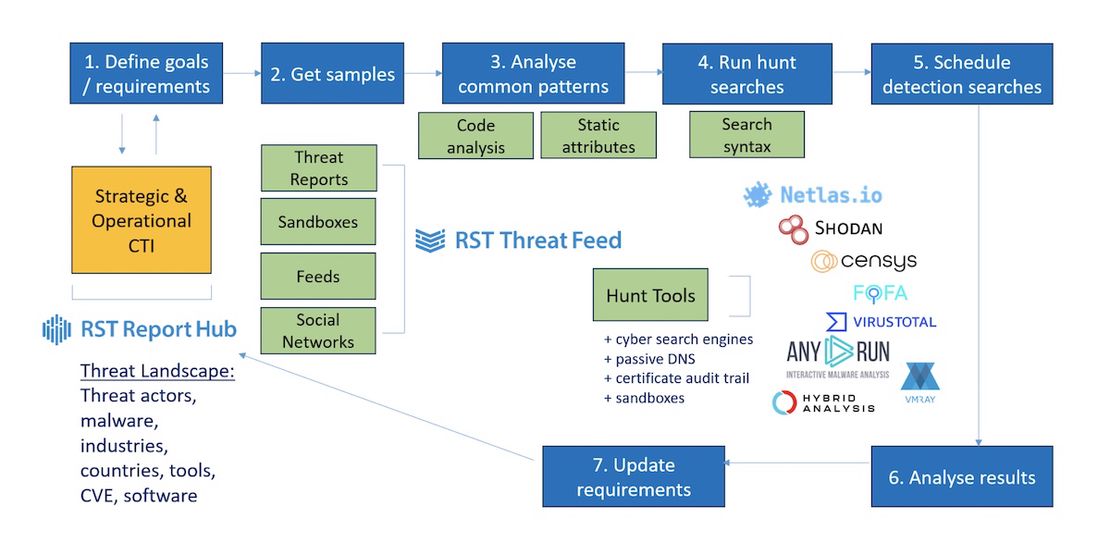
Hunting workflow scheme

The C2 Tracking Process

Before jumping to tools, it helps to understand the process. We run C2 tracking as a continuous loop with seven steps:

  1. Define goals and requirements: What threat actors, malware families, or tools are we tracking? This is driven by operational CTI: what’s active, what’s targeting our clients’ industries, and what’s emerging globally across the threat landscape.
  2. Get samples: Collect C2 indicators and beacon code from threat reports, sandbox detonations, threat feeds, and social media sharing. Our RST Threat Feed and Report Hub simplify this significantly, providing both current and historical C2 data.
  3. Analyse common patterns: Review samples to identify what makes a C2 server fingerprintable. Open-source C2 frameworks let you read actual source code to find unique HTML chunks, default certificates, specific HTTP headers, or communication patterns. Currently running malicious servers allow you to record their responses and identify a pattern to pivot for more.
  4. Run hunt searches: Execute queries against internet scanning engines to surface active infrastructure matching the fingerprints.
  5. Schedule detection searches: Automate the queries to run periodically so new infrastructure is caught as it comes online.
  6. Analyse results: Validate what you’re getting. False positives are common; therefore, avoid relying on a single parameter and instead validate results using multiple criteria. If a search returns zero results or thousands of results, the criteria may need adjustment.
  7. Update requirements: New C2 frameworks emerge, old ones get retired by threat actors. The loop starts again.

The analysis in step 3 is where the depth is. For open-source frameworks, you read the code and look for static identifiers: default page titles, specific JavaScript filenames, unique favicon hashes, and predictable certificate fields. For compiled beacons, you detonate them in a sandbox and capture network behaviour, including user agents, URI patterns, and TLS fingerprints.

A beacon is the malware component running on a compromised host that periodically checks in with a C2 server to receive commands and exfiltrate data.

Why Netlas Is Part of Our Stack

There’s no single internet scanning engine that does everything. Censys gives you fresh scan data quickly. FOFA has deep historical coverage. Shodan has a large installed base with a lot of community-developed queries.

Recommended Reading

Netlas vs Shodan: Platforms Comparison

Netlas has a specific strength that makes it valuable for C2 hunting: domain-level analysis. It also follows redirects, which helps uncover additional linked or otherwise hidden malicious URLs. When you’re investigating an IP hosting dozens of websites, you need to be able to cut through that noise and correlate properly. Netlas handles this well. It also supports a clean query syntax across HTTP response attributes, including titles, body content, favicon hashes, JARM fingerprints, and certificate metadata, which maps directly to the fingerprints we extract in step 3.

Netlas in Practice: Real Search Examples

Here’s how our queries translate into Netlas searches for specific C2 frameworks.

Hookbot C2, panel title

Hookbot operators regularly leave the default admin panel title in place. This is the simplest class of fingerprint to construct and often the most durable, because changing a panel title requires deliberate operator action rather than just server rotation.

http.title:"Hookbot Panel"

SectopRAT C2 servers consistently expose their interface on port 9000, return 404 on unauthenticated requests, and use the Microsoft-HTTPAPI/2.0 server header alongside a specific set of allowed HTTP methods. No single attribute here is unique in isolation. The combination is what makes it a useful fingerprint.

port:9000 AND http.headers.server:"Microsoft-HTTPAPI/2.0" AND http.status_code:404 AND http.headers.access_control_allow_methods:"OPTIONS, HEAD, GET, PUT, POST, DELETE, PATCH"

Cobalt Strike, certificate fingerprint

Cobalt Strike’s default self-signed certificate has been documented extensively, but operators still deploy it. Combined with other indicators, this remains a productive search.

certificate.fingerprint_md5:950098276A495286EB2A2556FBAB6D83

Recommended Reading

Top 10 Critical Threat Actors to Watch in 2026: Ransomware, APTs & Defensive Strategies

Cobalt Strike, JARM fingerprint

JARM fingerprints the TLS stack rather than certificate content, which means it survives certificate rotation. This value corresponds to the default Cobalt Strike listener TLS configuration. Because JARM alone can match non-malicious infrastructure sharing similar TLS libraries, treat results as a starting point for further validation rather than confirmed C2.

jarm:2ad2ad16d2ad2ad00042d42d00042ddb04deffa1705e2edc44cae1ed24a4da AND http.status_code:404 AND http.headers.content_type:"text/plain" AND http.headers.server:"Apache" AND http.headers.content_length:0

What is a JARM fingerprint?

A JARM fingerprint is a hash derived from how a server responds to multiple crafted TLS handshakes. It helps identify infrastructure by TLS behavior, even when certificates change.

Open directory exposure

Threat actors staging payloads often leave open directories on C2 infrastructure. This query is simple but consistently surfaces active staging servers. It is worth running routinely and pivoting from there.

http.title:"Directory listing for"

Recommended Reading

Proactive Threat Hunting: Techniques to Identify Malicious Infrastructure

The Domain Hosting Problem

One underappreciated challenge in C2 hunting is shared infrastructure. A malicious server sitting on an IP that also hosts dozens of legitimate sites creates noise in indicator feeds and can generate false positives in detection pipelines.

This is an area where Netlas earns its place. The ability to quickly understand what’s co-hosted on an IP, and to query at the domain level rather than just the IP level, helps with triage. It is the difference between adding a dirty shared IP to a feed and adding a precise domain or URL that actually identifies the threat.

What Scanning Engines Can’t See

Internet scanning is not a complete solution, and it’s worth being direct about the blind spots.

IPv4 is finite, with 65,535 ports across roughly 4 billion public addresses, but scanning engines do not cover all ports. They follow a limited number of redirects. Some infrastructure is intentionally rate-limited or responds differently to scanner IP ranges, which are partially known to sophisticated operators.

Then there’s C2 that doesn’t use open ports at all. Telegram bots, Discord webhooks, and Reddit-based C2 channels leave no port-listening footprint. Tracking these requires sandbox detonation: get the beacon, run it, capture the outbound connections. YARA rules applied to beacon executables are the other side of this, providing static analysis for string patterns, communication structures, and known hashes that identify the implant before it calls home.

YARA rules are pattern-matching signatures used to identify malware families or suspicious files based on strings, byte patterns, and logical conditions.

For example, our pipeline ingests Any.Run sandbox reports at scale and extracts both network and file indicators. The Netlas searches and sandbox analysis are complementary, not competing, approaches.

Recommended Reading

The Evolution of C2: Centralized to On-Chain

Turning Searches into a Feed

Running one-off queries is useful for investigation. Running them continuously is what produces a feed. Once a search is validated with a low false positive rate and consistent results, we schedule it. New results are processed, tagged with the appropriate malware family or threat actor cluster, and pushed into RST Threat Feed.

The loop then closes: analysts consuming the feed get C2 indicators with context, detection engineers get STIX patterns and Sigma rules built from the same data, and the intelligence requirements get updated when threat actors shift tooling.

STIX (Structured Threat Information Expression) is a standardized format for sharing cyber threat intelligence, including indicators, threat actors, malware, and relationships between them.

Infrastructure-specific queries have a finite lifespan as operators rotate or rebuild servers, which is exactly why scheduling regular re-runs matters: new deployments using the same framework defaults will surface in the next cycle.

Getting Started

The searches above are a starting point, not an exhaustive list. If you want to explore RST Cloud’s C2 intelligence data directly, a free demo and trial is available at rstcloud.com. For questions on methodology or integration, reach out at [email protected].

Calendar

Book Your Netlas Demo

Chat with our team to explore how the Netlas platform can support your security research and threat analysis.