




Typically, this blog focuses on tools designed for offensive security. Today, however, we’re shifting gears to explore the defensive side: the fascinating world of honeypots.
Tracking malicious actors can be an exhilarating and rewarding pursuit, and honeypots are one of the most effective tools for this purpose. These deceptive systems are designed to lure attackers and gather critical intelligence on their tactics and behavior.
In this article, we’ll break down what a honeypot is, how it operates, and provide you with a detailed list of the 20 best free and open source honeypots for capturing valuable threat intelligence when attackers engage with your decoy systems.
Before diving into the specifics, let’s take a step back to explore the foundational concepts that make honeypots such a powerful defensive strategy.
When a cyber attacker engages with the honeypot, it captures essential data about the intruder’s methods, objectives, and sometimes even their identity. This intelligence is incredibly valuable for understanding the threat landscape.
A honeypot operates as a decoy system, strategically vulnerable and typically hosted on virtual machines or cloud servers that are part of a network yet remain isolated and under close surveillance by system and network teams. To attract malicious actors, honeypots exhibit deliberate vulnerabilities — flaws that attackers are meant to find and exploit.
These vulnerabilities might include security gaps within an application or system weaknesses such as open ports that aren’t needed, obsolete software versions, simple passwords, or outdated, unpatched operating systems.
Once an attacker finds these vulnerabilities, they often try to break into the system and gain more control — aiming to take over the device or application. Meanwhile, everything they do is quietly recorded by the honeypot — giving security teams valuable data to improve defenses and, in serious cases, report the incident to law enforcement.
Assessing Risks of Honeypotting
While honeypots are powerful tools in the cybersecurity arsenal, they come with their own set of risks that need careful consideration. If not properly isolated and monitored, honeypots can inadvertently expose real network systems to attackers, leading to potential breaches.
Can attackers tell when they’re inside a honeypot? Absolutely.
Technically skilled users may notice subtle indicators that suggest they’ve entered a decoy environment. Tools like Shodan’s Honeyscore, which estimates the likelihood of an IP address being a honeypot, or Netlas with its rich software tagging capabilities, can aid in detection.
Let’s take a closer look at how to identify honeypots using Netlas.
Honeypots often emulate multiple services on a single port to attract a wide variety of malicious activity. While this approach may fool automated scanners, it’s typically easy for humans to spot. Consider the following response:
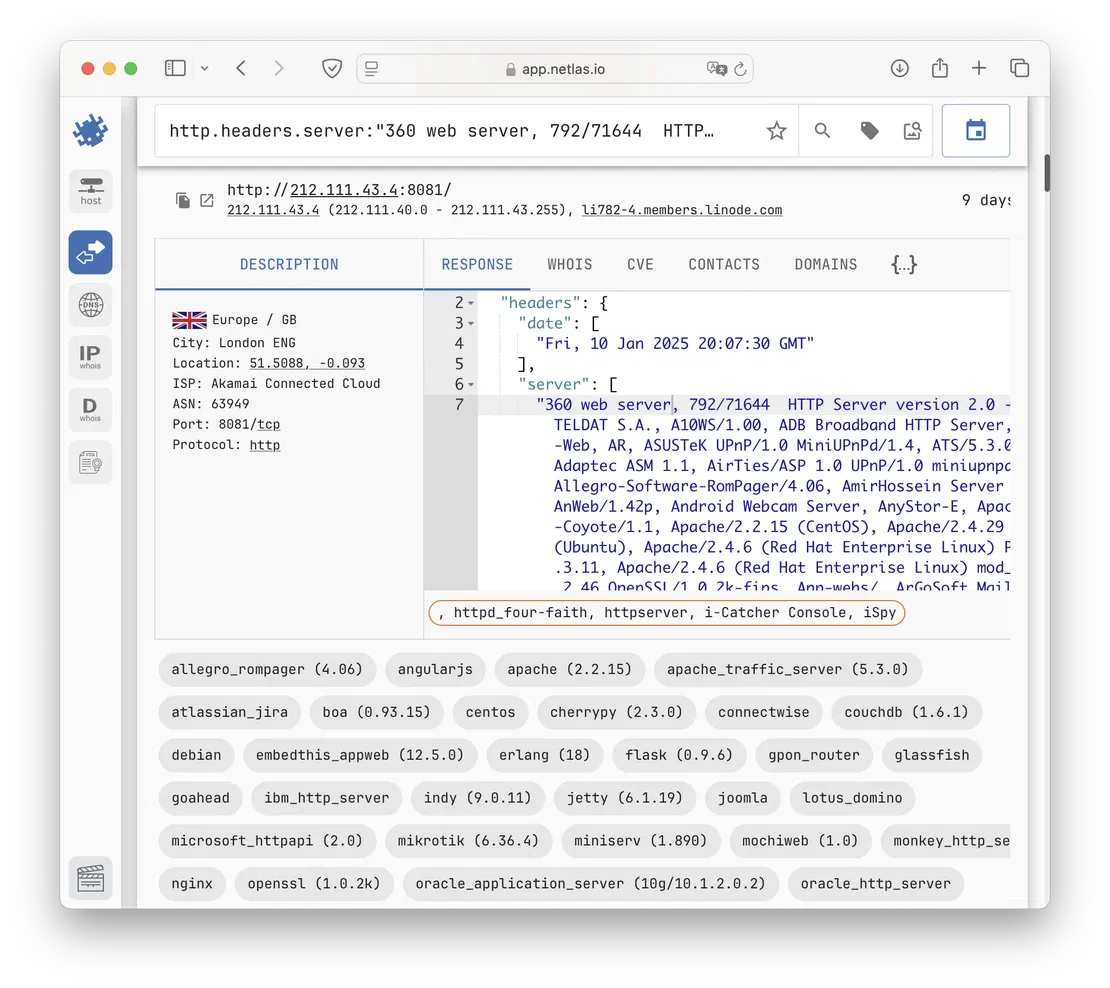
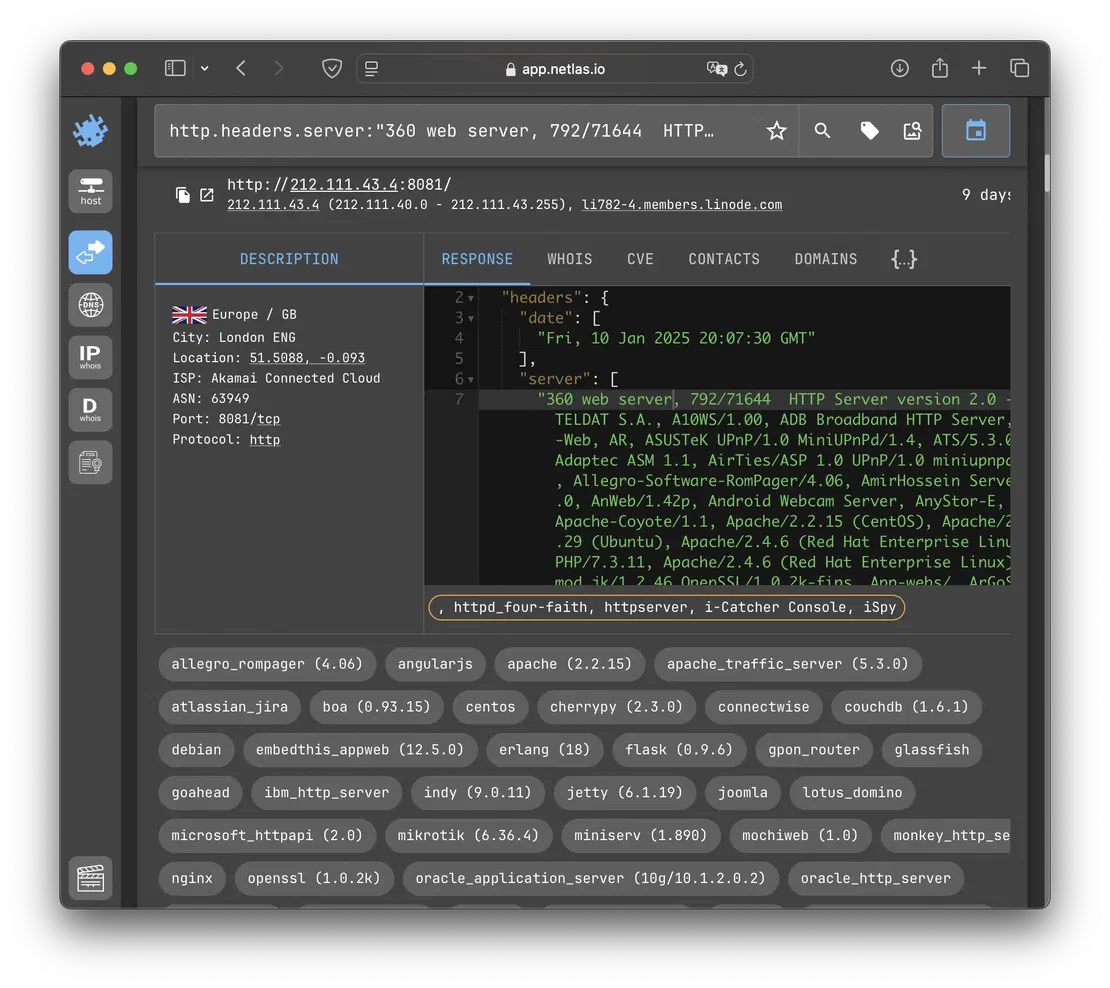
The server header lists an unrealistic combination of technologies. The chance that all of this software is genuinely running on a single service is effectively zero — strongly suggesting it’s a honeypot configured to lure attackers.
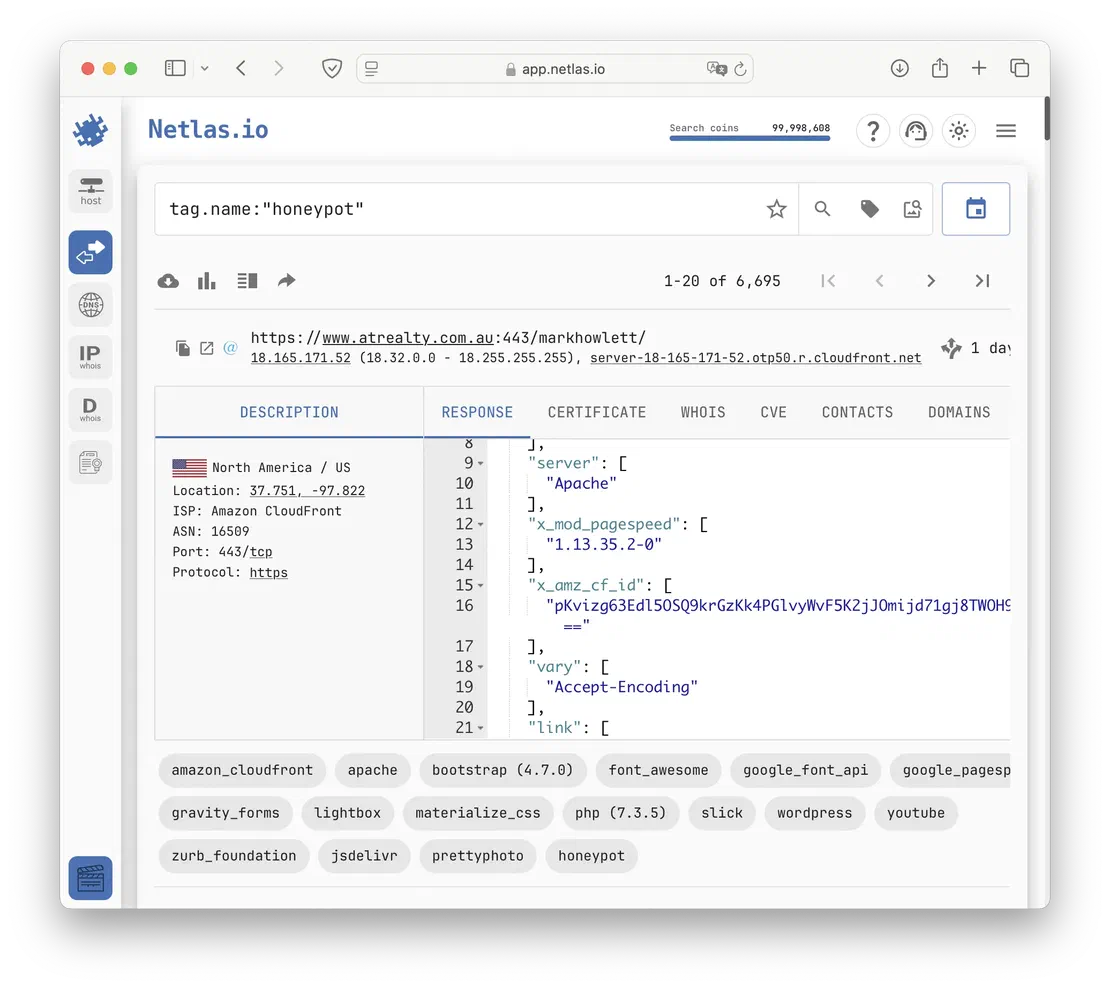
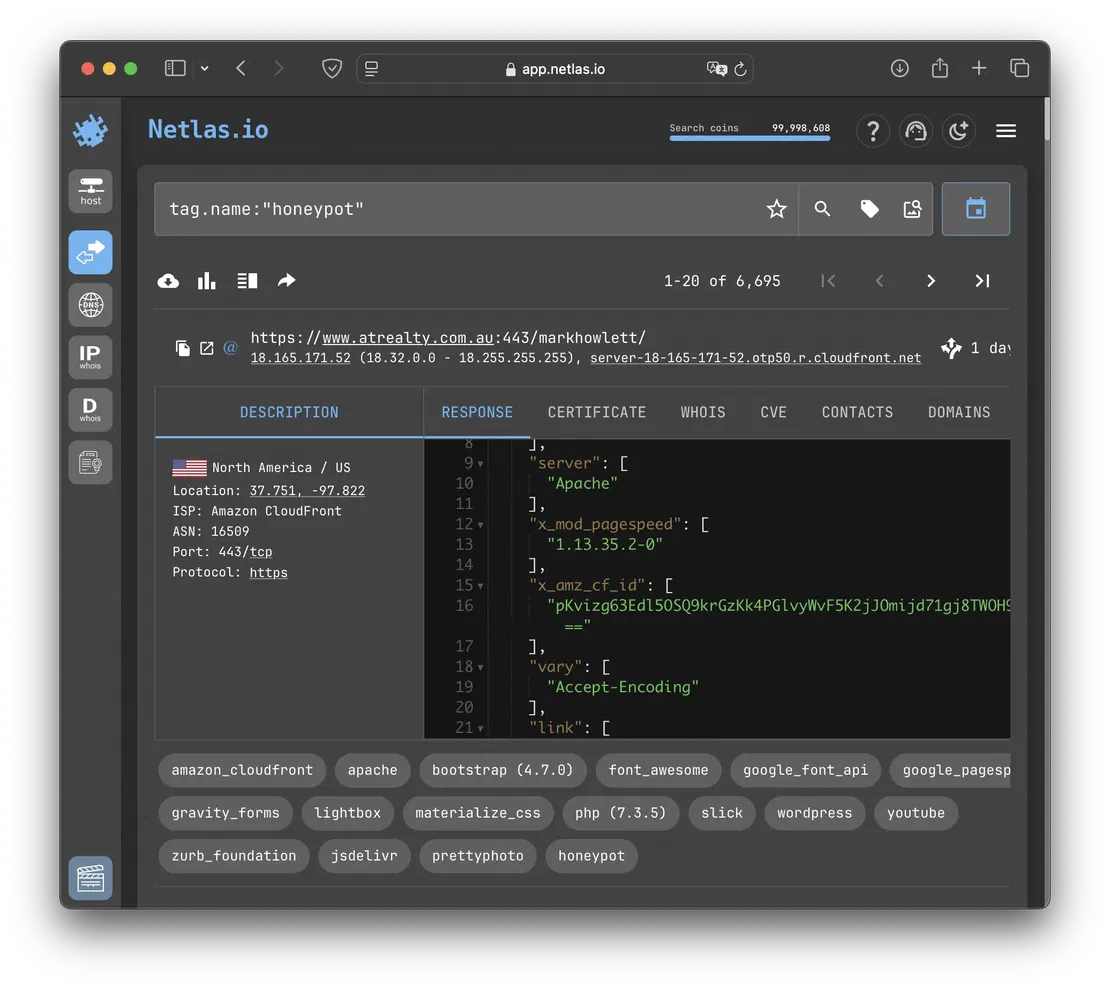
Another method is to use the honeypot tag. This tag highlights systems identified as honeypots by Netlas’s automated classification.
Simply run the following query in the Responses Search:
To get a list of all honeypots detected by the search engine. Something like the following image.
The primary purpose of using honeypots is to detect emerging attack techniques, collect detailed incident data, and use that intelligence to improve overall network defenses.
Honeypots are generally categorized by their intended purpose into two main types:
Importantly, the same honeypot software can function as either a research or production system, depending on how it is configured and the context in which it is deployed.
By interaction level, honeypots are classified based on how much functionality they offer to attackers:
Interactivity determines threat type
Low-interaction honeypots are ideal for detecting mass, automated attacks — such as botnets, scanners, and worms. High-interaction honeypots, on the other hand, are more effective at capturing the tactics, techniques, and procedures (TTPs) of advanced persistent threats (APTs) — skilled human adversaries engaging in targeted intrusions.
Although there are numerous types of honeypots, here are a few of the most widely recognized:
Key Takeaways from This Section
Choosing the right honeypot can be challenging with so many options available. Below is a curated collection of free and open source tools — spanning a wide range of services, protocols, and interaction levels to suit various cybersecurity needs.
Multi-protocol honeypots are designed to emulate multiple network services simultaneously. This allows them to detect a broader range of malicious activity — from brute-force login attempts to service enumeration and lateral movement scans — all from a single deployment.
https://github.com/thinkst/opencanary
| Interaction Type | Language | License | Last Activity |
|---|---|---|---|
| Low | Python | BSD‑3‑Clause | May 2025 |
OpenCanary emulates multiple common services — including SSH, HTTP, FTP, MySQL, and SMB — and provides flexible alerting via syslog, email, and integration with SIEM tools. Lightweight and easy to configure, it is widely used for network-wide threat detection.
https://github.com/mushorg/glutton
| Interaction Type | Language | License | Last Activity |
|---|---|---|---|
| Low | Go | GPL‑3.0 | May 2025 |
Glutton accepts and logs any TCP connection through modular handlers. It captures metadata from incoming probes and supports protocol fingerprinting — ideal for detecting scanning, reconnaissance, and unknown service enumeration.
https://github.com/qeeqbox/chameleon
| Interaction Type | Language | License | Stars | Last Activity |
|---|---|---|---|---|
| Low | Python / Docker | AGPL‑3.0 | 689 | August 2023 |
Chameleon is a multi-service, low‑interaction honeypot framework written in Python (with Docker support), offering emulators for over a dozen protocols. Modular deployment through Docker or scripts. Visual live monitoring via Grafana dashboards. Structured logging (PostgreSQL, syslog) of credentials, traffic, and protocol interactions.
Although the last significant code update was in January 2022, it remains a popular and versatile option for multi-protocol honeynet setups, offering broad coverage in a single-pane solution.
https://github.com/DinoTools/dionaea
| Interaction Type | Language | License | Last Activity |
|---|---|---|---|
| Low | C / Python | GPL‑2.0 | February 2021 |
Dionaea is a low-interaction honeypot supporting multiple protocols — including SMB, FTP, HTTP, and MySQL. It emulates vulnerable services to capture malware and shellcode, using the Libemu library. Integrated with hpfeeds and SQLite logging, it is still used for malware collection and early-stage network reconnaissance detection.
https://pypi.org/project/honeypots
| Interaction Type | Language | License | Last Activity |
|---|---|---|---|
| Low | Python | AGPL‑3.0 | September 2024 |
The honeypots package provides a configurable collection of network service traps, including modules for HTTP, SSH, FTP, DNS, and more. It logs attacker interactions and integrates with common data sinks such as syslog, PostgreSQL, and Elasticsearch, making it a flexible option for both research and production honeynets.
HTTP honeypots simulate vulnerable web servers to attract and analyze attacks like scanning, exploitation, and web-based malware delivery — making them key tools in honeypot cyber security.
https://github.com/bocajspear1/honeyhttpd
| Interaction Type | Language | License | Last Activity |
|---|---|---|---|
| Low | Python | MPL‑2.0 | May 2025 |
HoneyHTTPD is a lightweight Python framework for creating customizable fake web servers. You can script precise HTTP/HTTPS responses and log each request, with options to export data to files, Elasticsearch, or AWS S3.
https://github.com/DataDog/HASH
| Interaction Type | Language | License | Last Activity |
|---|---|---|---|
| Low | Node.js | Apache‑2.0 | May 2024 |
HASH is a YAML-driven honeypot framework that serves randomized HTTP/HTTPS responses to emulate a wide range of web services. It’s highly effective at deceiving bots and integrates easily with monitoring pipelines.
https://github.com/christophe77/express-honeypot
| Interaction Type | Language | License | Last Activity |
|---|---|---|---|
| Low to Medium | Node.js | MIT | February 2025 |
Express‑honeypot uses Express middleware to detect LFI and RFI attacks. It dynamically serves hundreds of fake URLs and logs malicious access attempts, including any downloaded payloads.
https://github.com/0xNslabs/http-honeypot
| Interaction Type | Language | License | Last Activity |
|---|---|---|---|
| Low | Python | MIT | July 2023 |
This Twisted-based honeypot clones a target site and logs all HTTP interactions (headers, IP, request paths). It inlines resources for realism, making it suitable for educational or light deployment scenarios.
https://wordpress.org/plugins/blackhole-bad-bots/
| Interaction Type | Language | License | Last Activity |
|---|---|---|---|
| Low | PHP | GPL‑2.0 | March 2025 |
Blackhole for Bad Bots is a WordPress plugin that embeds a hidden trap link into site footers — invisible to human visitors but detectable by bots that ignore robots.txt. When triggered, the plugin blocks those bots from accessing the site. It’s lightweight, effective, and actively maintained, with over 30,000 installs.
SSH honeypots emulate terminal‑based remote access to capture brute-force attempts, command execution, and attacker behavior.
https://github.com/cowrie/cowrie
| Interaction Type | Language | License | Last Release |
|---|---|---|---|
| Medium to High | Python | ISC‑0.0 | Nov 2024 |
Cowrie simulates a Debian‑style shell with a configurable fake filesystem and supports SSH, Telnet, and file transfers. It securely logs sessions, SFTP/SCP activity, and enables optional proxying to live backend systems.
https://github.com/jaksi/sshesame
| Interaction Type | Language | License | Last Release |
|---|---|---|---|
| Low to Medium | Go | Apache‑2.0 | Aug 2024 |
sshesame is a lightweight SSH honeypot written in Go. It accepts any credentials and logs connection attempts, channel requests, and session activity without executing commands. It supports YAML configuration, structured (JSON) logging, and has prebuilt binaries and Docker deployment options.
Database honeypots simulate vulnerable database services like MySQL, MongoDB, or Elasticsearch to attract, monitor, and analyze attacks targeting critical data systems.
https://github.com/sjinks/mysql-honeypotd
| Interaction Type | Language | License | Last Activity |
|---|---|---|---|
| Low | C | MIT | May 2025 |
mysql‑honeypotd is a lightweight C-based MySQL server honeypot that logs login attempts, authentication failures, and basic client metadata. With active development and real-world use, it’s ideal for monitoring brute-force and reconnaissance activity.
https://github.com/0xNslabs/postgresql-honeypot
| Interaction Type | Language | License | Last Activity |
|---|---|---|---|
| Low | Python | MIT | May 2025 |
This compact Python/Twisted script mimics a PostgreSQL server and logs all connection attempts, including usernames, database names, and client metadata. It serves well for identifying brute‑force and reconnaissance probing against Postgres instances.
https://github.com/0n1shi/redis-honeypot
| Interaction Type | Language | License | Last Activity |
|---|---|---|---|
| Low | Go | MIT | November 2022 |
Beehive Redis simulates a Redis server, supporting basic commands like PING, GET, and KEYS. It logs all client interactions to help detect scanning, brute‑force attempts, or unauthorized data access.
Email honeypots emulate SMTP servers to trap spam, phishing, and malicious bots — helping to strengthen email security defenses.
https://github.com/phin3has/mailoney
| Interaction Type | Language | License | Last Activity |
|---|---|---|---|
| Low | Python | MIT | May 2025 |
Mailoney is a modern, actively maintained SMTP honeypot written in Python. It logs connection attempts, credentials, and full message content. It supports various operating modes (including open relay and credential capture), stores data in a database, and offers Docker-friendly deployment options.
https://github.com/referefref/SMTPLLMPot
| Interaction Type | Language | License | Last Activity |
|---|---|---|---|
| Low | Python & Shell | GPL‑3.0 | May 2025 |
SMTPLLMPot is a novel proof-of-concept SMTP honeypot that integrates GPT‑3.5 to respond interactively to SMTP clients. It logs all incoming messages and leverages AI to emulate realistic SMTP server behavior, making it effective against modern malicious bots.
IoT honeypots emulate vulnerable or exposed device services — like Telnet, MQTT, Modbus, and CoAP — to attract, log, and analyze attacks against smart devices and embedded systems. These honeypots are vital for tracking IoT-targeted malware, botnet propagation, and unauthorized access attempts.
https://github.com/honeynet/riotpot
| Interaction Type | Language | License | Last Activity |
|---|---|---|---|
| Low‑Hybrid | Go | MIT | January 2024 |
RIoTPot is a Go-based, plugin‑driven honeypot for IoT protocols such as Telnet, SSH, HTTP, MQTT, Modbus, and CoAP. It acts as a proxy, capturing inbound requests and optionally forwarding them to real backend services for deeper deception. It includes a web dashboard, supports custom routes, and is actively developed under the Honeynet Project — making it one of the most complete IoT honeypots currently available.
https://github.com/m1k1o/iot-honeypot-framework
| Interaction Type | Language | License | Last Activity |
|---|---|---|---|
| Low‑Hybrid | Go / TypeScript / Python | Apache‑2.0 | April 2022 |
The IoT Honeypot Framework provides a scalable infrastructure for deploying honeypots for MQTT, CoAP, HTTP, Modbus, and Telnet using Docker Swarm. It integrates seamlessly with Elasticsearch for logging and analysis, and comes prepackaged with services and dashboards. Ideal for large-scale IoT security research or operational threat intelligence environments.
https://github.com/sa7mon/miniprint
| Interaction Type | Language | License | Last Activity |
|---|---|---|---|
| Low-Medium | Python | GPL‑3.0 | July 2023 |
Miniprint is a medium-interaction printer honeypot that emulates a networked printer exposed to the public internet. It supports Printer Job Language (PJL) over raw TCP, offers a fully virtualized file system for attackers to interact with, and logs all PostScript and plaintext print jobs to a dedicated uploads directory. Designed for deep inspection, it captures extensive interaction data without writing to the host system.
Managing multiple honeypots across a network can be complex without centralized control. Below are two modern platforms intended to solve this task.
T-Pot is a full-featured honeypot platform maintained by Deutsche Telekom Security. It integrates more than 20 honeypot daemons — including Cowrie, Dionaea, and Mailoney — into a containerized system with automated dashboards powered by the ELK stack (Elasticsearch, Logstash, Kibana). T-Pot runs entirely on Docker, offering modular deployment and real-time threat visualization, making it ideal for SOCs, researchers, and defenders looking for a polished, scalable solution.
CommunityHoneyNetwork (CHN) is a modern management platform built with microservices, Docker, RabbitMQ, and Elasticsearch. It retains support for core honeypots like Cowrie and Dionaea while providing distributed logging and a centralized interface for managing sensors. Though less actively maintained than T-Pot, CHN remains a viable option for academic use and labs experimenting with honeynet architecture.
Why use management platforms?
These platforms significantly reduce the operational overhead of deploying, managing, and analyzing honeypot data at scale — enabling defenders to focus on insights rather than infrastructure.
Are you prepared to fortify your network against emerging threats? Start by assessing your attack surface to understand what potentially exploitable information might be visible to attackers.
Whether you’re monitoring web applications, SSH services, industrial protocols, or IoT devices, there’s a honeypot tailored to your use case:
Benefits of honeypot deployment
Honeypots can serve as powerful tools in your defensive strategy. When thoughtfully deployed, they not only detect malicious activity — they help you understand it. And understanding is the first step toward resilience.

I can show you how deep the Internet really goes
Discover exposed assets, infrastructure links, and threat surfaces across the global Internet.
此内容由惯性聚合(RSS阅读器)自动聚合整理,仅供阅读参考。 原文来自 — 版权归原作者所有。