Cybersecurity has entered a new era. For MSPs, the question has evolved from whether customers need advanced threat detection and response capabilities to whether they can afford to operate without them.
As ransomware groups become faster, more adaptive, and increasingly reliant on legitimate tools rather than traditional malware, Managed Detection and Response (MDR) has evolved from a premium security add-on into a foundational security requirement.
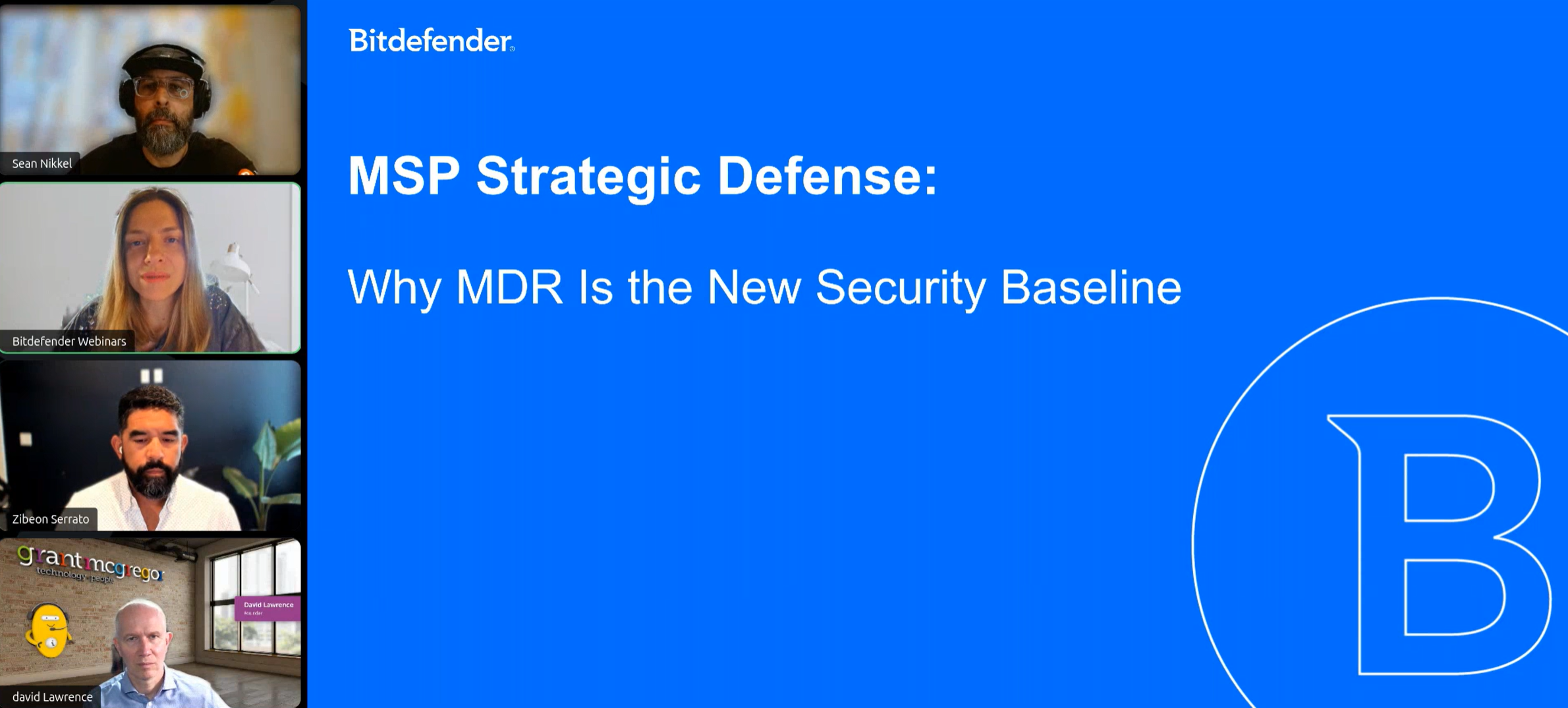
During our recent webinar, Why MDR Is the New Security Baseline, David Lawrence, Founder and Director of Grant McGregor, and Sean Nikkel, Team Lead, Cyber Intelligence Fusion Cell at Bitdefender, shared insights from both the MSP and frontline threat intelligence perspectives.
The new reality is that many of today's most effective attacks rely on legitimate administrative tools, stolen credentials, and hands-on-keyboard activity rather than traditional malware. By abusing trusted tools, blending into routine activity, and moving rapidly from initial access to business impact, attackers are forcing MSPs to rethink what constitutes a baseline security service and how they protect their customers.
Key Takeaways
Just a few years ago, many MSPs positioned MDR as an optional service reserved for organizations with heightened security requirements. Today, that mindset is changing.
Rising cyber insurance requirements, expanding compliance obligations, increased board-level scrutiny, and a steady stream of high-profile cyberattacks are driving greater cybersecurity awareness across organizations of all sizes.
According to David Lawrence, these factors have fundamentally changed customer conversations. Rather than waiting for their MSP to raise security concerns, customers are increasingly asking about resilience, risk management, compliance, and incident preparedness.
As a result, more MSPs are making MDR a standard component of their security offerings. What was once considered advanced security is quickly becoming the baseline for protecting modern businesses.
"What was once considered advanced security is quickly becoming the baseline for protecting modern businesses."
Endpoint Detection and Response (EDR) remains a critical component of modern cybersecurity. It provides visibility into endpoint activity, collects telemetry, and helps identify suspicious behavior across the environment.
However, visibility alone does not stop an attack.
EDR can generate valuable alerts, but those alerts still need to be investigated, validated, prioritized, and acted upon. For organizations with limited security resources, or MSPs managing multiple customer environments, this can quickly become overwhelming.
This is where MDR adds value. MDR provides MSPs with an extension of their security team, helping validate suspicious activity, investigate potential threats, and take action when incidents occur.
Key MDR capabilities include:
Instead of simply surfacing suspicious activity, MDR helps determine whether an attack is underway and what actions should be taken to contain it.
As attack timelines continue to shrink, the ability to respond quickly can be just as important as the ability to detect a threat in the first place.
One of the most significant trends discussed during the webinar was the growing use of living-off-the-land (LotL) techniques.
Instead of deploying easily detectable malware, attackers increasingly abuse legitimate administrative tools that already exist within the environment. Common examples include PowerShell, Remote Desktop Protocol (RDP), SMB, TeamViewer, Splashtop, Chrome Remote Desktop, and other remote administration utilities.
Because these tools are routinely used by IT teams and administrators, distinguishing normal activity from malicious behavior becomes significantly more challenging.
By blending into everyday operations, attackers can move laterally through networks, maintain persistence, and execute their objectives while generating fewer obvious indicators of compromise.
As a result, cybersecurity teams must look beyond malware detection and focus on identifying suspicious behavior, unusual activity patterns, and attacker intent.
Another key theme emerging from frontline investigations is speed.
Many ransomware operators can move from initial access to data exfiltration and encryption in just a few hours, leaving organizations with little time to respond.
During the webinar, Sean Nikkel shared an investigation involving a highly adaptive ransomware operator. After gaining access to an environment, the attacker used Chrome Remote Desktop for remote access. When defenders disrupted that activity, they quickly switched to TeamViewer, then Splashtop, and later another remote administration tool.
This cat-and-mouse cycle unfolded within hours, demonstrating how quickly attackers can adapt to defensive measures and continue pursuing their objectives.
The takeaway for MSPs is clear: effective cybersecurity requires more than detection. When attackers can move this quickly, rapid investigation and response become critical to limiting business impact.
The webinar also highlighted a real-world incident involving a financial services organization.
The customer had implemented multiple security controls, including security awareness training, email security filtering, endpoint protection, EDR, and MDR.
Despite these controls, an employee received a phishing email that had already been quarantined by the email security solution. The user manually released the message, downloaded the attachment, and attempted to execute it.
At that point, endpoint protection intervened, while the MDR team immediately investigated and responded to the activity.
The incident is an important reminder that even well-trained users can make mistakes. No single security control is perfect. Effective cybersecurity requires multiple layers of protection working together to prevent, detect, investigate, and respond to threats.
One of the strongest business lessons from the discussion was the importance of establishing a security roadmap for customers.
When security conversations focus on individual products, customers often view recommendations as isolated purchases rather than part of a broader strategy. Successful MSPs take a different approach, positioning cybersecurity as an ongoing journey that evolves alongside business needs and the threat landscape.
Whether that journey includes endpoint protection, MDR, compliance initiatives, security awareness training, or tabletop exercises, the goal is to help customers understand both their current security requirements and the next steps toward greater resilience.
By providing a clear roadmap, MSPs can shift conversations away from products and toward outcomes, risk reduction, and long-term security maturity.
As organizations mature their cybersecurity programs, many are discovering the value of tabletop exercises.
By simulating a cyber incident and walking stakeholders through their response processes, tabletop exercises can uncover communication gaps, unclear responsibilities, missing procedures, and technology blind spots that may otherwise go unnoticed.
Perhaps most importantly, they reinforce that cybersecurity is a business-wide responsibility. Effective incident response requires coordination across leadership, operations, communications, legal teams, and external partners.
For MSPs, tabletop exercises are both a valuable service offering and a practical way to help customers strengthen their cyber resilience.
What is MDR?
Managed Detection and Response (MDR) combines advanced security technology with human expertise to detect, investigate, and respond to cyber threats around the clock.
What is the difference between EDR and MDR?
EDR provides visibility into endpoint activity and generates alerts when suspicious behavior is detected. MDR builds on that visibility by adding 24/7 monitoring, threat hunting, investigation, and incident response capabilities.
Why are MSPs adopting MDR?
MSPs are increasingly adopting MDR in response to evolving attack techniques, growing customer expectations, cyber insurance requirements, compliance obligations, and the need for continuous security monitoring.
What are Living-off-the-Land attacks?
Living-off-the-Land (LOTL) attacks involve abusing legitimate administrative tools already present in an environment, such as PowerShell, RDP, and remote access software, to evade detection and blend into normal business activity.
How quickly can ransomware attacks spread?
According to observations shared during the webinar, some ransomware attacks can progress from initial access to data exfiltration and encryption in just a few hours, leaving organizations with limited time to respond.
Why should MSPs include MDR in their standard security offering?
MDR helps MSPs provide continuous monitoring, threat investigation, and incident response capabilities without requiring customers to build and staff their own security operations center (SOC). As attack timelines continue to shrink, these capabilities are becoming increasingly important for protecting customer environments.
As cyber threats continue to evolve, MSPs face increasing pressure to deliver more than technology alone. Customers are looking for partners who can help them reduce risk, strengthen resilience, meet compliance requirements, and respond effectively when incidents occur.
This is where MDR plays a critical role. By combining advanced detection capabilities with human expertise and continuous monitoring, MDR helps MSPs identify threats earlier, respond faster, and reduce the impact of security incidents across their customer base.
The key takeaway from the discussion is that MDR is becoming a foundational component of modern MSP security services. MSPs that integrate MDR into their core offerings will be better positioned to protect customers, strengthen trusted advisor relationships, and differentiate themselves in an increasingly competitive market.
Learn more about Bitdefender MDR for MSPs or watch the full webinar on demand.
此内容由惯性聚合(RSS阅读器)自动聚合整理,仅供阅读参考。 原文来自 — 版权归原作者所有。