

惯性聚合 高效追踪和阅读你感兴趣的博客、新闻、科技资讯
阅读原文 在惯性聚合中打开

推荐订阅源

小众软件
小众软件
量子位
博客园 - 叶小钗
Apple Machine Learning Research
U
Unit 42
IT之家
IT之家
F
Fortinet All Blogs
GbyAI
GbyAI
MongoDB | Blog
MongoDB | Blog
H
Hackread – Cybersecurity News, Data Breaches, AI and More
大猫的无限游戏
大猫的无限游戏
freeCodeCamp Programming Tutorials: Python, JavaScript, Git & More
The Register - Security
NISL@THU
NISL@THU
Webroot Blog
Webroot Blog
A
Arctic Wolf
钛媒体:引领未来商业与生活新知
钛媒体:引领未来商业与生活新知
V
Visual Studio Blog
Recent Announcements
Threat Intelligence Blog | Flashpoint
Blog — PlanetScale
Blog — PlanetScale
L
LangChain Blog
P
Palo Alto Networks Blog
Y
Y Combinator Blog
WordPress大学
WordPress大学
让小产品的独立变现更简单 - ezindie.com
AWS News Blog
AWS News Blog
有赞技术团队
有赞技术团队
Engineering at Meta
Engineering at Meta
C
Cybersecurity and Infrastructure Security Agency CISA
aimingoo的专栏
aimingoo的专栏
Know Your Adversary
Know Your Adversary
Cyberwarzone
Cyberwarzone
Martin Fowler
Martin Fowler
The Hacker News
The Hacker News
P
Privacy International News Feed
T
Threat Research - Cisco Blogs
G
GRAHAM CLULEY
宝玉的分享
宝玉的分享
博客园 - 聂微东
cs.CL updates on arXiv.org
Cyber Security Advisories - MS-ISAC
奇客Solidot–传递最新科技情报
奇客Solidot–传递最新科技情报
The GitHub Blog
The GitHub Blog
S
Securelist
T
The Exploit Database - CXSecurity.com
T
Threatpost
Microsoft Azure Blog
The Cloudflare Blog
F
Full Disclosure

Sysdig Blog

Masterclass: AI is more than ChatGPT and LLMs CVE-2026-39987 update: How attackers weaponized marimo to deploy a blockchain botnet via HuggingFace 5 steps to securing AI workloads Marimo OSS Python Notebook RCE: From Disclosure to Exploitation in Under 10 Hours Security briefing: March 2026 The Sysdig MCP server is now available in AWS Marketplace Risk isn’t reduced until you take action: How teams resolve issues in the cloud AI infrastructure security: Why it deserves its own category Three pillars for building effective runtime-powered cloud defense, the right way Closing the cloud security gap with runtime security Seeing risk isn’t stopping it: Why visibility alone isn’t enough TeamPCP expands: Supply chain compromise spreads from Trivy to Checkmarx GitHub Actions AI coding agents are running on your machines — Do you know what they're doing? Runtime security for AI coding agents: Protecting AI-assisted development How runtime insights power every cloud security use case CVE-2026-33017: How attackers compromised Langflow AI pipelines in 20 hours Inline Cloud Response: Accelerating AWS threat containment for SOC teams Runtime malware detection for AWS Fargate Detecting CVE-2026-3288 & CVE-2026-24512: Ingress-nginx configuration injection vulnerabilities for Kubernetes Malware detection with Sysdig Security briefing: February 2026 Leveling up Kubernetes Posture: From baselines to risk-aware admission Eliminating runtime blind spots: How CleanStart and Sysdig build continuous trust across the container lifecycle LLMjacking: From Emerging Threat to Black Market Reality Real risks live at runtime: Why CISOs must care about deep telemetry in 2026 Sysdig named a Leader in the Forrester Wave™: Cloud Native Application Protection Solutions, Q1 2026 How to run rootless containers AI-assisted cloud intrusion achieves admin access in 8 minutes Security briefing: January 2026 Securing GPU-accelerated AI workloads in Oracle Kubernetes Engine Bringing OSS runtime security to AWS: Falco integration with AWS Security Hub CSPM Our customers have spoken: Sysdig rated a Strong Performer in Gartner® Voice of the Customer for Cloud-Native Application Protection Platforms Protecting sensitive business data in preparation for the organization's Gen AI VoidLink threat analysis: Sysdig discovers C2-compiled kernel rootkits AI is still a workload: A practical guide to securing AI workloads How threat actors are using self-hosted GitHub Actions runners as backdoors How Sysdig Sage delivers AI-powered, real-world vulnerability management Security briefing: December 2025 Top 10 ways to get breached in 2026 EtherRAT dissected: How a React2Shell implant delivers 5 payloads through blockchain C2 Introducing runtime file integrity monitoring and response with Sysdig FIM How to detect multi-stage attacks with runtime behavioral analytics EtherRAT: DPRK uses novel Ethereum implant in React2Shell attacks Detecting React2Shell: The maximum-severity RCE vulnerability affecting React Server Components and Next.js The rise of AI agents: How autonomous AI Is transforming cloud security Kubernetes 1.35 - New security features The Urgency of Securing AI Workloads for CISOs Security briefing: November 2025 Quantum and the cloud: Science fiction turned security strategy Cloud security, the right way: What the industry should demand (and why "good enough" isn't) Return of the Shai-Hulud worm affects over 25,000 GitHub repositories Detecting CVE-2024-1086: The decade-old Linux kernel vulnerability that’s being actively exploited in ransomware campaigns What’s old is new again: How to demystify AI security with AIBOMs Securing Kubernetes with agentic cloud security How agentic cloud security reduces real risks Hunting reverse shells: How the Sysdig Threat Research Team builds smarter detection rules Shifting left with AI and MCP: Sysdig + Amazon Q Developer How Falco and Stratoshark close the gap between open source runtime detection and deep forensic analysis Investigating security issues with ChatGPT and the GitHub MCP server New runc vulnerabilities allow container escape: CVE-2025-31133, CVE-2025-52565, CVE-2025-52881 Harden your LLM security with OWASP Security briefing: October 2025 How agentic AI is changing cloud security Kubernetes Incident Response: Detect, investigate, and contain in under 10 minutes Sysdig recognized as a Cloud Security Leader in Latio Tech Cloud Security Market Report AI echolocation of cloud risks using Sysdig & Snyk MCP servers Sysdig MCP Server: Bridging AI and cloud security insights Understanding CVE-2025-49844: “RediShell” Critical Remote Code Execution in Redis How Sysdig secures your containers and Kubernetes Sysdig Security Briefing: September 2025 Cloud security, the right way: The 3 pillars of real-time defense Open source spotlight: Bringing web application security to Falco with Falcoya's Nginx plugin Malicious NPM packages: Are you exposed? AI for SOC teams: 5 cloud security prompts to start your day with Sysdig Sage™ Shai-Hulud: The novel self-replicating worm infecting hundreds of NPM packages ZynorRAT technical analysis: Reverse engineering a novel, Turkish Go-based RAT Modern vulnerability management, built for the cloud Build your AWS incident response playbook with open source tools 2025 Gartner® CNAPP Market Guide: Runtime visibility is no longer optional Threat hunting with Sysdig: Uncovering “IngressNightmare” Open source spotlight: From alerts to action with AI-powered Falco Vanguard From triage to action: How Sysdig’s agentic cloud security platform slashes noise and accelerates remediation The vision comes to life: Agentic cloud security with Sysdig Sage™ Data security findings: A technical deep dive Connecting runtime to source: Sysdig and Semgrep integration Fix what matters, faster: How Sysdig and Semgrep are unifying security without silos – from code to runtime Defending sensitive data with Sysdig Secure Redefining cloud security, the right way Join the movement: The Sysdig Open Source Community is live A smarter, safer cloud in the age of AI Unifying detection and response: Sysdig + Cortex XSOAR for security at cloud speed The future of security is open, and it needs a unified hub: The Sysdig Open Source Community is here CVE-2025-53104: Command injection via GitHub Actions workflow in gluestack-ui Why MCP server security is critical for AI-driven enterprises What’s new in Sysdig — June 2025 AI-powered CNAPP with Sysdig Sage™ Revolutionizing Cybersecurity Search with Sysdig Sage™ Sysdig Threat Bulletin: Iranian Cyber Threats The end of the prioritization-only era: Vulnerability management needs action Dangerous by default: Insecure GitHub Actions found in MITRE, Splunk, and other open source repositories
CVE-2026-31431: “Copy Fail” Linux kernel flaw lets local users gain root in seconds
Michael Clark · 2026-04-30 · via Sysdig Blog

On April 29, 2026, CVE-2026-31431 (CVSS 7.8 HIGH), nicknamed “Copy Fail,” was disclosed in the Linux kernel's algif_aead userspace crypto interface. Researchers at Theori demonstrated that an unprivileged local user can corrupt the page cache backing setuid binaries and gain root access within seconds. There are working exploits for Ubuntu 24.04, Amazon Linux 2023, RHEL 10.1, and SUSE 16 kernels.

The flaw was introduced in 2017 via commit 72548b093ee3, which switched AEAD operations to in-place processing. A fix was included in the patch series ending with commit fafe0fa2995a in early April, and it reverts that near decade-old optimization. The Sysdig Threat Research Team (TRT) has analyzed the issue, tested a detection rule, and deployed runtime detection coverage.

Affected Versions

  • Vulnerable: Linux kernel 4.14 through 7.0-rc, all 6.18.x prior to 6.18.22, and 6.19.x prior to 6.19.12 (regression introduced in 4.14, July 2017)
  • Fixed: 7.0, 6.19.12, 6.18.22 
  • Vulnerable downstream distribution backports: Older LTS lines, such as 6.12.x, 6.6.x, 5.15.x, 5.10.x
  • Proof of concept (PoC): theori-io/copy-fail-CVE-2026-31431
  • CISA KEV: Not listed at the time of this publication

Root cause

algif_aead exposes the kernel's AEAD ciphers to userspace through AF_ALG sockets. Following the 2017 in-place optimization, the kernel sets req->src = req->dst and chains tag pages from the source scatterlist into the output scatterlist via sg_chain(). When userspace feeds the socket through splice(), those tag pages reference the page cache of the spliced file.

The authencesn(hmac(sha256),cbc(aes)) algorithm writes four bytes at offset assoclen + cryptlen as scratch space for Extended Sequence Number rearrangement. But because of the flaw, the output scatterlist now extends into the chained page cache pages. That four-byte write ends up inside the spliced file’s cached data in memory, bypassing the file's permissions.

Exploitation

The public PoC is roughly 700 bytes of Python script and chains three primitives:

1.	Bind an AF_ALG socket to authencesn(hmac(sha256),cbc(aes)).
2.	splice() page cache pages of /usr/bin/su into the crypto pipeline.
3.	Issue a recvmsg() whose AAD bytes 47 supply the 4-byte value the authencesn scratch write will deposit into the target page.

The HMAC verification fails as expected, but the corruption persists in the page cache. Repeating the primitive at successive offsets stages a small shellcode into the cached pages of /usr/bin/su. Running su afterward executes the patched binary and yields a root shell. The attacker controls the target file, write offset, and four-byte payload.

Unlike Dirty Pipe (CVE-2022-0847), which required precise pipe buffer manipulation and version-specific targeting, Copy Fail operates as a straight-line logic flaw that triggers reliably across distributions without races or crash-prone timing windows.

Impact

Any local unprivileged user on a vulnerable kernel can gain root access. There is no standalone remote vector: An attacker needs code execution on the machine first, either directly or

through a prior compromise such as a web application vulnerability. Once that foothold exists, this exploit escalates any unprivileged user to root. Because the exploit relies only on standard syscalls (socket, setsockopt, splice, sendmsg, recvmsg) and an algorithm available in default kernel configurations, it works on unmodified enterprise distributions without additional kernel modules.

Detection with Sysdig Secure

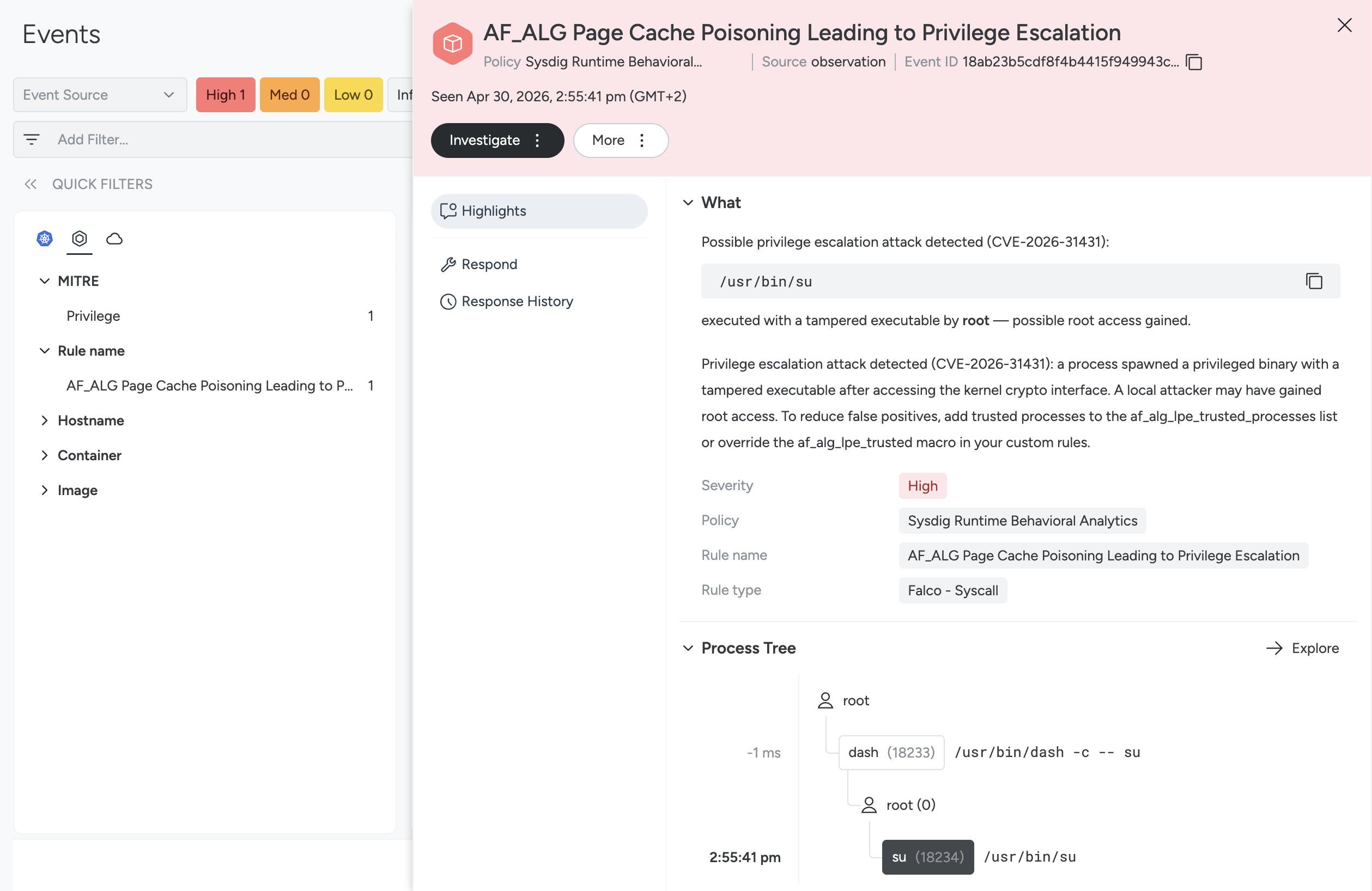
Sysdig Secure customers automatically have a detection in place, using the rule AF_ALG Page Cache Poisoning Leading to Privilege Escalation. It is part of the Sysdig Runtime Behavioral Analytics managed policy. This rule is very precise due to the advanced Observations detection engine.
Detection with open source Falco

For Falco Feeds customers and open source Falco users, the rule below can be used to detect suspicious activity around AF_ALG socket creation. It may, however, require tuning depending on your environment. This type of socket is used by Kernel TLS (kTLS), which is becoming more common. For Falco Feeds customers, this rule will be automatically available.

- list: known_af_alg_binaries
    items: [cryptsetup, "systemd-cryptse", "systemd-cryptsetup", veritysetup, integritysetup, "cryptsetup-resh", kcapi-enc, kcapi-dgst, kcapi-rng, kcapi-sym]

  - macro: successful_af_alg_socket
    condition: >
      evt.type = socket and
      evt.rawres >= 0 and
      (evt.arg.domain contains AF_ALG or evt.rawarg.domain = 38)

  - macro: successful_af_alg_seqpacket_socket
    condition: >
      successful_af_alg_socket and
      (evt.arg.type = 5 or
       evt.arg.type = 2053 or
       evt.arg.type = 524293 or
       evt.arg.type = 526341)

- rule: Unexpected Process Using Kernel AEAD Crypto Socket
  desc: >
    Detects creation of an AF_ALG SEQPACKET socket — the kernel AEAD crypto API interface exclusively required by AEAD operations (authencesn, ccm, gcm) — from a process outside the known disk-encryption toolchain. This is the mandatory first step of CVE-2026-31431, a Linux kernel LPE that uses AF_ALG + splice() to corrupt a SUID binary in the page cache. The SOCK_SEQPACKET type filters out the majority of legitimate AF_ALG users (hashing, symmetric crypto) which use SOCK_DGRAM.
  condition: >
    successful_af_alg_seqpacket_socket and
    not proc.name in (known_af_alg_binaries)
  output: Unexpected process %proc.name opened AF_ALG AEAD kernel crypto socket with parent %proc.pname under user %user.loginname (socket.domain=%evt.arg.domain socket.type=%evt.arg.type proc.pid=%proc.pid proc.exe=%proc.exe proc.name=%proc.name proc.exepath=%proc.exepath proc.pname=%proc.pname proc.pexepath=%proc.pexepath gparent=%proc.aname[2] gexepath=%proc.aexepath[2] ggparent=%proc.aname[3] container.name=%container.name image=%container.image.repository:%container.image.tag proc.cmdline=%proc.cmdline proc.pcmdline=%proc.pcmdline gcmdline=%proc.acmdline[2] ggcmdline=%proc.acmdline[3] proc.ppid=%proc.ppid user.name=%user)
  priority: CRITICAL
  tags: [host, container, kernel, cve, CVE-2026-31431, MITRE,
          MITRE_TA0004_privilege_escalation,
          MITRE_T1068_exploitation_for_privilege_escalation]

Recommendations

  • Update to Linux 7.0, 6.19.12, or 6.18.22 (or the corresponding distribution backport for older LTS lines).
  • Restrict AF_ALG socket creation where possible via seccomp profiles, container runtime defaults, or by disabling CONFIG_CRYPTO_USER_API_AEAD on hosts that do not require userspace crypto.
  • Deploy the Falco rule above to flag unprivileged AF_ALG socket creation across hosts and containers.
  • Audit running workloads for legitimate AF_ALG users so that detection exceptions are scoped to known binaries rather than disabled.
  • Monitor for unexpected modifications to setuid binaries and unexpected privilege transitions following kernel crypto syscalls.

Conclusion

Copy Fail is a reliable local privilege escalation that turns an eight-year-old performance optimization into a four-syscall path from unprivileged user to root. With a working public PoC covering every major enterprise distribution, exploitation is trivial wherever patches lag. 

Until kernels are updated, runtime detection of AF_ALG socket abuse is the most practical compensating control, and algif_* exploitation should be treated the same way Dirty Pipe was: Assume any local foothold can become root access within seconds.